Salary Forecasting Template: Predict Workforce Costs for HR & Finance

Workforce costs represent 50-70% of total operating expenses for most organizations. Yet many companies approach salary budgeting reactively, planning only one year ahead and scrambling when growth plans change or unexpected attrition hits. Strategic salary forecasting transforms this chaos into a proactive, data-driven process that aligns workforce costs with long-term business objectives.
A robust salary forecasting model enables HR and Finance teams to answer critical questions: What will our workforce cost in three years? How does a 20% growth plan impact total compensation expense? What happens to our budget if attrition increases by 5%? These answers drive smarter hiring decisions, more accurate financial planning, and better strategic alignment.
For comprehensive resources on compensation planning, visit our HR Management Hub and Financial Planning Hub. For compensation-specific guidance, explore our Compensation & Benefits section. For ready-to-use templates, see our Salary Planning Template and IT Departmental Budget Template.
Quick Start: Use our free Employee Cost Calculator to instantly calculate the true cost of an employee including salary, taxes, benefits, and overhead.
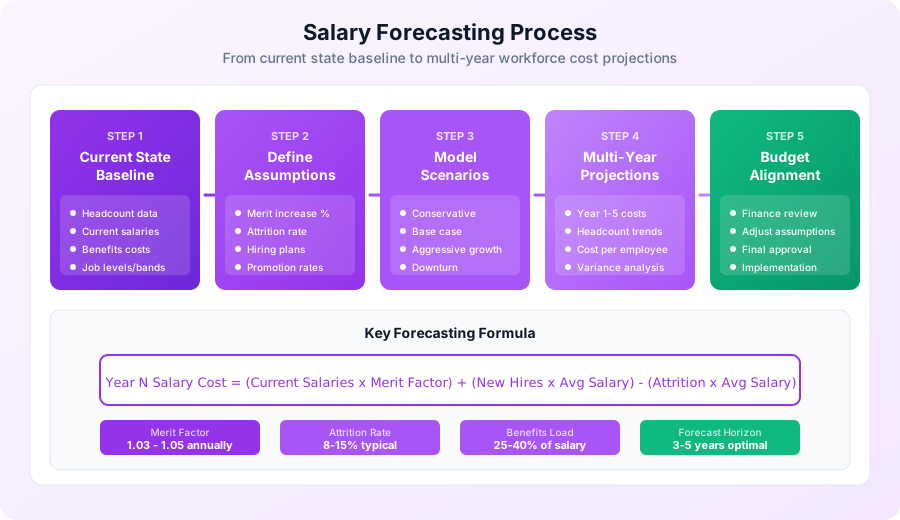
This guide walks you through building a comprehensive salary forecasting model, from establishing your current state baseline to projecting multi-year workforce costs across different growth scenarios.
What is Salary Forecasting?
Salary forecasting is the process of predicting future workforce compensation costs based on current employee data, historical trends, and planned business changes. Unlike annual salary planning (which focuses on next year's merit increases), salary forecasting projects costs 3-5 years into the future, accounting for headcount growth, attrition, promotions, and market adjustments.
Key Differences from Annual Salary Planning:
| Aspect | Annual Salary Planning | Salary Forecasting |
|---|---|---|
| Time Horizon | 1 year | 3-5 years |
| Primary Focus | Merit increases | Total workforce cost |
| Granularity | Individual employees | Department/role aggregates |
| Key Variables | Performance ratings | Attrition, growth, market trends |
| Output | Raise budget | Financial projections |
| Primary Users | HR, Managers | Finance, Executive team, Board |
When You Need Salary Forecasting:
- Strategic planning: Supporting 3-5 year business plans
- Fundraising: Projecting burn rate and runway for investors
- M&A activity: Due diligence and integration planning
- Workforce planning: Aligning headcount with revenue growth
- Budget defense: Justifying HR investment to CFO/Board
Core Components of a Salary Forecasting Model
1. Current State Baseline
Your forecast starts with accurate current state data. Every forecasting error originates from bad baseline data, so invest time validating this foundation.
Required Data Elements:
| Data Point | Source | Validation Check |
|---|---|---|
| Total headcount | HRIS | Match to payroll records |
| Total salary expense | Payroll | Reconcile to GL |
| Average salary by level | HRIS | Compare to market data |
| Headcount by department | HRIS | Match to org chart |
| Benefits cost per employee | Benefits admin | Verify with Finance |
| Payroll taxes/burden rate | Finance | Confirm percentage |
Baseline Data Quality Checklist:
- All active employees included (no missed contractors or temps)
- Salary data current (no pending changes unrecorded)
- Job levels consistently assigned
- Department codes accurate
- Part-time employees converted to FTE equivalents
- Benefits costs include employer portion only
2. Forecasting Assumptions
Assumptions drive your forecast. Document each assumption clearly, cite sources, and plan for sensitivity testing.
Merit Increase Assumptions:
Merit increases compound annually, making them critical to forecast accuracy.
Year N Salary = Current Salary x (1 + Merit Rate)^N

Example: $100,000 salary with 3.5% annual merit
Year 1: $100,000 x 1.035 = $103,500
Year 2: $103,500 x 1.035 = $107,123
Year 3: $107,123 x 1.035 = $110,872
Typical Merit Rates by Industry (2025):
| Industry | Average Merit | Range |
|---|---|---|
| Technology | 4.0% | 3.5-5.0% |
| Financial Services | 3.5% | 3.0-4.0% |
| Healthcare | 3.2% | 2.8-3.8% |
| Manufacturing | 3.0% | 2.5-3.5% |
| Retail | 2.8% | 2.3-3.3% |
| Non-profit | 2.5% | 2.0-3.0% |
Attrition Assumptions:
Attrition directly impacts costs through replacement hiring, severance, and productivity loss.
Net Headcount Change = Hires - Terminations

Terminations = Starting Headcount x Attrition Rate
Backfill Hires = Terminations x Backfill Rate (typically 80-100%)
Attrition Rate Benchmarks:
| Category | Voluntary | Involuntary | Total |
|---|---|---|---|
| High-growth tech | 15-20% | 3-5% | 18-25% |
| Mature tech | 10-15% | 2-4% | 12-19% |
| Financial services | 8-12% | 3-5% | 11-17% |
| Healthcare | 12-18% | 2-4% | 14-22% |
| Manufacturing | 8-12% | 4-6% | 12-18% |
| Overall average | 10-15% | 3-5% | 13-20% |
Benefits Load Factor:
Benefits costs typically run 25-40% of base salary, depending on plan richness.
Total Employee Cost = Base Salary x (1 + Benefits Load + Payroll Tax Rate)

Example: $100,000 salary
Benefits load: 30%
Payroll taxes: 8%
Total cost: $100,000 x 1.38 = $138,000
Benefits Cost Components:
| Component | Typical % of Salary | Notes |
|---|---|---|
| Health insurance | 12-18% | Varies by plan, geography |
| Retirement match | 3-6% | 401k match, pension |
| PTO accrual | 5-8% | Vacation, sick, holidays |
| Life/disability | 1-2% | Group rates |
| Other benefits | 2-4% | Wellness, perks, development |
| Total Benefits | 25-40% | |
| Payroll taxes | 7-10% | FICA, FUTA, state taxes |
| Total Burden | 32-50% |
3. Growth Assumptions
Headcount growth is often the largest driver of forecast variance. Model growth carefully.
Growth Planning Inputs:
- Hiring plan by department and quarter
- Average salary for new hires (often higher than incumbents due to market movement)
- Ramp time for new hires (partial year cost)
- Contractor-to-FTE conversion plans
New Hire Cost Calculation:
New Hire Annual Cost = Salary x (1 + Burden Rate) x (Months Employed / 12)

Example: New hire starting June 1
Salary: $120,000
Burden rate: 35%
Months in year: 7 (June-December)
Year 1 cost: $120,000 x 1.35 x (7/12) = $94,500
Year 2 cost: $120,000 x 1.35 = $162,000 (full year)
4. Promotion and Level Changes
Promotions add 10-20% to individual salaries, creating budget pressure beyond standard merit increases.
Promotion Assumptions:
- Promotion rate: Typically 5-10% of population annually
- Average promotion increase: 10-15%
- Timing: Often concentrated (annual review cycle)
Promotion Budget Impact = Headcount x Promotion Rate x Avg Salary x Promotion Increase %

Example: 500 employees, $100K average salary
Promotion rate: 8%
Promotion increase: 12%
Impact: 500 x 0.08 x $100,000 x 0.12 = $480,000 additional annual cost
Building Your Salary Forecasting Model
Step 1: Structure Your Forecasting Template
Organize your model with clear separation between inputs, calculations, and outputs.
Recommended Tab Structure:
| Tab | Purpose | Key Contents |
|---|---|---|
| Assumptions | Input variables | Merit rates, attrition, growth, benefits load |
| Current State | Baseline data | Headcount, salaries, departments |
| Headcount Forecast | FTE projections | Hiring, attrition, net change by period |
| Salary Forecast | Cost projections | By department, level, total |
| Scenarios | Sensitivity analysis | Conservative, base, aggressive |
| Dashboard | Executive summary | Charts, key metrics, variance |
Step 2: Build the Headcount Forecast
Start with headcount before calculating costs. Every dollar of salary ties to a person.
Headcount Forecasting Formula:
Ending Headcount = Beginning Headcount + New Hires - Terminations

Where:
- Beginning Headcount = Previous period ending headcount
- New Hires = Planned hiring (from growth plan)
- Terminations = Beginning Headcount x Attrition Rate
Quarterly Headcount Forecast Example:
| Quarter | Beginning HC | Planned Hires | Attrition (12% annual) | Ending HC |
|---|---|---|---|---|
| Q1 | 500 | 15 | 15 | 500 |
| Q2 | 500 | 20 | 15 | 505 |
| Q3 | 505 | 25 | 15 | 515 |
| Q4 | 515 | 20 | 16 | 519 |
| Year Total | 500 | 80 | 61 | 519 |
Pro Tip: Attrition should be applied to beginning-of-period headcount, not ending, to avoid circular references.
Step 3: Calculate Salary Cost Projections
With headcount established, layer in compensation costs.
Annual Salary Cost Formula:
Year N Salary Cost =
  (Prior Year Salary Cost x Merit Factor)
  + (New Hire Headcount x New Hire Avg Salary x Months/12)
  - (Terminated Headcount x Avg Salary x Remaining Months/12)
  + Promotion Budget
Detailed Calculation Example:
| Component | Calculation | Amount |
|---|---|---|
| Prior year salaries | $50,000,000 | $50,000,000 |
| Merit increases (3.5%) | $50,000,000 x 0.035 | $1,750,000 |
| New hires (80 @ $110K avg) | 80 x $110,000 x 0.5 | $4,400,000 |
| Terminations (61 @ $95K avg) | -61 x $95,000 x 0.5 | -$2,897,500 |
| Promotions (8% @ 12%) | $50M x 0.08 x 0.12 | $480,000 |
| Year 1 Total Salaries | $53,732,500 |
Convert to Total Cost:
Total Workforce Cost = Salary Cost x (1 + Benefits Load + Payroll Taxes)

Example:
Salaries: $53,732,500
Benefits (30%): $16,119,750
Payroll taxes (8%): $4,298,600
Total: $74,150,850
Step 4: Build Multi-Year Projections
Extend calculations across your forecast horizon, typically 3-5 years.
5-Year Projection Example:
| Year | Headcount | Total Salaries | Benefits (30%) | Taxes (8%) | Total Cost | YoY Change |
|---|---|---|---|---|---|---|
| Current | 500 | $50,000,000 | $15,000,000 | $4,000,000 | $69,000,000 | - |
| Year 1 | 519 | $53,732,500 | $16,119,750 | $4,298,600 | $74,150,850 | 7.5% |
| Year 2 | 542 | $58,012,438 | $17,403,731 | $4,640,995 | $80,057,164 | 8.0% |
| Year 3 | 568 | $62,884,362 | $18,865,309 | $5,030,749 | $86,780,420 | 8.4% |
| Year 4 | 596 | $68,403,442 | $20,521,033 | $5,472,275 | $94,396,750 | 8.8% |
| Year 5 | 626 | $74,635,395 | $22,390,619 | $5,970,832 | $102,996,845 | 9.1% |
Key Insight: With 3.5% annual merit and 4% headcount growth, total workforce cost grows 7-9% annually. This compounding effect often surprises leadership.
Scenario Modeling: Stress-Testing Your Forecast
No forecast survives contact with reality. Build multiple scenarios to understand sensitivity.
Conservative Scenario
Assumptions:
- Merit increases: 3.0% (below market)
- Headcount growth: Flat (replacement hiring only)
- Attrition: 15% (elevated)
- Benefits inflation: 5%
Use Case: Economic downturn, cost-cutting mode, hiring freeze
Base Case Scenario
Assumptions:
- Merit increases: 3.5% (market)
- Headcount growth: 5% annually
- Attrition: 12% (normal)
- Benefits inflation: 4%
Use Case: Standard planning, moderate growth
Aggressive Growth Scenario
Assumptions:
- Merit increases: 4.5% (above market for retention)
- Headcount growth: 15% annually
- Attrition: 18% (higher in high-growth environments)
- Benefits inflation: 3% (economies of scale)
Use Case: Hyper-growth, post-funding, market expansion
Scenario Comparison Table
| Metric | Conservative | Base Case | Aggressive |
|---|---|---|---|
| Year 3 Headcount | 480 | 568 | 720 |
| Year 3 Total Cost | $72M | $87M | $115M |
| Cost/Employee | $150,000 | $153,000 | $160,000 |
| 3-Year Cost Growth | 4% | 26% | 67% |
Decision Framework:
Present all three scenarios to leadership with clear implications:
- Conservative protects margin but risks talent loss
- Base case balances growth and cost management
- Aggressive enables rapid scaling but requires funding
Advanced Forecasting Techniques
1. Cohort-Based Modeling
Instead of applying uniform assumptions, segment employees into cohorts with different characteristics.
Cohort Segmentation:
| Cohort | Size | Avg Salary | Merit Rate | Attrition | Notes |
|---|---|---|---|---|---|
| Executives | 15 | $250,000 | 3.0% | 5% | Stable, high cost |
| Engineering | 150 | $140,000 | 4.5% | 18% | Hot market, high turnover |
| Sales | 100 | $85,000 | 3.5% | 25% | Commission not included |
| Operations | 200 | $65,000 | 3.0% | 12% | Stable, lower cost |
| Support | 35 | $55,000 | 3.5% | 15% | Career ladder needed |
Why Cohort Modeling Matters:
- Engineering attrition at 18% vs. operations at 12% dramatically changes backfill costs
- Different merit rates by department reflect market realities
- More accurate replacement cost assumptions by level
2. Seasonality Adjustments
Hiring and attrition often follow seasonal patterns.
Typical Patterns:
| Month | Hiring Index | Attrition Index | Notes |
|---|---|---|---|
| January | 80% | 120% | New year job searches |
| February | 100% | 110% | Post-bonus departures |
| March | 120% | 100% | Q1 hiring push |
| April | 110% | 90% | Post-tax season |
| May | 100% | 90% | Pre-summer stability |
| June | 90% | 100% | Summer slowdown starts |
| July | 70% | 90% | Peak vacation season |
| August | 80% | 80% | Low activity |
| September | 130% | 100% | Fall hiring surge |
| October | 120% | 90% | Budget year push |
| November | 80% | 70% | Holiday freeze |
| December | 50% | 70% | Year-end freeze |
Application: Apply seasonality factors when forecasting quarterly headcount and cash flow timing.
3. Market Adjustment Reserves
Build separate budget for off-cycle market corrections.
Market Adjustment Budget:
Market Adjustment Reserve = Total Salaries x 0.5% to 1.0%

Example: $50M payroll
Reserve: $250,000 - $500,000 annually

Purpose:
- Competitive counter-offers
- Equity corrections for compression
- Hot-skill premiums
4. Acquisition/Divestiture Modeling
For M&A scenarios, model workforce changes separately.
Acquisition Model Additions:
- Acquired headcount (by level/function)
- Salary benchmarking gaps (typically 10-20% variance)
- Integration costs (severance, retention bonuses)
- Synergy assumptions (headcount reductions)
- Timeline for integration (12-24 months typical)
Common Salary Forecasting Mistakes
Mistake 1: Ignoring Compounding
Problem: Projecting costs as linear rather than compounding growth.
Impact: 3.5% merit over 5 years isn't 17.5%—it's 18.8% due to compounding.
Solution: Always use compound growth formulas: Future Value = Present Value x (1 + rate)^n
Mistake 2: Underestimating New Hire Costs
Problem: Using current average salary for new hire projections.
Impact: New hires often cost 10-15% more than incumbents due to market movement.
Solution: Use market data for new hire salary assumptions, not internal averages.
Mistake 3: Overlooking Replacement Costs
Problem: Modeling attrition as pure savings.
Impact: Replacement costs (recruiting, training, productivity loss) add 50-200% of salary.
Solution: Include "cost of attrition" factor: Savings offset by replacement costs.
Mistake 4: Static Benefits Assumptions
Problem: Holding benefits load constant over forecast period.
Impact: Healthcare costs typically increase 5-7% annually, faster than salaries.
Solution: Model benefits inflation separately from salary merit increases.
Mistake 5: Forgetting Promotion Budget
Problem: Merit budget only, no separate promotion allocation.
Impact: Promotions add 0.5-1.0% to total payroll annually beyond merit.
Solution: Include explicit promotion budget line: Headcount x Promotion Rate x Increase %.
Forecasting Formulas Reference
Core Formulas
Compound Merit Growth:
Future Salary = Current Salary x (1 + Merit Rate)^Years
Total Employee Cost:
Total Cost = Salary x (1 + Benefits Load + Payroll Tax Rate)
Net Headcount Change:
Ending HC = Beginning HC + Hires - (Beginning HC x Attrition Rate)
Promotion Budget Impact:
Promotion Cost = Payroll x Promotion Rate x Avg Promotion Increase
New Hire Partial Year Cost:
Year 1 Cost = Salary x Burden Rate x (Months Employed / 12)
Variance Analysis
Forecast vs. Actual Variance:
Variance = (Actual - Forecast) / Forecast x 100%

Acceptable variance: +/- 5% for annual, +/- 10% for multi-year
Cost Per Employee Trend:
Cost/Employee = Total Workforce Cost / Average Headcount

Track this ratio over time to identify efficiency gains or cost creep.
Implementation Checklist
Phase 1: Foundation (Week 1-2)
- Extract current employee data from HRIS
- Validate headcount against payroll
- Reconcile salary totals to GL
- Document job level structure
- Calculate current cost per employee
Phase 2: Assumptions (Week 2-3)
- Research industry merit benchmarks
- Analyze historical attrition rates
- Gather hiring plan from leadership
- Document benefits cost breakdown
- Validate payroll tax rates
Phase 3: Model Building (Week 3-4)
- Build headcount forecast by quarter
- Calculate salary projections by year
- Add benefits and burden calculations
- Create scenario toggles
- Build summary dashboard
Phase 4: Validation (Week 4-5)
- Stress-test with extreme scenarios
- Review with Finance for reasonableness
- Compare to peer companies if data available
- Document all assumptions
- Create sensitivity analysis
Phase 5: Presentation (Week 5-6)
- Prepare executive summary
- Build visual charts and graphs
- Develop scenario comparison
- Create FAQ document
- Schedule leadership review
Tools and Resources
Excel/Sheets Template Components
A comprehensive salary forecasting template should include:
Input Tabs:
- Assumptions (merit, attrition, benefits, growth)
- Current state employee data
- Hiring plan by quarter/year
Calculation Tabs:
- Headcount forecast model
- Salary projection model
- Total cost calculations
Output Tabs:
- Multi-year summary
- Scenario comparison
- Dashboard with charts
- Variance tracking
Related Resources
For related tools and templates, explore:
- Salary Planning Spreadsheet - Annual salary planning template
- Compensation Budgeting Guide - Comprehensive compensation planning
- Employee Cost Calculator - Calculate true employee cost
- Financial Planning Templates - Broader financial planning tools
- HR Management Hub - Complete HR resource library
Key Takeaways
-
Start with accurate baseline data: Every forecasting error originates from bad current state data. Invest time validating headcount and salary totals before projecting forward.
-
Document all assumptions: Merit rates, attrition, benefits load—document sources and rationale for each. This enables sensitivity analysis and audit trails.
-
Model multiple scenarios: Conservative, base, and aggressive scenarios help leadership understand the range of possible outcomes and make informed decisions.
-
Account for compounding: Merit increases compound annually. A 3.5% raise for 5 years is 18.8% total, not 17.5%. Use proper compound growth formulas.
-
Include hidden costs: Benefits inflation, promotion budgets, and replacement costs often exceed initial estimates. Build reserves for these factors.
-
Review and adjust quarterly: Forecasts degrade over time. Compare actual vs. forecast quarterly and adjust assumptions as market conditions change.
-
Align with business strategy: The best forecast means nothing if it doesn't connect to business objectives. Link workforce cost projections to revenue plans and strategic initiatives.
Effective salary forecasting transforms HR from a cost center reporting historical data into a strategic partner providing forward-looking insights. With a robust forecasting model, you can anticipate budget needs, evaluate growth scenarios, and make data-driven workforce decisions that support long-term business success.
Related Resources:
- Compensation & Benefits Hub - Complete compensation resources
- Financial Planning Hub - Business financial planning tools
- HR Policy Templates - HR documentation essentials
- Employee Cost Calculator - Calculate total compensation cost