Process Improvement Templates: Lean Six Sigma Tools & DMAIC Worksheets

Process improvement initiatives fail 70% of the time—not because the methodologies don't work, but because teams lack structured tools to apply them. Without proper templates, improvement efforts become ad-hoc exercises that fade once champions move on.
Lean Six Sigma provides proven frameworks, but templates make them practical. This guide delivers ready-to-use worksheets for DMAIC projects, Kaizen events, value stream mapping, and statistical analysis—everything you need to drive sustainable improvements.
For related operations resources, explore our Project Management Hub, Business Process Documentation Guide, and SOP Template Library. For templates, see our Project Tracker Template.
Lean Six Sigma Framework Overview
Lean vs. Six Sigma
| Aspect | Lean | Six Sigma |
|---|---|---|
| Focus | Eliminate waste | Reduce variation |
| Origin | Toyota Production System | Motorola/GE |
| Approach | Flow optimization | Statistical analysis |
| Tools | 5S, Kanban, VSM | DMAIC, SPC, DOE |
| Speed | Quick wins | Rigorous analysis |
| Best For | Flow problems | Quality problems |
Combined Approach: Lean Six Sigma uses both—Lean for speed and waste elimination, Six Sigma for data-driven problem solving.
DMAIC Methodology
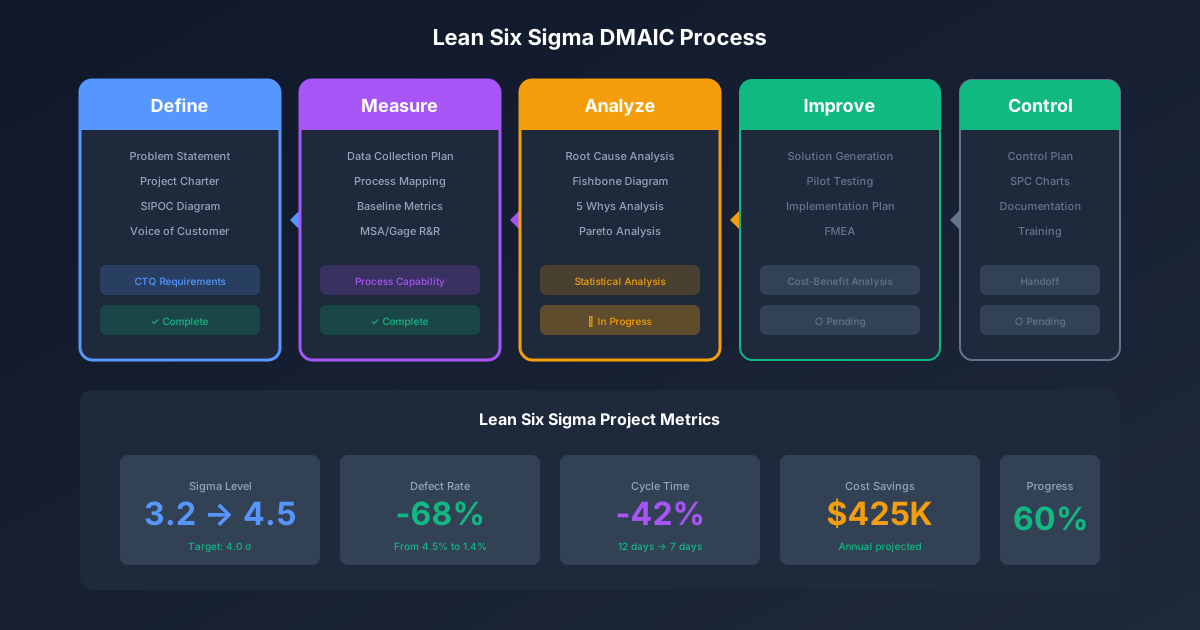
The structured approach for improvement projects:
| Phase | Purpose | Key Questions | Deliverables |
|---|---|---|---|
| Define | Scope the problem | What's broken? Why does it matter? | Project charter, SIPOC |
| Measure | Quantify current state | How bad is it? How do we measure? | Baseline data, process map |
| Analyze | Find root causes | Why is it happening? | Root cause analysis, data analysis |
| Improve | Implement solutions | What changes will fix it? | Pilot results, implementation plan |
| Control | Sustain gains | How do we keep it fixed? | Control plan, documentation |
Define Phase Templates
Project Charter Template
| Field | Description | Example |
|---|---|---|
| Project Title | Descriptive name | Reduce Order Processing Time |
| Business Case | Why this matters | Customer complaints up 40%, losing orders to competitors |
| Problem Statement | Specific issue description | Order processing takes 72 hours average vs. target of 24 hours |
| Goal Statement | SMART objective | Reduce order processing time from 72 to 24 hours by Q3 |
| Scope | In/out of scope | In: Order entry to shipment. Out: Returns processing |
| Project Team | Roles and members | Champion: VP Ops, Lead: Process Engineer, Team: 5 members |
| Timeline | Key milestones | Define: Week 1-2, Measure: Week 3-4, etc. |
| Resources | Budget, tools, support | $25K budget, Minitab license, IT support |
Problem Statement Formula:
[Process/Area] currently [performs at level] against [target/benchmark],
resulting in [business impact] of approximately [quantified impact].

Example:
Order processing currently takes 72 hours on average against a
target of 24 hours, resulting in customer satisfaction decline
of 15 points and estimated revenue loss of $500K annually.
SIPOC Diagram Template
High-level process view:
| Suppliers | Inputs | Process | Outputs | Customers |
|---|---|---|---|---|
| Customers | Orders | Receive Order | Order confirmation | Customers |
| Sales team | Customer info | Validate Order | Validated order | Warehouse |
| IT systems | Inventory data | Check Inventory | Availability status | Sales team |
| Warehouse | Products | Pick & Pack | Packed order | Shipping |
| Shipping carrier | Capacity | Ship Order | Tracking info | Customers |
Stakeholder Analysis Template
| Stakeholder | Role | Interest Level | Influence | Strategy |
|---|---|---|---|---|
| VP Operations | Champion | High | High | Regular briefings, escalation path |
| Customer Service | Affected team | High | Medium | Involve in solution design |
| IT Department | Enabler | Medium | High | Early engagement for tech needs |
| Finance | Budget holder | Medium | High | ROI justification |
| Warehouse Staff | End users | High | Low | Training, change management |
Measure Phase Templates
Process Map Template
Detailed Process Flow:
Start
  │
  ▼
┌─────────────────┐
│ 1. Receive order │ Time: 5 min
│    via portal    │ Defect: 8% incomplete
└────────┬────────┘
         │
         ▼
    ┌────────────┐
   /  Complete?   \────No────▶ Request info (24 hr delay)
   \              /           │
    └─────┬─────┘             │
          │ Yes               │
          ▼◄──────────────────┘
┌─────────────────┐
│ 2. Validate     │ Time: 10 min
│    customer info│ Defect: 5% errors
└────────┬────────┘
         │
         ▼
┌─────────────────┐
│ 3. Check        │ Time: 15 min (wait: 2 hr avg)
│    inventory    │ Defect: 12% stockout
└────────┬────────┘
         │
         ▼
    ┌────────────┐
   /  In stock?   \────No────▶ Backorder process
   \              /
    └─────┬─────┘
          │ Yes
          ▼
┌─────────────────┐
│ 4. Pick & pack  │ Time: 30 min
│                 │ Defect: 3% wrong item
└────────┬────────┘
         │
         ▼
End
Data Collection Plan
| Metric | Operational Definition | Data Source | Sample Size | Frequency | Collector |
|---|---|---|---|---|---|
| Cycle time | Time from order receipt to ship | ERP system | All orders | Continuous | System |
| Defect rate | Orders with errors / Total orders | Quality log | All orders | Daily | QA team |
| First pass yield | Orders correct on first attempt | ERP + Quality | 500 minimum | Weekly | Analyst |
| Customer wait time | Order date - Promise date | CRM | All orders | Continuous | System |
Measurement System Analysis (MSA)
Verify your measurement system is reliable:
Gage R&R Worksheet:
| Part | Operator A-1 | Operator A-2 | Operator B-1 | Operator B-2 | Range |
|---|---|---|---|---|---|
| 1 | 10.2 | 10.3 | 10.1 | 10.2 | 0.2 |
| 2 | 9.8 | 9.9 | 9.7 | 9.8 | 0.2 |
| 3 | 10.5 | 10.4 | 10.5 | 10.6 | 0.2 |
| ... | ... | ... | ... | ... | ... |
Interpretation:
- %GRR < 10%: Excellent measurement system
- %GRR 10-30%: Acceptable, depending on application
- %GRR > 30%: Unacceptable, fix before proceeding
Baseline Performance Summary
| Metric | Current Performance | Target | Gap |
|---|---|---|---|
| Average cycle time | 72 hours | 24 hours | 48 hours |
| Cycle time std dev | 18 hours | 4 hours | 14 hours |
| Defect rate | 15% | 3% | 12% |
| First pass yield | 85% | 97% | 12% |
| Process capability (Cp) | 0.67 | 1.33 | 0.66 |
Analyze Phase Templates
Fishbone (Ishikawa) Diagram Template
Categories for Manufacturing (6M):
        Methods            Materials           Machines
            \                  |                  /
             \                 |                 /
              \                |                /
               ────────────────┼───────────────
              /                |                \
             /                 |                 \
            /                  |                  \
    Measurement          Mother Nature       Manpower

                    ▼
              [EFFECT]
        Long Order Processing Time
Cause Details:
| Category | Potential Causes | Evidence? |
|---|---|---|
| Methods | No standard process | ✓ Observed 5 different approaches |
| Unnecessary approvals | ✓ 3 approval steps, 2 redundant | |
| Batch processing | ✓ Orders held until batch full | |
| Manpower | Insufficient training | ✓ Training gaps in new hires |
| High turnover | ? Turnover at 25% | |
| Workload imbalance | ✓ Some staff 120% utilized | |
| Machines | System downtime | ✓ 4 hours/week average |
| Slow system response | ✓ 30-second average page load | |
| Materials | Missing information | ✓ 20% orders incomplete |
| Wrong specifications | ? Need data | |
| Measurement | No real-time visibility | ✓ Reports are daily |
| Inconsistent metrics | ✓ Teams measure differently | |
| Mother Nature | Volume spikes | ✓ Monday volumes 2x average |
5 Whys Analysis Template
| Problem | Why 1 | Why 2 | Why 3 | Why 4 | Why 5 (Root Cause) |
|---|---|---|---|---|---|
| Orders take 72 hours | Orders wait in queue | Batching for efficiency | System can't handle singles | Legacy system design | No investment in upgrade |
| Multiple approvals needed | Policy from 2015 | High-value fraud incident | No fraud detection system | Budget not approved |
Pareto Analysis Template
Defect Type Frequency:
| Defect Type | Count | % of Total | Cumulative % |
|---|---|---|---|
| Missing information | 450 | 35% | 35% |
| System errors | 320 | 25% | 60% |
| Wrong item picked | 200 | 15% | 75% |
| Shipping address error | 150 | 12% | 87% |
| Inventory mismatch | 100 | 8% | 95% |
| Other | 80 | 6% | 100% |
| Total | 1,300 | 100% |
80/20 Rule: Top 3 defects (Missing information, System errors, Wrong item) account for 75% of all defects.
Hypothesis Testing Template
Comparing Two Process Versions:
| Test Type | Hypothesis | Sample Size | Result | Conclusion |
|---|---|---|---|---|
| 2-sample t-test | New process faster than old | Old: n=100, New: n=100 | p-value = 0.003 | Significant difference |
Template:
Null Hypothesis (H₀): μ_new = μ_old (no difference)
Alternative Hypothesis (H₁): μ_new < μ_old (new is faster)

Significance level: α = 0.05

Results:
- Old process mean: 72 hours (σ = 18)
- New process mean: 52 hours (σ = 12)
- t-statistic: -8.24
- p-value: < 0.001

Conclusion: Reject H₀. New process is significantly faster.
Root Cause Validation Matrix
| Root Cause | Evidence | Data Support | Team Agreement | Validated? |
|---|---|---|---|---|
| Batch processing delays | Process observation | 65% of wait time | Yes | ✓ |
| Redundant approvals | Policy review | 12 hours added | Yes | ✓ |
| System slowness | IT metrics | 30-sec response | Yes | ✓ |
| Incomplete orders | Quality data | 20% of orders | Yes | ✓ |
| Staff training gaps | Assessment | 40% failed test | Partial | Needs more data |
Improve Phase Templates
Solution Prioritization Matrix
Rate solutions on Impact (1-5) and Effort (1-5):
| Solution | Impact | Effort | Score | Priority |
|---|---|---|---|---|
| Eliminate batch processing | 5 | 2 | 2.5 | 1 |
| Remove redundant approvals | 4 | 1 | 4.0 | 2 |
| Add order validation rules | 4 | 3 | 1.3 | 3 |
| Upgrade ERP system | 5 | 5 | 1.0 | 4 |
| Increase staffing | 3 | 4 | 0.75 | 5 |
Score = Impact / Effort (Higher = Better)
Pilot Plan Template
| Element | Description |
|---|---|
| Pilot Scope | 100 orders from Region A for 2 weeks |
| Success Criteria | Cycle time < 30 hours, defect rate < 5% |
| Pilot Team | 3 processors, 1 supervisor |
| Training Required | 4-hour session on new process |
| Monitoring Plan | Daily metrics review, issue log |
| Risk Mitigation | Fallback to old process if critical failures |
| Decision Point | Go/No-Go meeting at Day 10 |
Implementation Plan Template
| Phase | Activity | Owner | Start | End | Status |
|---|---|---|---|---|---|
| 1. Prep | Update SOPs | Process Engineer | Week 1 | Week 1 | ✓ |
| 1. Prep | Configure system | IT | Week 1 | Week 2 | ✓ |
| 1. Prep | Develop training | Training team | Week 1 | Week 2 | ✓ |
| 2. Train | Pilot team training | L&D | Week 3 | Week 3 | In progress |
| 3. Pilot | Run pilot | Pilot team | Week 4 | Week 5 | Planned |
| 4. Evaluate | Analyze results | Process Engineer | Week 6 | Week 6 | Planned |
| 5. Rollout | Full deployment | Operations | Week 7 | Week 9 | Planned |
Before/After Comparison Template
| Metric | Before | After (Pilot) | Improvement | Sustained? |
|---|---|---|---|---|
| Average cycle time | 72 hours | 28 hours | 61% reduction | Yes |
| Cycle time std dev | 18 hours | 6 hours | 67% reduction | Yes |
| Defect rate | 15% | 4% | 73% reduction | Yes |
| First pass yield | 85% | 96% | 11% improvement | Yes |
| Customer complaints | 45/week | 12/week | 73% reduction | Monitoring |
Control Phase Templates
Control Plan Template
| Process Step | Control Point | Specification | Measurement | Frequency | Responsibility | Reaction Plan |
|---|---|---|---|---|---|---|
| Order receipt | Data completeness | 100% fields populated | System validation | Every order | System | Reject incomplete |
| Validation | Processing time | < 15 min | Timestamp delta | Every order | Supervisor | Investigate if > 20 min |
| Inventory check | Stock accuracy | 99% match | Cycle count | Daily | Warehouse | Reconcile differences |
| Shipping | Ship within SLA | < 24 hours | Ship timestamp | Every order | Logistics | Escalate to manager |
Control Chart Template
X-bar and R Chart Data:
| Sample | X1 | X2 | X3 | X4 | X5 | X-bar | Range |
|---|---|---|---|---|---|---|---|
| 1 | 24 | 26 | 25 | 23 | 27 | 25.0 | 4 |
| 2 | 25 | 24 | 26 | 25 | 25 | 25.0 | 2 |
| 3 | 23 | 24 | 25 | 26 | 24 | 24.4 | 3 |
| 4 | 28 | 26 | 27 | 25 | 26 | 26.4 | 3 |
| 5 | 24 | 25 | 24 | 25 | 25 | 24.6 | 1 |
Control Limits Calculation:
X-double-bar = Average of X-bar values = 25.08
R-bar = Average of Range values = 2.6

For n=5:
A2 = 0.577, D3 = 0, D4 = 2.114

UCL (X-bar) = X-double-bar + A2 × R-bar = 25.08 + (0.577 × 2.6) = 26.58
LCL (X-bar) = X-double-bar - A2 × R-bar = 25.08 - (0.577 × 2.6) = 23.58

UCL (R) = D4 × R-bar = 2.114 × 2.6 = 5.50
LCL (R) = D3 × R-bar = 0 × 2.6 = 0
Process Documentation Checklist
| Document | Owner | Status | Location |
|---|---|---|---|
| Updated SOP | Process Engineer | ✓ Complete | SharePoint/SOPs |
| Work instructions | Supervisor | ✓ Complete | Work area |
| Training materials | L&D | ✓ Complete | LMS |
| Control plan | Quality | ✓ Complete | Quality system |
| Monitoring dashboard | IT | ✓ Complete | Operations portal |
| Escalation procedure | Operations | ✓ Complete | SharePoint/Procedures |
Project Closure Report Template
| Section | Content |
|---|---|
| Executive Summary | Achieved 61% reduction in cycle time, exceeding 67% target |
| Problem Statement | Orders took 72 hours vs. 24-hour target |
| Root Causes | Batch processing, redundant approvals, system issues |
| Solutions Implemented | Real-time processing, streamlined approval, system optimization |
| Results | Cycle time: 72→28 hours, Defects: 15%→4% |
| Financial Impact | $500K annual savings from reduced complaints and rework |
| Lessons Learned | Early IT engagement critical, pilot scope was appropriate |
| Sustainability | Control plan in place, monthly reviews scheduled |
| Recognition | Team members acknowledged at all-hands meeting |
Value Stream Mapping Templates
Current State VSM Template
Customer                                              Customer
Demand: 100/day                                      Lead Time: 72 hrs
                                                     Process Time: 2 hrs
    ┌──────────────────────────────────────────────────────────┐
    │                                                          │
    ▼                                                          │
┌───────┐    ┌───────┐    ┌───────┐    ┌───────┐    ┌───────┐ │
│Receive│───▶│Validate│───▶│Inventory│──▶│Pick/Pack│──▶│ Ship  │─┘
│ Order │    │ Order │    │ Check  │    │        │    │       │
└───┬───┘    └───┬───┘    └───┬───┘    └───┬───┘    └───┬───┘
    │            │            │            │            │
    ▼            ▼            ▼            ▼            ▼
CT: 5 min    CT: 10 min   CT: 15 min   CT: 30 min   CT: 30 min
WT: 0        WT: 8 hrs    WT: 24 hrs   WT: 12 hrs   WT: 4 hrs
FPY: 92%     FPY: 95%     FPY: 88%     FPY: 97%     FPY: 99%
Batch: 20    Batch: 50    Batch: 1     Batch: 10    Batch: 20

Total Process Time: 90 min (2.5% value-add)
Total Lead Time: 72 hours
Future State VSM Template
Customer                                              Customer
Demand: 100/day                                      Lead Time: 24 hrs
                                                     Process Time: 1.5 hrs
    ┌──────────────────────────────────────────────────────────┐
    │                                                          │
    ▼                                                          │
┌───────┐    ┌───────┐    ┌───────┐    ┌───────┐    ┌───────┐ │
│Receive│───▶│Validate│───▶│Inventory│──▶│Pick/Pack│──▶│ Ship  │─┘
│ Order │    │ Order │    │ Check  │    │        │    │       │
└───┬───┘    └───┬───┘    └───┬───┘    └───┬───┘    └───┬───┘
    │            │            │            │            │
    ▼            ▼            ▼            ▼            ▼
CT: 3 min    CT: 5 min    CT: 5 min    CT: 25 min   CT: 25 min
WT: 0        WT: 2 hrs    WT: 6 hrs    WT: 4 hrs    WT: 2 hrs
FPY: 98%     FPY: 99%     FPY: 99%     FPY: 99%     FPY: 99%
Flow: 1      Flow: 1      Auto        Flow: 1      Flow: Cont.

Total Process Time: 63 min (4.4% value-add)
Total Lead Time: 24 hours
Improvement: 67% reduction in lead time
Value Stream Metrics
| Metric | Current | Future | Improvement |
|---|---|---|---|
| Lead time | 72 hours | 24 hours | 67% |
| Process time | 90 min | 63 min | 30% |
| Value-add % | 2.1% | 4.4% | 110% |
| First pass yield | 74% | 95% | 28% |
| Inventory (WIP) | 150 orders | 50 orders | 67% |
Kaizen Event Templates
Kaizen Event Charter
| Field | Content |
|---|---|
| Event Title | 5-Day Order Processing Kaizen |
| Date | March 10-14, 2025 |
| Scope | Order entry through warehouse handoff |
| Target | Reduce cycle time from 72 to 36 hours |
| Team | 6 members: 2 processors, 1 warehouse, 1 IT, 1 QA, facilitator |
| Resources | Conference room, process data, system access, flip charts |
| Preparation | VSM completed, data collected, management approval |
Kaizen Daily Schedule
Day 1: Train and Map
| Time | Activity |
|---|---|
| 8:00 | Kickoff, introductions, ground rules |
| 9:00 | Lean Six Sigma overview |
| 10:00 | Walk the process (Gemba walk) |
| 12:00 | Lunch |
| 1:00 | Document current state |
| 3:00 | Identify waste categories |
| 4:30 | Day 1 review |
Day 2: Analyze
| Time | Activity |
|---|---|
| 8:00 | Review Day 1 findings |
| 9:00 | Root cause analysis |
| 11:00 | Data analysis |
| 12:00 | Lunch |
| 1:00 | Prioritize opportunities |
| 3:00 | Draft future state |
| 4:30 | Day 2 review |
Day 3: Design
| Time | Activity |
|---|---|
| 8:00 | Review future state |
| 9:00 | Design solutions |
| 11:00 | Plan implementation |
| 12:00 | Lunch |
| 1:00 | Prepare for pilot |
| 3:00 | Risk assessment |
| 4:30 | Day 3 review |
Day 4: Implement
| Time | Activity |
|---|---|
| 8:00 | Begin implementation |
| 10:00 | Test new process |
| 12:00 | Lunch |
| 1:00 | Continue implementation |
| 3:00 | Adjust based on learnings |
| 4:30 | Day 4 review |
Day 5: Control and Close
| Time | Activity |
|---|---|
| 8:00 | Measure results |
| 10:00 | Develop control plan |
| 11:00 | Document new process |
| 12:00 | Lunch |
| 1:00 | Create sustainability plan |
| 3:00 | Prepare report-out |
| 4:00 | Executive presentation |
Kaizen Report-Out Template
| Section | Content |
|---|---|
| Background | Why this process, why now |
| Team | Members and roles |
| Scope | What was included/excluded |
| Methodology | Approach taken |
| Findings | Key discoveries |
| Solutions | What was implemented |
| Results | Before/after metrics |
| Sustainability | How improvements will be maintained |
| Next Steps | Follow-up actions with owners and dates |
Key Takeaways
-
Start with Define: A clear problem statement and scope prevents wasted effort
-
Measure before improving: Baseline data is essential for proving results
-
Use root cause analysis: Treating symptoms creates recurring problems
-
Prioritize high-impact, low-effort solutions: Quick wins build momentum
-
Control is critical: Improvements without controls fade over time
-
Document everything: Templates enable replication and sustainability
For related resources, explore our Business Process Documentation Guide, Operations KPI Dashboard, and Workflow Automation Best Practices.