Financial Modeling Templates for Business Analysis & Valuation

Financial Modeling Templates for Business Analysis & Valuation
For: Finance professionals, investment analysts, business owners, and corporate development teams Goal: Master the essential financial models used for business valuation, investment analysis, and strategic decision-making Outcome: Build professional-grade financial models that drive informed business decisions
For comprehensive financial planning resources, visit our Financial Planning Hub. For related tools, explore our Business Calculators and investment analysis templates.
Quick Start: Financial modeling combines accounting fundamentals with forward-looking projections. The key is building models that are transparent, auditable, and flexible enough for scenario analysis.
What is Financial Modeling?
Financial modeling is the process of building a mathematical representation of a company's financial performance. These models project future financial statements based on historical data, assumptions, and business drivers.
Why Financial Models Matter:
- Investment Decisions - Determine fair value for acquisitions, investments, and divestitures
- Strategic Planning - Forecast cash flows, evaluate expansion scenarios, plan capital allocation
- Capital Raising - Demonstrate growth potential to investors and lenders
- Performance Tracking - Compare actual results against projections, identify variances
Who Uses Financial Models?
| Professional | Primary Models | Use Case |
|---|---|---|
| Investment Bankers | DCF, LBO, M&A | Transaction advisory, deal structuring |
| Private Equity | LBO, Returns Analysis | Deal screening, portfolio monitoring |
| Corporate Finance | 3-Statement, Budget Models | Planning, forecasting, variance analysis |
| Equity Research | DCF, Comparables | Stock valuation, investment recommendations |
| Business Owners | 3-Statement, Cash Flow | Fundraising, strategic planning |
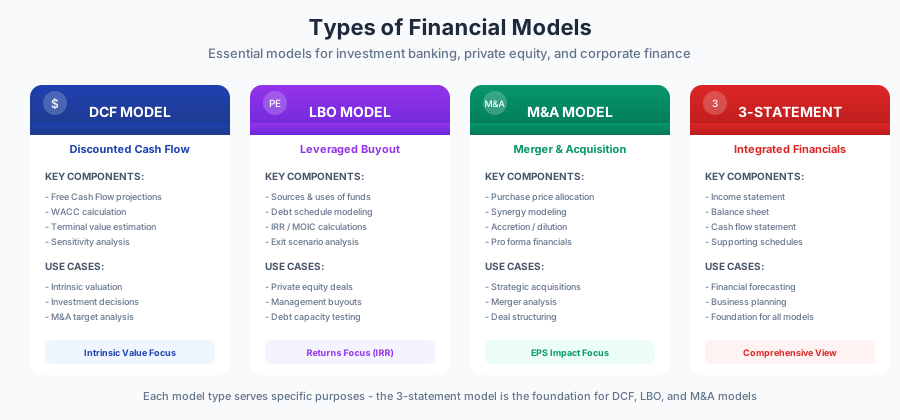
The Four Essential Financial Models
1. Three-Statement Model (Foundation)
The 3-statement model integrates the income statement, balance sheet, and cash flow statement into a single, linked model. This is the foundation for all other financial models.
Key Components:
Income Statement Drivers:
- Revenue growth rate (historical trend, market assumptions)
- Cost of goods sold (% of revenue)
- Operating expenses (fixed vs. variable components)
- Depreciation and amortization schedules
- Interest expense (linked to debt schedule)
- Tax rate assumptions
Balance Sheet Drivers:
- Working capital (DSO, DIO, DPO)
- Fixed assets and CapEx schedule
- Debt and equity financing
- Retained earnings (linked to income statement)
Cash Flow Statement:
- Operating cash flow (net income + non-cash adjustments)
- Investing activities (CapEx, acquisitions)
- Financing activities (debt, equity, dividends)
- Ending cash balance (links back to balance sheet)
Example: Revenue Build-Up
| Component | Year 1 | Year 2 | Year 3 | Year 4 | Year 5 |
|---|---|---|---|---|---|
| Units Sold | 10,000 | 12,000 | 14,400 | 17,280 | 20,736 |
| Growth Rate | - | 20% | 20% | 20% | 20% |
| Price per Unit | $100 | $103 | $106 | $109 | $113 |
| Price Growth | - | 3% | 3% | 3% | 3% |
| Revenue | $1.0M | $1.24M | $1.53M | $1.88M | $2.34M |
Formula: Revenue = Units Sold × Price per Unit
Best Practices for 3-Statement Models:
- Build modularly - Separate input sheets, calculations, and outputs
- Use consistent formatting - Blue for inputs, black for formulas, green for links
- Document all assumptions - Create an assumptions sheet with sources
- Test with circular references - Enable iterative calculations for interest expense
- Balance sheet must balance - Assets = Liabilities + Equity (always)
2. Discounted Cash Flow (DCF) Model
The DCF model calculates the intrinsic value of a company by discounting projected future cash flows to present value. This is the gold standard for fundamental valuation.
DCF Model Structure:
Step 1: Project Free Cash Flow (FCF)
Free Cash Flow = EBIT × (1 - Tax Rate)
                + Depreciation & Amortization
                - Capital Expenditures
                - Change in Net Working Capital
Step 2: Calculate Weighted Average Cost of Capital (WACC)
WACC = (E/V × Re) + (D/V × Rd × (1 - Tc))

Where:
E = Market value of equity
D = Market value of debt
V = Total value (E + D)
Re = Cost of equity
Rd = Cost of debt
Tc = Corporate tax rate
Step 3: Estimate Terminal Value
Gordon Growth Method:
Terminal Value = FCF(n+1) / (WACC - g)

Where:
FCF(n+1) = Free cash flow in final year × (1 + g)
g = Perpetuity growth rate (typically 2-3%)
Exit Multiple Method:
Terminal Value = EBITDA(n) × Exit Multiple
Step 4: Discount to Present Value
Enterprise Value = Σ [FCF(t) / (1 + WACC)^t] + [Terminal Value / (1 + WACC)^n]
Complete DCF Example:
| Year | 2024 | 2025 | 2026 | 2027 | 2028 | Terminal |
|---|---|---|---|---|---|---|
| Revenue | $10.0M | $12.5M | $15.6M | $19.5M | $24.4M | - |
| Revenue Growth | - | 25% | 25% | 25% | 25% | 3% |
| EBITDA | $2.0M | $2.6M | $3.4M | $4.5M | $5.9M | - |
| EBITDA Margin | 20% | 21% | 22% | 23% | 24% | - |
| D&A | $0.3M | $0.4M | $0.5M | $0.6M | $0.7M | - |
| EBIT | $1.7M | $2.2M | $2.9M | $3.9M | $5.2M | - |
| Tax (25%) | $0.4M | $0.6M | $0.7M | $1.0M | $1.3M | - |
| NOPAT | $1.3M | $1.7M | $2.2M | $2.9M | $3.9M | - |
| + D&A | $0.3M | $0.4M | $0.5M | $0.6M | $0.7M | - |
| - CapEx | $0.5M | $0.6M | $0.8M | $1.0M | $1.2M | - |
| - ΔNWC | $0.2M | $0.3M | $0.3M | $0.4M | $0.5M | - |
| FCF | $0.9M | $1.2M | $1.6M | $2.1M | $2.9M | - |
| Discount Factor (10%) | 0.91 | 0.83 | 0.75 | 0.68 | 0.62 | - |
| PV of FCF | $0.8M | $1.0M | $1.2M | $1.4M | $1.8M | - |
Valuation Summary:
| Component | Value |
|---|---|
| Sum of PV FCF | $6.2M |
| Terminal Value (3.0M × 1.03 / (10% - 3%)) | $44.1M |
| PV of Terminal Value | $27.4M |
| Enterprise Value | $33.6M |
| Less: Net Debt | ($2.0M) |
| Equity Value | $31.6M |
3. Leveraged Buyout (LBO) Model
The LBO model is used by private equity firms to evaluate acquisition targets and determine returns from using debt to acquire and later exit a company.
LBO Structure:
Sources and Uses:
| Uses of Funds | Amount | Sources of Funds | Amount |
|---|---|---|---|
| Purchase Price | $50M | Senior Debt (4.0x EBITDA) | $24M |
| Transaction Fees | $2M | Subordinated Debt (1.5x) | $9M |
| Refinance Debt | $8M | Equity Contribution | $27M |
| Total Uses | $60M | Total Sources | $60M |
Key LBO Metrics:
Internal Rate of Return (IRR):
IRR = Rate that makes NPV of investment = 0
Typical PE target: 20-25% IRR
Multiple on Invested Capital (MOIC):
MOIC = Exit Equity Value / Initial Equity Investment
Typical PE target: 2.0-3.0x MOIC
Debt Paydown Schedule Example:
| Year | Beginning Debt | EBITDA | FCF | Debt Paydown | Ending Debt | Leverage |
|---|---|---|---|---|---|---|
| Entry | $33M | $6.0M | - | - | $33M | 5.5x |
| Year 1 | $33M | $6.5M | $3.0M | $3.0M | $30M | 4.6x |
| Year 2 | $30M | $7.2M | $3.5M | $3.5M | $26.5M | 3.7x |
| Year 3 | $26.5M | $8.0M | $4.0M | $4.0M | $22.5M | 2.8x |
| Year 4 | $22.5M | $8.8M | $4.5M | $4.5M | $18M | 2.0x |
| Year 5 | $18M | $9.5M | $5.0M | Exit | Exit | - |
Returns Calculation:
| Metric | Calculation | Value |
|---|---|---|
| Entry EBITDA | $6.0M | |
| Exit EBITDA (Year 5) | $9.5M | |
| Exit Multiple | 8.0x | |
| Enterprise Value at Exit | $9.5M × 8.0x | $76M |
| Less: Remaining Debt | ($18M) | |
| Equity Value at Exit | $58M | |
| Initial Equity | $27M | |
| MOIC | $58M / $27M | 2.1x |
| IRR | Solve for rate | ~16% |
4. Merger & Acquisition (M&A) Model
The M&A model analyzes the financial impact of combining two companies, focusing on EPS accretion/dilution and synergy realization.
M&A Model Components:
Purchase Price Analysis:
| Component | Calculation |
|---|---|
| Offer Price per Share | $25.00 |
| Target Shares Outstanding | 10M |
| Equity Value | $250M |
| Plus: Target Net Debt | $50M |
| Enterprise Value | $300M |
| Target LTM EBITDA | $40M |
| EV/EBITDA Multiple | 7.5x |
Synergy Analysis:
| Synergy Type | Annual Value | Realization Timeline |
|---|---|---|
| Cost Synergies | ||
| Headcount reduction | $5M | Years 1-2 |
| Facility consolidation | $3M | Year 2 |
| Procurement savings | $2M | Year 1 |
| Revenue Synergies | ||
| Cross-selling | $4M | Years 2-3 |
| Geographic expansion | $2M | Year 3 |
| Total Synergies | $16M | Fully realized Year 3 |
Accretion/Dilution Analysis:
| Metric | Standalone | Pro Forma | Accretion |
|---|---|---|---|
| Acquirer Net Income | $100M | - | - |
| Target Net Income | $20M | - | - |
| Synergies (after-tax) | - | $12M | - |
| Financing Costs | - | ($8M) | - |
| Pro Forma Net Income | - | $124M | - |
| Acquirer Shares | 50M | - | - |
| New Shares Issued | - | 10M | - |
| Pro Forma Shares | - | 60M | - |
| Standalone EPS | $2.00 | - | - |
| Pro Forma EPS | - | $2.07 | +3.5% |
The deal is 3.5% accretive to EPS in Year 1
Building Financial Models: Best Practices
Model Architecture
Recommended Structure:
1. Cover Page (model overview, version, date)
2. Table of Contents
3. Assumptions Sheet (all inputs in one place)
4. Historical Financials (3-5 years)
5. Projections (3-10 years)
   - Revenue Build
   - Income Statement
   - Balance Sheet
   - Cash Flow Statement
   - Supporting Schedules
6. Valuation (DCF, Multiples, etc.)
7. Sensitivity Analysis
8. Scenario Analysis
9. Summary/Output Page
Formatting Standards
Color Coding:
- Blue: Hard-coded inputs and assumptions
- Black: Formulas and calculations
- Green: Links to other sheets or external sources
- Red: Error checks and warnings
Cell Formatting:
- Currency: $#,##0 or $#,##0.0
- Percentages: 0.0% or 0.00%
- Multiples: 0.0x
- Dates: MM/DD/YYYY
Layout Best Practices:
- Time flows left to right
- Calculations flow top to bottom
- One formula per row (avoid mixed calculations)
- No hardcoded numbers in formulas
Error Checking
Essential Checks:
| Check | Formula | Expected |
|---|---|---|
| Balance Sheet Balances | Assets - Liabilities - Equity | $0 |
| Cash Flow Ties | Beginning Cash + CF = Ending Cash | TRUE |
| Revenue Tie-Out | Revenue build = Income Statement | TRUE |
| Interest Calculation | Interest = Average Debt × Rate | TRUE |
| Tax Rate Reasonableness | Tax / Pre-tax Income | 20-30% |
Formula Example (Balance Sheet Check):
=IF(ABS(Assets - Liabilities - Equity) < 0.01, "OK", "ERROR")
Sensitivity Analysis
Sensitivity analysis shows how changes in key assumptions affect model outputs. This is critical for understanding risk and uncertainty.
One-Way Sensitivity
Impact of Discount Rate on Enterprise Value:
| WACC | Enterprise Value | % Change |
|---|---|---|
| 8% | $42.3M | +26% |
| 9% | $37.5M | +12% |
| 10% | $33.6M | Base |
| 11% | $30.3M | -10% |
| 12% | $27.5M | -18% |
Two-Way Sensitivity (Data Table)
Enterprise Value Sensitivity to WACC and Terminal Growth:
| WACC \ g | 2.0% | 2.5% | 3.0% | 3.5% | 4.0% |
|---|---|---|---|---|---|
| 8% | $38.5M | $40.2M | $42.3M | $44.8M | $47.9M |
| 9% | $34.2M | $35.7M | $37.5M | $39.5M | $42.0M |
| 10% | $30.8M | $32.1M | $33.6M | $35.3M | $37.4M |
| 11% | $28.0M | $29.1M | $30.3M | $31.8M | $33.5M |
| 12% | $25.7M | $26.5M | $27.5M | $28.7M | $30.2M |
Key Insight: A 1% change in WACC impacts value by approximately 10-15%.
Scenario Analysis
Define Multiple Operating Scenarios:
| Metric | Bear Case | Base Case | Bull Case |
|---|---|---|---|
| Revenue Growth | 15% | 25% | 35% |
| EBITDA Margin | 18% | 22% | 26% |
| Terminal Growth | 2% | 3% | 4% |
| WACC | 12% | 10% | 9% |
| Enterprise Value | $22.1M | $33.6M | $52.8M |
| Probability | 25% | 50% | 25% |
Expected Value = (25% × $22.1M) + (50% × $33.6M) + (25% × $52.8M) = $35.5M
Common Modeling Mistakes to Avoid
Structural Errors
- Hardcoded numbers in formulas - Always reference cells, never type numbers directly
- Inconsistent time periods - Use the same period convention throughout
- Broken links - Regularly audit external references
- Circular reference errors - Enable iterative calculations, but minimize circularity
- Missing error checks - Balance sheet MUST balance at all times
Assumption Errors
- Unrealistic growth rates - Benchmark against industry and historical performance
- Ignoring working capital - Growing companies consume cash through working capital
- Constant margins at scale - Margins typically change as companies grow
- Terminal value dominates - If >80% of value is in terminal value, stress test heavily
- No sanity checks - Compare implied multiples to market comparables
Technical Errors
- Wrong discount rate - Use WACC for enterprise value, cost of equity for equity value
- Mid-year vs. year-end discounting - Be consistent (mid-year is more accurate)
- Nominal vs. real - Match discount rate type to cash flow type
- Currency inconsistency - Convert all values to single currency
- Calendar vs. fiscal year - Align all data to same year-end
Advanced Modeling Techniques
Monte Carlo Simulation
Instead of discrete scenarios, use probability distributions for key inputs:
Input Distributions:
- Revenue growth: Normal distribution, mean 25%, std dev 10%
- EBITDA margin: Triangular distribution, min 15%, mode 22%, max 28%
- Discount rate: Uniform distribution, 9% to 12%
Output: Probability distribution of enterprise value with confidence intervals
Excel Implementation:
- Use NORM.INV(RAND(), mean, std_dev) for normal distributions
- Run 1,000+ iterations using Data Tables
- Calculate percentiles (5th, 50th, 95th) for output
Option-Based Valuation
For companies with embedded optionality (startups, R&D-heavy firms):
Real Options Applications:
- Option to expand - Value of growth opportunities
- Option to abandon - Value of downside protection
- Option to delay - Value of waiting for better information
Black-Scholes for Real Options:
S = Present value of project cash flows
K = Investment required to exercise option
T = Time until option expires
r = Risk-free rate
σ = Volatility of project value
Financial Modeling Templates
Essential Templates for Your Toolkit
Our comprehensive financial modeling template includes:
3-Statement Model:
- Fully integrated IS, BS, CF statements
- Revenue and expense drivers
- Working capital schedules
- Debt and depreciation schedules
- 5-year projection period
DCF Valuation:
- Free cash flow projections
- WACC calculator
- Terminal value (both methods)
- Sensitivity analysis
LBO Analysis:
- Sources and uses
- Debt schedule with multiple tranches
- IRR and MOIC calculations
- Credit statistics
M&A Accretion/Dilution:
- Purchase price analysis
- Pro forma financials
- Synergy build-up
- EPS accretion analysis
Industry-Specific Considerations
SaaS/Subscription Models
Key Metrics:
- Monthly Recurring Revenue (MRR)
- Annual Recurring Revenue (ARR)
- Net Revenue Retention (NRR)
- Customer Acquisition Cost (CAC)
- Lifetime Value (LTV)
- CAC Payback Period
Revenue Build:
ARR = Beginning ARR + New ARR + Expansion ARR - Churned ARR
Manufacturing/Industrial
Key Metrics:
- Capacity utilization
- Unit economics (cost per unit)
- Working capital intensity
- CapEx requirements
Inventory Build:
Ending Inventory = Beginning Inventory + Production - COGS (units)
Financial Services
Key Metrics:
- Net Interest Margin (NIM)
- Return on Assets (ROA)
- Return on Equity (ROE)
- Tier 1 Capital Ratio
Revenue Build:
Net Interest Income = Interest Income - Interest Expense
Total Revenue = NII + Non-Interest Income
Model Review Checklist
Before finalizing any financial model, complete this checklist:
Structural Review:
- All sheets have consistent formatting
- Table of contents is accurate
- All links are functioning
- No circular reference errors
- Balance sheet balances in all periods
Assumption Review:
- All inputs are documented
- Sources are cited
- Assumptions are reasonable vs. benchmarks
- Sensitivity ranges are appropriate
Output Review:
- Results pass sanity checks
- Implied multiples are reasonable
- Cash flow signs are logical
- Terminal value percentage is reasonable (less than 70%)
Technical Review:
- Formulas are consistent across rows
- No hardcoded numbers in formulas
- Error checks pass
- Model is protected/locked where appropriate
Key Takeaways
Building Professional Financial Models:
- Start with the 3-statement model - This is the foundation for all other models
- Use consistent formatting - Color coding, layout, and structure matter
- Document everything - Assumptions, sources, and methodology
- Build in flexibility - Sensitivity and scenario analysis are essential
- Always error check - Balance sheet must balance, cash must tie
- Iterate and refine - Models improve with each version
For Business Analysis:
- DCF for intrinsic value - Best for stable, predictable businesses
- Comparables for market value - Best for public companies with peers
- LBO for PE transactions - Focus on cash flow and debt capacity
- M&A for strategic deals - Focus on synergies and EPS impact
Additional Resources
Related Guides:
Financial Planning Hub:
Conclusion
Financial modeling is both an art and a science. The best models combine technical accuracy with practical business insights. Whether you are valuing an acquisition target, planning a capital raise, or forecasting next year's performance, the principles in this guide will help you build models that drive informed decisions.
Start with the fundamentals:
- Master the 3-statement model first
- Add DCF for valuation
- Expand to LBO and M&A for transactions
With practice and attention to detail, you will develop the modeling skills that finance professionals rely on for critical business decisions.
Questions about financial modeling? Share your modeling challenges in the comments, and we will help you build better models.