Investment Analysis Report Template: Evaluate Projects & Capital Expenditures

Making sound investment decisions is one of the most critical responsibilities in business management. Whether you are evaluating a major capital expenditure, comparing technology investments, or assessing expansion opportunities, a rigorous investment analysis framework separates successful organizations from those that struggle with poor capital allocation. For comprehensive resources, visit our Financial Planning Hub and explore our Investment Analysis resources. For ready-to-use templates, see our Investment Analysis Template, Break-Even Analysis, and CapEx Planning Template.
This guide provides a complete investment analysis report template and methodology, covering the essential metrics, calculations, and frameworks you need to evaluate any project or capital expenditure with confidence.
Why Investment Analysis Matters
Every dollar invested in one project is a dollar that cannot be invested elsewhere. This opportunity cost makes rigorous investment analysis essential for:
- Capital allocation optimization - Ensuring limited resources flow to highest-return projects
- Risk mitigation - Identifying potential downsides before committing capital
- Stakeholder alignment - Providing clear justification for investment decisions
- Performance tracking - Establishing baselines for post-implementation review
- Strategic planning - Aligning investments with organizational objectives
The Cost of Poor Investment Decisions
Organizations without structured investment analysis processes often experience:
- Capital tied up in underperforming projects
- Missed opportunities due to delayed decision-making
- Difficulty securing board or executive approval
- Inability to compare competing investment options objectively
- Post-implementation surprises that undermine financial projections
A robust investment analysis framework can prevent millions in misallocated capital and ensure your organization pursues only the most strategically valuable opportunities.
Core Components of an Investment Analysis Report
Executive Summary
Every investment analysis report should begin with a concise executive summary that includes:
- Investment overview - Brief description of the proposed project or expenditure
- Total investment required - Capital costs, implementation costs, and ongoing expenses
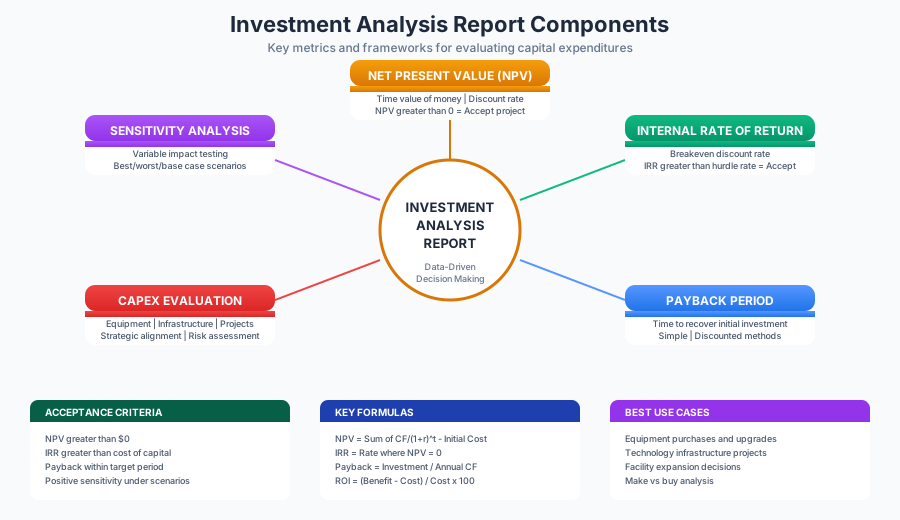
- Key financial metrics - NPV, IRR, payback period at a glance
- Recommendation - Clear accept/reject/defer guidance with rationale
- Critical assumptions - Key variables that drive the analysis
1. Net Present Value (NPV) Analysis
NPV is the gold standard for investment evaluation because it accounts for the time value of money and provides a dollar amount representing the project's value creation.
Formula:
NPV = Sum of [Cash Flow(t) / (1 + r)^t] - Initial Investment

Where:
- Cash Flow(t) = Net cash flow in period t
- r = Discount rate (cost of capital)
- t = Time period
Interpretation:
- NPV > $0 - Project creates value; generally accept
- NPV = $0 - Project breaks even; consider strategic factors
- NPV < $0 - Project destroys value; generally reject
Example Calculation:
Consider a manufacturing equipment investment:
- Initial investment: $500,000
- Annual cash flows: $150,000 for 5 years
- Discount rate: 10%
| Year | Cash Flow | Discount Factor | Present Value |
|---|---|---|---|
| 0 | -$500,000 | 1.000 | -$500,000 |
| 1 | $150,000 | 0.909 | $136,350 |
| 2 | $150,000 | 0.826 | $123,900 |
| 3 | $150,000 | 0.751 | $112,650 |
| 4 | $150,000 | 0.683 | $102,450 |
| 5 | $150,000 | 0.621 | $93,150 |
| Total | $68,500 |
Result: NPV of $68,500 indicates the project creates value and should be accepted.
Key insight: NPV tells you the absolute dollar value a project adds to the organization, making it ideal for comparing projects of different sizes.
2. Internal Rate of Return (IRR)
IRR represents the discount rate at which the NPV equals zero. It provides a percentage return that can be compared against your cost of capital or hurdle rate.
Formula:
0 = Sum of [Cash Flow(t) / (1 + IRR)^t] - Initial Investment

Solve for IRR (typically requires iteration or financial calculator)
Interpretation:
- IRR > Cost of Capital - Project returns exceed required return; accept
- IRR = Cost of Capital - Project earns exactly the required return; neutral
- IRR < Cost of Capital - Project does not meet return requirements; reject
Using the Same Example:
Solving for IRR where NPV = 0:
- IRR = approximately 15.2%
With a 10% cost of capital, this project exceeds the hurdle rate by 5.2 percentage points.
IRR Strengths:
- Easy to understand as a percentage return
- Facilitates comparison across different investment sizes
- Widely used in corporate finance
IRR Limitations:
- Can produce multiple rates for non-conventional cash flows
- Assumes reinvestment at the IRR rate
- May conflict with NPV for mutually exclusive projects
Best practice: Use IRR alongside NPV, not as a replacement. When IRR and NPV conflict for mutually exclusive projects, NPV should take precedence.
3. Payback Period Analysis
Payback period measures how long it takes to recover the initial investment from cash flows. It is particularly useful for assessing liquidity risk and cash flow planning.
Simple Payback Formula:
Payback Period = Initial Investment / Annual Cash Flow

For uneven cash flows:
Payback Period = Years before full recovery + (Remaining amount / Cash flow in recovery year)
Example:
- Initial investment: $500,000
- Annual cash flow: $150,000
- Simple Payback: $500,000 / $150,000 = 3.33 years
Discounted Payback Period:
Discounted payback accounts for the time value of money by using present values of cash flows:
| Year | Cash Flow | PV of Cash Flow | Cumulative PV |
|---|---|---|---|
| 0 | -$500,000 | -$500,000 | -$500,000 |
| 1 | $150,000 | $136,350 | -$363,650 |
| 2 | $150,000 | $123,900 | -$239,750 |
| 3 | $150,000 | $112,650 | -$127,100 |
| 4 | $150,000 | $102,450 | -$24,650 |
| 5 | $150,000 | $93,150 | $68,500 |
Discounted Payback: 4 years + ($24,650 / $93,150) = 4.26 years
Payback Period Guidelines by Industry:
| Industry | Typical Target Payback |
|---|---|
| Technology | 18-36 months |
| Manufacturing | 3-5 years |
| Infrastructure | 5-7 years |
| Real Estate | 7-10 years |
Advanced Analysis: Sensitivity and Scenario Testing
4. Sensitivity Analysis
Sensitivity analysis examines how changes in key variables affect investment outcomes. This is essential for understanding risk and identifying critical assumptions.
Key Variables to Test:
- Revenue projections - What if sales are 10%, 20%, or 30% lower?
- Cost estimates - What if implementation or operating costs exceed budget?
- Discount rate - How sensitive is NPV to changes in cost of capital?
- Project timeline - What if delays extend the payback period?
- Inflation - How do rising costs affect long-term projections?
Sensitivity Analysis Example:
Testing NPV sensitivity to revenue variation for our equipment investment:
| Revenue Scenario | Annual Cash Flow | NPV | Decision |
|---|---|---|---|
| Base Case | $150,000 | $68,500 | Accept |
| -10% Revenue | $135,000 | $11,725 | Accept |
| -20% Revenue | $120,000 | -$45,050 | Reject |
| +10% Revenue | $165,000 | $125,275 | Accept |
| +20% Revenue | $180,000 | $182,050 | Accept |
Key Insight: This project remains viable if revenue decreases by up to 15%, but becomes value-destructive beyond that threshold.
Scenario Analysis
While sensitivity analysis tests one variable at a time, scenario analysis examines multiple variables changing simultaneously:
Base Case Scenario:
- Revenue growth: 5% annually
- Cost inflation: 3% annually
- Discount rate: 10%
- Result: NPV = $68,500
Optimistic Scenario:
- Revenue growth: 8% annually
- Cost inflation: 2% annually
- Discount rate: 8%
- Result: NPV = $145,000
Pessimistic Scenario:
- Revenue growth: 2% annually
- Cost inflation: 5% annually
- Discount rate: 12%
- Result: NPV = -$25,000
Expected Value Calculation:
Assign probabilities to each scenario:
- Optimistic: 25% probability
- Base Case: 50% probability
- Pessimistic: 25% probability
Expected NPV = (0.25 x $145,000) + (0.50 x $68,500) + (0.25 x -$25,000)
Expected NPV = $36,250 + $34,250 - $6,250
Expected NPV = $64,250
Capital Expenditure Evaluation Framework
For major capital expenditures, use this comprehensive framework:
Step 1: Define the Investment
- Project description - What are you investing in?
- Strategic alignment - How does this support business objectives?
- Alternatives considered - What other options were evaluated?
- Timing - Why now versus later?
Step 2: Estimate Costs
Initial Capital Costs:
- Equipment purchase price
- Installation and setup
- Training and change management
- Working capital requirements
- Contingency allowance (typically 10-15%)
Ongoing Operating Costs:
- Maintenance and support
- Labor and staffing
- Materials and supplies
- Energy and utilities
- Insurance and taxes
End-of-Life Costs:
- Disposal or decommissioning
- Salvage value (credit)
- Site remediation if applicable
Step 3: Estimate Benefits
Hard Benefits (Quantifiable):
- Cost savings from efficiency gains
- Revenue increase from expanded capacity
- Reduced labor costs
- Lower material waste
- Energy savings
Soft Benefits (Estimable):
- Improved customer satisfaction
- Enhanced employee productivity
- Better quality and fewer defects
- Competitive positioning
- Risk mitigation
Step 4: Calculate Financial Metrics
Using your cost and benefit estimates:
- Develop cash flow projections for each year of the investment horizon
- Calculate NPV using your organization's cost of capital
- Determine IRR and compare to hurdle rate
- Compute payback period (simple and discounted)
- Perform sensitivity analysis on key variables
Step 5: Assess Non-Financial Factors
- Strategic fit - Does this align with long-term goals?
- Risk profile - What could go wrong?
- Resource requirements - Do we have the capability to execute?
- Opportunity cost - What are we giving up?
- Timing - Is this the right moment?
Step 6: Make Recommendation
Synthesize all analysis into a clear recommendation:
- Accept - Proceed with investment
- Reject - Do not proceed
- Defer - Delay decision pending additional information
- Modify - Proceed with changes to scope, timing, or approach
Real-World Investment Analysis Example
Case Study: Technology Infrastructure Upgrade
Scenario: A mid-sized company is evaluating a $2 million investment in cloud infrastructure to replace aging on-premise servers.
Investment Summary:
| Category | Amount |
|---|---|
| Cloud migration and setup | $400,000 |
| New hardware/equipment | $300,000 |
| Software licensing (Year 1) | $200,000 |
| Training and change management | $150,000 |
| Contingency (15%) | $150,000 |
| Total Initial Investment | $1,200,000 |
Annual Cash Flow Projections:
| Year | Operating Savings | New Costs | Net Cash Flow |
|---|---|---|---|
| 1 | $350,000 | $180,000 | $170,000 |
| 2 | $400,000 | $190,000 | $210,000 |
| 3 | $450,000 | $200,000 | $250,000 |
| 4 | $480,000 | $210,000 | $270,000 |
| 5 | $500,000 | $220,000 | $280,000 |
Financial Analysis (10% Discount Rate):
NPV Calculation:
Year 1: $170,000 / 1.10 = $154,545
Year 2: $210,000 / 1.21 = $173,554
Year 3: $250,000 / 1.331 = $187,829
Year 4: $270,000 / 1.464 = $184,426
Year 5: $280,000 / 1.611 = $173,806

Total PV of Cash Flows: $874,160
NPV = $874,160 - $1,200,000 = -$325,840
Wait - This NPV is Negative!
At first glance, this investment should be rejected. However, let us consider:
Extended Analysis (7-Year Horizon):
| Year | Net Cash Flow | PV at 10% |
|---|---|---|
| 6 | $290,000 | $163,687 |
| 7 | $300,000 | $153,947 |
Revised NPV (7 years): -$325,840 + $163,687 + $153,947 = -$8,206
Intangible Benefits Not Quantified:
- Enhanced security reducing breach risk
- Improved disaster recovery capability
- Greater scalability for growth
- Better employee experience and productivity
- Competitive positioning for digital transformation
Recommendation: Proceed with the investment. While the 7-year NPV is slightly negative, the strategic benefits and risk mitigation value justify the investment. The break-even point occurs in Year 7, with positive returns thereafter.
Investment Analysis Template Checklist
Use this checklist to ensure your investment analysis is complete:
Project Definition:
- Clear description of investment
- Strategic alignment documented
- Alternatives evaluated
- Sponsor and stakeholders identified
Cost Analysis:
- All initial capital costs identified
- Ongoing operating costs estimated
- End-of-life costs considered
- Contingency allowance included
Benefit Analysis:
- Hard benefits quantified
- Soft benefits estimated
- Revenue impacts modeled
- Cost savings documented
Financial Metrics:
- NPV calculated
- IRR determined
- Payback period computed
- ROI percentage calculated
Risk Assessment:
- Sensitivity analysis performed
- Scenario analysis completed
- Key risks identified
- Mitigation strategies outlined
Documentation:
- Executive summary prepared
- Assumptions clearly stated
- Data sources documented
- Recommendation clearly articulated
Common Investment Analysis Mistakes to Avoid
Mistake 1: Ignoring the Time Value of Money
The Error: Using simple ROI or undiscounted payback for multi-year projects.
Why It Matters: $100,000 received in 5 years is worth significantly less than $100,000 today due to inflation and opportunity cost.
The Fix: Always use NPV and discounted payback for projects exceeding one year.
Mistake 2: Underestimating Implementation Costs
The Error: Focusing only on purchase price while ignoring installation, training, integration, and change management costs.
Why It Matters: Hidden costs often represent 30-50% of total project cost.
The Fix: Use a total cost of ownership approach and include contingency.
Mistake 3: Overly Optimistic Revenue Projections
The Error: Building the business case on best-case revenue assumptions.
Why It Matters: Projects that only work under optimistic scenarios frequently disappoint.
The Fix: Use conservative estimates and stress-test with sensitivity analysis.
Mistake 4: Ignoring Opportunity Cost
The Error: Evaluating a project in isolation without considering alternative uses of capital.
Why It Matters: Accepting a 12% return project means rejecting other projects that might return 15%.
The Fix: Compare projects against alternatives and consider capital constraints.
Mistake 5: Analysis Paralysis
The Error: Seeking perfect information before making any decision.
Why It Matters: Delayed decisions have their own cost, and perfect information never exists.
The Fix: Set decision timelines and accept that some uncertainty is inherent.
Implementing Investment Analysis in Your Organization
Establish Approval Thresholds
Create clear guidelines for investment approval levels:
| Investment Size | Approval Authority | Analysis Required |
|---|---|---|
| Under $50K | Department Manager | Simple ROI |
| $50K - $250K | VP/Director | NPV + Payback |
| $250K - $1M | Executive Team | Full Analysis |
| Over $1M | Board of Directors | Full Analysis + External Review |
Create Standardized Templates
Develop templates that ensure consistency:
- Investment proposal form - Standard format for submitting requests
- Financial analysis workbook - Excel template with NPV, IRR, payback formulas
- Risk assessment matrix - Framework for identifying and scoring risks
- Post-implementation review - Template for comparing actual vs projected results
Train Decision Makers
Ensure stakeholders understand:
- How to interpret NPV, IRR, and payback metrics
- When different metrics are most appropriate
- How to evaluate sensitivity analysis results
- Common pitfalls and how to avoid them
Conclusion
A robust investment analysis process is essential for making sound capital allocation decisions. By applying NPV, IRR, payback period analysis, and sensitivity testing systematically, you can:
- Evaluate investments objectively using proven financial metrics
- Compare projects of different sizes and durations fairly
- Understand risk exposure through scenario and sensitivity analysis
- Communicate investment rationale clearly to stakeholders
- Track performance against projections post-implementation
The key is consistency. Apply the same rigorous framework to every significant investment decision, document your assumptions clearly, and learn from both successes and failures.
Related Resources:
- TCO vs ROI: Which to Use When - Comprehensive comparison guide
- Financial Planning Templates for Business Growth - Essential planning tools
- Total Cost of Ownership Analysis Guide - Complete TCO methodology
Start building your investment analysis capability today with professional templates that incorporate all the methodologies covered in this guide. Your future capital allocation decisions will thank you.