AI Acceptable Use Policy Template: Enterprise Guidelines for Generative AI

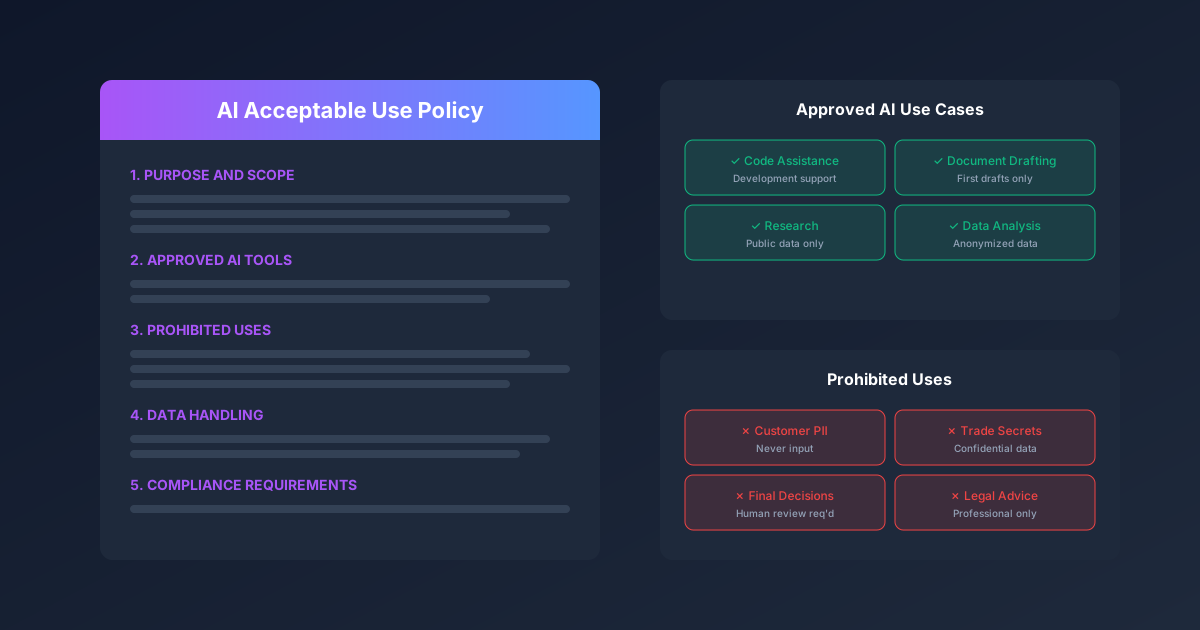
Generative AI has transformed workplace productivity—but it's also created unprecedented risks. Employees using ChatGPT, Copilot, and other AI tools without guidelines have inadvertently exposed confidential data, created legal liabilities, and generated compliance violations.
A well-crafted AI acceptable use policy balances innovation with protection. This guide provides a comprehensive template for governing AI use in enterprise environments, covering data security, intellectual property, compliance, and responsible use.
For related governance resources, explore our IT Management Hub, Security & Compliance Center, and IT Governance Framework Guide. For policy templates, see our IT Policy Templates.
Why Your Organization Needs an AI Policy Now
The Urgency Problem
Data Exposure Incidents:
- Samsung engineers leaked proprietary code to ChatGPT (2023)
- Law firms submitted AI-generated briefs with fabricated citations
- Healthcare workers shared patient data with AI assistants
- Financial analysts exposed trading strategies to AI tools
Regulatory Pressure:
- EU AI Act requires governance frameworks
- SEC scrutinizing AI use in financial services
- HIPAA implications for healthcare AI use
- State privacy laws apply to AI data processing
Liability Risks:
- Copyright infringement from AI-generated content
- Discrimination from biased AI outputs
- Contractual breaches from confidentiality violations
- Professional liability for AI-assisted decisions
Policy Adoption Statistics
| Industry | Companies with AI Policy | Average Time to Implement |
|---|---|---|
| Financial Services | 78% | 3-6 months |
| Healthcare | 65% | 4-8 months |
| Technology | 82% | 2-4 months |
| Manufacturing | 45% | 6-12 months |
| Retail | 38% | 6-12 months |
| Average | 62% | 4-7 months |
AI Acceptable Use Policy Template
Section 1: Purpose and Scope
1.1 Purpose
This Artificial Intelligence Acceptable Use Policy ("Policy") establishes guidelines for the responsible use of generative AI tools and services by [Company Name] employees, contractors, and authorized third parties. The Policy aims to:
- Enable productivity benefits while protecting organizational assets
- Ensure compliance with legal and regulatory requirements
- Mitigate data security and privacy risks
- Maintain ethical standards and professional integrity
- Preserve intellectual property rights
1.2 Scope
This Policy applies to:
- All employees, contractors, consultants, and temporary workers
- All generative AI tools including but not limited to:
- Large language models (ChatGPT, Claude, Gemini, Llama)
- Code assistants (GitHub Copilot, Amazon CodeWhisperer, Tabnine)
- Image generators (DALL-E, Midjourney, Stable Diffusion)
- Voice and video AI (ElevenLabs, Synthesia, HeyGen)
- AI-powered productivity tools (Notion AI, Grammarly, Jasper)
- Both company-approved and personal AI tools used for work purposes
- AI features embedded in enterprise software (Microsoft 365 Copilot, Salesforce Einstein)
1.3 Definitions
| Term | Definition |
|---|---|
| Generative AI | AI systems that create new content (text, code, images, audio, video) |
| Prompt | Input provided to an AI system to generate output |
| Confidential Data | Information classified as confidential, restricted, or internal-only per the Data Classification Policy |
| Approved AI Tools | AI services vetted and approved by IT Security and Legal |
| Personal AI Tools | AI services accessed outside company-provided accounts |
Section 2: Data Protection Requirements
2.1 Prohibited Data Inputs
The following data types must NEVER be entered into generative AI tools:
Category A: Strictly Prohibited
- Personally Identifiable Information (PII) of customers, employees, or partners
- Protected Health Information (PHI) under HIPAA
- Payment Card Industry (PCI) data
- Social Security Numbers, government IDs
- Authentication credentials, API keys, passwords
- Customer lists and contact information
Category B: Prohibited Without Explicit Approval
- Source code from proprietary systems
- Trade secrets and intellectual property
- Financial data and projections
- Legal documents and contracts
- Strategic plans and M&A information
- Security configurations and architecture
Category C: Requires Sanitization
- Internal documents (remove names, dates, specifics)
- Process descriptions (anonymize references)
- Technical specifications (remove identifying details)
2.2 Data Classification Quick Reference
| Classification | Can Use with AI? | Conditions |
|---|---|---|
| Public | ✅ Yes | No restrictions |
| Internal | ⚠️ Limited | Sanitize identifying information |
| Confidential | ❌ No | Never input to AI tools |
| Restricted | ❌ No | Never input to AI tools |
2.3 Safe Prompting Guidelines
✅ Acceptable:
"Explain the concept of microservices architecture
and when to use it."

"Write a Python function that validates email
addresses using regex."

"Create a template for a project status report."
❌ Prohibited:
"Summarize this customer contract: [paste contract]"

"Debug this code from our payment system: [paste code]"

"Write a response to this customer complaint:
Dear Mr. Johnson at 123 Main St..."
Section 3: Approved Tools and Access
3.1 Approved AI Tools
[Company Name] has evaluated and approved the following AI tools for business use:
| Tool | Approved Use Cases | Data Restrictions | Access Level |
|---|---|---|---|
| Microsoft 365 Copilot | Document drafting, email, analysis | Enterprise data (within tenant) | All employees |
| GitHub Copilot Business | Code completion, documentation | Non-confidential code | Engineering |
| Grammarly Business | Writing assistance | No confidential content | All employees |
| [Internal AI Platform] | [Specific use cases] | Approved for confidential | [Departments] |
3.2 Prohibited Tools
The following AI tools are prohibited for work use due to data retention or security concerns:
- Consumer versions of ChatGPT (free tier)
- Bard/Gemini personal accounts
- Unvetted open-source AI models
- AI tools from non-approved vendors
- Browser extensions with AI features (unless approved)
3.3 Tool Request Process
To request approval for a new AI tool:
- Submit AI Tool Request Form to IT Security
- Provide business justification and use cases
- Legal reviews terms of service and data handling
- IT Security conducts technical assessment
- Privacy team evaluates data protection impact
- Approval/denial communicated within 15 business days
Section 4: Acceptable Use Guidelines
4.1 Permitted Uses
AI tools may be used for:
- Research and Learning: Exploring concepts, understanding technologies
- Drafting Assistance: Creating first drafts of non-confidential documents
- Code Assistance: Writing boilerplate code, debugging public code examples
- Creative Work: Generating ideas, brainstorming, outlining
- Productivity: Summarizing public information, formatting documents
- Communication: Improving grammar, tone adjustment (non-confidential content)
4.2 Prohibited Uses
AI tools must NOT be used for:
- Submitting AI output as original work without disclosure
- Making automated decisions affecting employment, credit, or legal rights
- Creating deepfakes or synthetic media of real people
- Generating content that violates laws or company policies
- Bypassing security controls or access restrictions
- Processing data subject to legal holds
- Replacing required human judgment in regulated activities
4.3 Human Oversight Requirements
All AI-generated output requires human review before:
| Output Type | Review Requirement | Reviewer |
|---|---|---|
| External communications | Manager approval | Direct supervisor |
| Code deployment | Code review | Senior engineer |
| Legal/compliance content | Legal review | Legal department |
| Financial analysis | Validation | Finance team |
| Customer-facing content | Quality check | Content owner |
| Strategic recommendations | Business judgment | Decision maker |
4.4 Disclosure Requirements
Employees must disclose AI assistance when:
- Content will be published externally (with exceptions for grammar/editing)
- Work product will be submitted to clients or regulators
- Requested by supervisors or stakeholders
- Creating content for legal, financial, or compliance purposes
Disclosure format: "This document was created with AI assistance and reviewed by [Name]."
Section 5: Intellectual Property and Copyright
5.1 Ownership of AI Outputs
- AI-generated content created during employment using company resources is company property
- Employees do not retain rights to AI outputs created for work purposes
- Third-party IP rights in AI outputs remain with respective owners
5.2 Copyright Considerations
- AI-generated content may not qualify for copyright protection
- Do not claim copyright on purely AI-generated works
- Human creative contribution required for copyright claims
- Document human contributions to AI-assisted works
5.3 Third-Party Content
- Do not input copyrighted materials without license
- AI outputs may inadvertently reproduce copyrighted content
- Review outputs for potential infringement before use
- Report suspected copyright issues to Legal
5.4 Trade Secret Protection
- Never input trade secrets into AI tools
- AI outputs do not qualify as trade secrets without independent development
- Competitors may have access to similar AI outputs
- Document independent human analysis for competitive work
Section 6: Compliance and Regulatory Requirements
6.1 Industry-Specific Requirements
Financial Services (SEC, FINRA, OCC):
- AI use must comply with fair lending requirements
- Model risk management applies to AI models
- Recordkeeping requirements include AI interactions
- Fiduciary duties require human judgment
Healthcare (HIPAA, FDA):
- No PHI in consumer AI tools
- AI clinical recommendations require physician review
- Medical device regulations may apply to AI tools
- Document AI use in clinical decision support
Legal Services:
- AI cannot provide legal advice
- Attorneys responsible for AI-assisted work product
- Confidentiality obligations supersede AI convenience
- Court filings require verification of AI content
6.2 Privacy Compliance
- GDPR: Data minimization applies to AI inputs
- CCPA: Disclosure required for AI processing
- State privacy laws: Varies by jurisdiction
- International transfers: Verify AI vendor data locations
6.3 Recordkeeping
Retain records of AI interactions when:
- Used for regulated activities
- Part of audit trail requirements
- Subject to litigation holds
- Required by industry regulations
Retention period: [X years] or as required by applicable regulations.
Section 7: Security Requirements
7.1 Access Controls
- Use company-provided AI tool accounts only
- Enable multi-factor authentication where available
- Do not share AI tool credentials
- Report compromised accounts immediately
7.2 Network Security
- Access approved AI tools through corporate network or VPN
- Do not use AI tools on public Wi-Fi for work purposes
- Browser security extensions must remain active
- Do not bypass content filtering for AI access
7.3 Endpoint Security
- AI tools approved for mobile devices: [List]
- Personal devices must meet security requirements
- AI browser extensions require IT approval
- Local AI models require security assessment
7.4 Incident Reporting
Report immediately to IT Security if:
- Confidential data was inadvertently submitted to AI
- AI tool was compromised or behaved unexpectedly
- Suspicious AI-generated content was received
- AI tool requested unusual permissions
Implementation Checklist
Phase 1: Foundation (Weeks 1-4)
- Executive sponsor identified
- Cross-functional team assembled (IT, Legal, HR, Compliance)
- Current AI usage assessed
- Risk assessment completed
- Policy draft created
Phase 2: Review and Approval (Weeks 5-8)
- Legal review completed
- IT Security review completed
- Privacy impact assessment done
- HR review for employment implications
- Executive approval obtained
- Board notification (if required)
Phase 3: Communication and Training (Weeks 9-12)
- Policy published to all employees
- Training materials developed
- Mandatory training sessions scheduled
- FAQ document created
- Help desk trained on AI questions
- Reporting mechanisms established
Phase 4: Operationalization (Ongoing)
- Monitoring tools configured
- Exception request process active
- Compliance auditing scheduled
- Policy review calendar set
- Incident response procedures tested
Training Requirements
Required Training Modules
Module 1: AI Fundamentals (30 minutes)
- What is generative AI
- How AI tools process data
- Data retention and privacy risks
Module 2: Policy Overview (45 minutes)
- Key policy requirements
- Prohibited vs. permitted uses
- Data classification review
Module 3: Safe Prompting (30 minutes)
- Writing effective prompts
- Avoiding data exposure
- Sanitization techniques
Module 4: Role-Specific Training (varies)
- Engineering: Code assistant guidelines
- Legal: AI in legal work
- HR: AI in employment decisions
- Finance: AI in financial analysis
Training Completion Requirements
| Role | Required Modules | Deadline | Renewal |
|---|---|---|---|
| All Employees | 1, 2, 3 | 30 days | Annual |
| Engineers | 1, 2, 3, 4 | 30 days | Annual |
| Managers | 1, 2, 3 + Manager Module | 30 days | Annual |
| Executives | 1, 2 + Executive Briefing | 30 days | Annual |
Exception Request Process
When to Request an Exception
Exceptions may be appropriate for:
- Innovative use cases not covered by policy
- Tools under evaluation for broader deployment
- Research and development projects
- Pilot programs with enhanced controls
Exception Request Form
| Field | Description |
|---|---|
| Requestor | Name, department, manager |
| AI Tool | Specific tool or capability |
| Use Case | Detailed description of intended use |
| Data Types | What data will be processed |
| Business Justification | Why this exception is needed |
| Risk Mitigation | Proposed safeguards |
| Duration | Time period for exception |
| Review Checkpoint | When to evaluate continuation |
Approval Workflow
- Department Manager: Business justification review
- IT Security: Technical risk assessment
- Legal: Compliance and liability review
- Privacy: Data protection impact
- CISO/CIO: Final approval for significant exceptions
Approval timeline: 10-15 business days
Enforcement and Consequences
Violation Categories
Category 1: Minor Violations
- First-time unintentional policy deviation
- No data exposure occurred
- Self-reported promptly
Consequence: Verbal warning, additional training
Category 2: Moderate Violations
- Repeated minor violations
- Data exposure with low risk
- Failure to follow approved processes
Consequence: Written warning, mandatory training, temporary access restriction
Category 3: Serious Violations
- Confidential data exposure
- Intentional policy circumvention
- Regulatory compliance breach
Consequence: Suspension, formal investigation, potential termination
Category 4: Severe Violations
- Trade secret disclosure
- Patient/customer data breach
- Legal/regulatory action triggered
Consequence: Immediate suspension, termination, potential legal action
Investigation Process
- Incident reported to IT Security
- Initial assessment within 24 hours
- Evidence preservation
- Investigation team assigned
- Employee interview
- Findings documented
- Consequence determination
- Remediation implemented
- Lessons learned captured
Monitoring and Compliance
Technical Monitoring
| Monitoring Type | Scope | Frequency |
|---|---|---|
| DLP scanning | AI tool traffic | Real-time |
| Usage analytics | Approved tools | Weekly |
| Prompt auditing | Enterprise AI | Sampled |
| Access logs | All AI tools | Continuous |
Compliance Auditing
Quarterly Reviews:
- Policy exception status
- Training completion rates
- Incident trend analysis
- Tool inventory update
Annual Reviews:
- Full policy review
- Regulatory update assessment
- Technology landscape scan
- Effectiveness evaluation
Key Metrics
| Metric | Target | Measurement |
|---|---|---|
| Training completion | 100% | LMS tracking |
| Incident response time | < 4 hours | Ticket system |
| Exception request time | < 15 days | Workflow tracking |
| Policy awareness | > 90% | Survey |
| Compliance rate | > 95% | Audit findings |
Policy Governance
Policy Review Schedule
- Quarterly: Approved tools list update
- Semi-Annual: Training content refresh
- Annual: Full policy review
- Ad-Hoc: Regulatory changes, major incidents, new technology
Change Management
- Change proposed by policy owner or stakeholder
- Impact assessment conducted
- Stakeholder review (Legal, IT, HR, Compliance)
- Approval by policy sponsor
- Communication plan executed
- Training updated if needed
- Effective date announced
Related Policies
This policy should be read in conjunction with:
- Information Security Policy
- Data Classification Policy
- Acceptable Use Policy
- Privacy Policy
- Intellectual Property Policy
- Employee Code of Conduct
- Remote Work Policy
Key Takeaways
-
Protect confidential data: Never input PII, PHI, trade secrets, or proprietary code into AI tools
-
Use approved tools only: Company-vetted AI tools have appropriate security and privacy controls
-
Human oversight required: AI outputs must be reviewed before external use or critical decisions
-
Disclose AI assistance: Be transparent about AI involvement in work products
-
Report incidents immediately: Quick reporting minimizes damage from data exposure
-
Stay current: AI technology and regulations evolve rapidly—complete refresher training
For related governance resources, explore our IT Governance KPIs Dashboard Guide, Security Policy Review Checklist, and HR Policy Templates.