SaaS Metrics Dashboard Template: Track MRR, Churn, LTV & Key KPIs

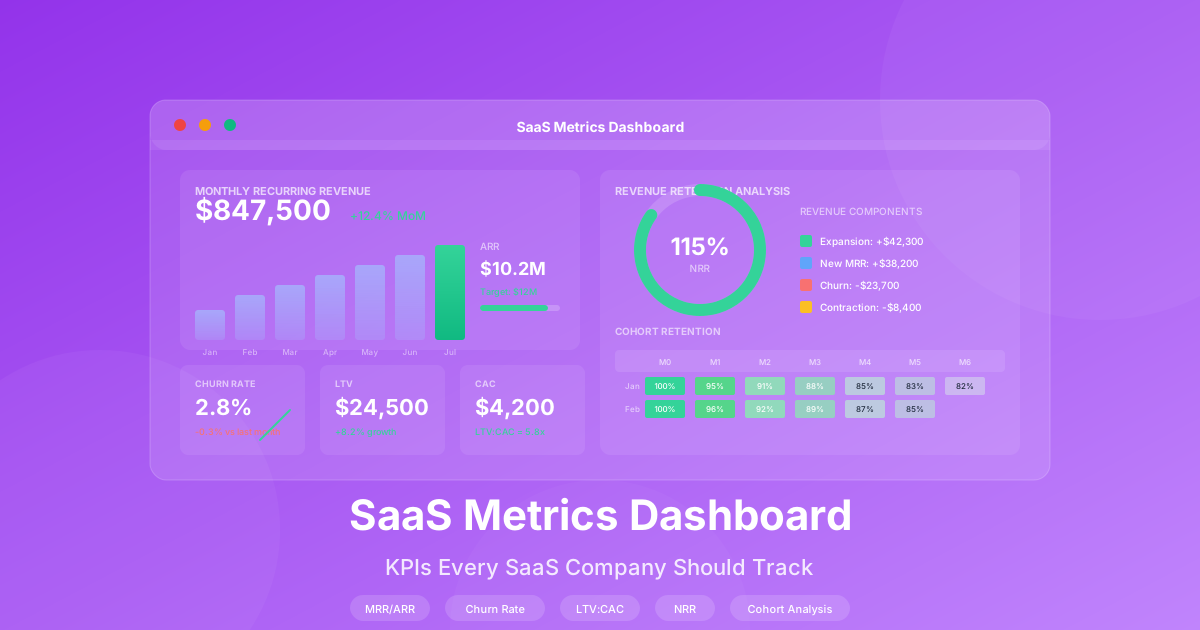
SaaS Metrics Dashboard Template: Track MRR, Churn, LTV & Key KPIs
For: SaaS founders, CFOs, finance teams, and operations leaders managing subscription businesses Goal: Build a comprehensive metrics dashboard that provides real-time visibility into business health Outcome: Data-driven decision making, investor-ready reporting, and early warning of growth issues
For comprehensive financial planning resources, visit our Financial Planning Hub and Analysis section. For revenue forecasting methodologies, explore our Revenue Forecasting Template guide.
Quick Start: SaaS businesses live and die by their metrics. A well-designed dashboard transforms raw data into actionable insights, helping you spot trends, identify problems early, and make confident decisions about growth investments.
Why SaaS Metrics Matter
Subscription businesses operate differently from traditional companies. Revenue recognition, customer relationships, and growth dynamics follow unique patterns that require specialized tracking. Without proper metrics visibility, you are flying blind.
The Cost of Metrics Blindness
| Gap | Business Impact |
|---|---|
| No MRR tracking | Cannot forecast revenue or plan resources |
| Ignoring churn | Revenue erosion goes unnoticed until crisis |
| Unknown CAC | Overspending on unprofitable customer acquisition |
| Missing LTV | Cannot evaluate customer segment profitability |
| No cohort analysis | Cannot identify retention improvement opportunities |
What Great Metrics Tracking Enables
- Strategic confidence in growth investments and hiring plans
- Early warning of churn acceleration or growth slowdown
- Investor readiness with professional, auditable reporting
- Operational clarity for sales, marketing, and customer success teams
- Benchmarking against industry standards and competitors
The SaaS Metrics Framework
Before building your dashboard, understand how metrics interconnect. The AARRR framework (Acquisition, Activation, Revenue, Retention, Referral) provides a foundation for organizing your KPIs.

Core Revenue Metrics: MRR and ARR
Monthly Recurring Revenue (MRR) and Annual Recurring Revenue (ARR) are the foundational metrics for any SaaS business. Every other metric builds from these calculations.
MRR Calculation Formula
MRR = Number of Active Customers x Average Revenue Per Account (ARPA)

Alternative calculation:
MRR = Sum of all active subscription values (monthly basis)
For annual contracts:
MRR Contribution = Annual Contract Value / 12
MRR Components Breakdown
Track MRR by component to understand growth dynamics:
| MRR Type | Formula | Description |
|---|---|---|
| New MRR | Sum of first-month revenue from new customers | Growth from customer acquisition |
| Expansion MRR | Revenue increase from existing customers | Upsells, cross-sells, seat additions |
| Contraction MRR | Revenue decrease from existing customers | Downgrades, seat removals |
| Churned MRR | Revenue lost from cancelled customers | Complete customer losses |
| Reactivation MRR | Revenue from returning customers | Win-backs |
The MRR Waterfall
Ending MRR = Starting MRR + New MRR + Expansion MRR
             - Contraction MRR - Churned MRR + Reactivation MRR
Example monthly calculation:
| Component | Amount | Notes |
|---|---|---|
| Starting MRR | $500,000 | Beginning of month |
| + New MRR | $42,000 | 28 new customers at $1,500 ARPA |
| + Expansion MRR | $25,000 | 5% expansion rate |
| - Contraction MRR | $8,000 | 1.6% contraction |
| - Churned MRR | $15,000 | 3% logo churn |
| + Reactivation MRR | $3,000 | 2 returning customers |
| Ending MRR | $547,000 | Net growth: 9.4% |
ARR Calculation
ARR = MRR x 12

or for annual contracts directly:
ARR = Sum of all active annual contract values
ARR is the standard metric for enterprise SaaS companies and is preferred by investors for valuations. Companies above $10M ARR typically report ARR rather than MRR.
MRR/ARR Dashboard Components
Your dashboard should display:
- Current MRR/ARR - Large, prominent display
- MRR Growth Rate - Month-over-month and year-over-year
- MRR Waterfall Chart - Visual breakdown of components
- MRR Trend Line - 12-24 month historical view
- ARR Target Progress - Against annual goals
Churn Rate Analysis
Churn is the silent killer of SaaS businesses. Even small differences in churn rates compound dramatically over time.
Types of Churn
| Churn Type | Formula | What It Measures |
|---|---|---|
| Logo Churn | (Lost Customers / Starting Customers) x 100 | Customer retention |
| Revenue Churn | (Churned MRR / Starting MRR) x 100 | Revenue retention |
| Gross Revenue Churn | (Churned MRR + Contraction MRR) / Starting MRR x 100 | Total revenue loss |
| Net Revenue Churn | (Churned + Contraction - Expansion) / Starting MRR x 100 | Net revenue change |
Churn Rate Formulas
Monthly Logo Churn Rate:
Logo Churn Rate = (Customers Lost During Month / Customers at Start of Month) x 100
Monthly Revenue Churn Rate:
Revenue Churn Rate = (MRR Lost to Churn / MRR at Start of Month) x 100
Annual Churn Rate (from monthly):
Annual Churn = 1 - (1 - Monthly Churn Rate)^12

Example:
Monthly churn of 3% = 1 - (1 - 0.03)^12 = 1 - 0.694 = 30.6% annual churn
SaaS Churn Benchmarks
| Business Type | Good Monthly Churn | Excellent Monthly Churn |
|---|---|---|
| SMB SaaS | Under 5% | Under 3% |
| Mid-Market SaaS | Under 2% | Under 1% |
| Enterprise SaaS | Under 1% | Under 0.5% |
Important: These are logo churn rates. Revenue churn should be even lower, and net revenue retention should ideally exceed 100%.
The Churn Compounding Problem
Small churn differences have massive long-term impact:
| Starting ARR | 2% Monthly Churn | 5% Monthly Churn | Difference |
|---|---|---|---|
| Year 1 | $78M remaining | $54M remaining | $24M gap |
| Year 2 | $61M remaining | $29M remaining | $32M gap |
| Year 3 | $48M remaining | $16M remaining | $32M gap |
Reducing churn from 5% to 2% monthly is equivalent to tripling your effective customer lifetime.
Churn Dashboard Components
Include these churn visualizations:
- Current Churn Rate - Logo and revenue, with trend arrows
- Churn Trend Chart - 12-month view with trendline
- Churn by Segment - By plan tier, industry, or customer size
- Churned Customer List - Recent churns with reasons
- At-Risk Customers - Health score warnings
Customer Lifetime Value (LTV)
LTV measures the total revenue you can expect from a customer over their entire relationship. This metric is critical for understanding acquisition economics.
LTV Calculation Methods
Simple LTV Formula:
LTV = ARPA x Gross Margin % x (1 / Monthly Churn Rate)

Example:
ARPA = $500/month
Gross Margin = 80%
Monthly Churn = 2.5%

LTV = $500 x 0.80 x (1 / 0.025) = $500 x 0.80 x 40 = $16,000
Alternative LTV (using customer lifetime):
Customer Lifetime (months) = 1 / Monthly Churn Rate
LTV = ARPA x Customer Lifetime x Gross Margin %
Cohort-Based LTV (most accurate):
LTV = Sum of (Monthly Revenue x Retention Rate) for all future months

Month 1: $500 x 100% = $500
Month 2: $500 x 97.5% = $487.50
Month 3: $500 x 95% = $475
...
Sum all months to get cohort LTV
LTV by Customer Segment
Different customer segments have dramatically different LTVs:
| Segment | ARPA | Churn Rate | Gross Margin | LTV |
|---|---|---|---|---|
| Starter | $99/mo | 5% | 85% | $1,683 |
| Professional | $299/mo | 3% | 82% | $8,174 |
| Enterprise | $999/mo | 1% | 78% | $77,922 |
This analysis reveals where to focus acquisition and retention efforts.
LTV Dashboard Components
- Overall LTV - Company-wide average
- LTV by Plan/Tier - Segment comparison
- LTV Trend - Tracking improvement over time
- LTV:CAC Ratio - Unit economics health check
- Customer Lifetime - Average months retained
Customer Acquisition Cost (CAC)
CAC measures the total cost to acquire a new customer. Understanding CAC is essential for sustainable growth.
CAC Calculation Formula
Blended CAC:
CAC = (Total Sales & Marketing Expenses) / (Number of New Customers Acquired)

Include:
- Marketing spend (ads, content, events)
- Sales salaries and commissions
- Sales tools and technology
- Marketing tools and technology
- Related overhead
Example:
Monthly S&M Spend: $150,000
New Customers: 50

CAC = $150,000 / 50 = $3,000 per customer
CAC by Channel
Track CAC by acquisition source to optimize spend:
| Channel | Monthly Spend | New Customers | CAC | LTV:CAC |
|---|---|---|---|---|
| Paid Search | $40,000 | 20 | $2,000 | 8.0x |
| Content Marketing | $25,000 | 15 | $1,667 | 9.6x |
| Outbound Sales | $60,000 | 12 | $5,000 | 3.2x |
| Referrals | $10,000 | 8 | $1,250 | 12.8x |
| Events | $15,000 | 5 | $3,000 | 5.3x |
| TOTAL | $150,000 | 60 | $2,500 | 6.4x |
CAC Payback Period
CAC payback measures how long it takes to recover acquisition costs:
CAC Payback (months) = CAC / (ARPA x Gross Margin %)

Example:
CAC = $3,000
ARPA = $500/month
Gross Margin = 80%

Payback = $3,000 / ($500 x 0.80) = $3,000 / $400 = 7.5 months
CAC Payback Benchmarks
| Payback Period | Assessment | Action |
|---|---|---|
| Under 6 months | Excellent | Invest more in acquisition |
| 6-12 months | Good | Healthy economics |
| 12-18 months | Acceptable | Monitor and optimize |
| 18-24 months | Concerning | Reduce CAC or improve monetization |
| Over 24 months | Problematic | Urgent action required |
The LTV:CAC Ratio
The LTV:CAC ratio is the single most important metric for evaluating SaaS unit economics.
LTV:CAC Calculation
LTV:CAC Ratio = Customer Lifetime Value / Customer Acquisition Cost

Example:
LTV = $16,000
CAC = $3,000
LTV:CAC = 16,000 / 3,000 = 5.3x
LTV:CAC Benchmarks and Interpretation
| LTV:CAC Ratio | Interpretation | Recommendation |
|---|---|---|
| Under 1:1 | Losing money on every customer | Stop acquisition spending |
| 1:1 to 2:1 | Marginally viable | Improve unit economics urgently |
| 2:1 to 3:1 | Break-even to slight profit | Optimize before scaling |
| 3:1 to 5:1 | Healthy economics | Scale acquisition confidently |
| Over 5:1 | Strong economics | May be under-investing in growth |
Target: 3:1 minimum, 5:1 ideal for most SaaS businesses.
LTV:CAC Dashboard Display
Your dashboard should prominently feature:
- Current LTV:CAC Ratio - Large display with benchmark indicator
- Ratio Trend - Tracking improvement over time
- Ratio by Segment - Identify most profitable customers
- Ratio by Channel - Guide acquisition investment
- Payback Period - Complementary cash flow metric
Net Revenue Retention (NRR)
NRR measures how much revenue you retain and expand from existing customers, excluding new customer acquisition.
NRR Calculation
NRR = ((Starting MRR + Expansion - Contraction - Churn) / Starting MRR) x 100

Example:
Starting MRR: $500,000
Expansion MRR: $30,000
Contraction MRR: $10,000
Churned MRR: $15,000

NRR = (($500,000 + $30,000 - $10,000 - $15,000) / $500,000) x 100
NRR = ($505,000 / $500,000) x 100 = 101%
NRR Benchmarks
| NRR Range | Assessment | Typical Business Type |
|---|---|---|
| Under 80% | Poor | High churn, no expansion |
| 80-90% | Below average | SMB with limited upsell |
| 90-100% | Average | Standard SMB SaaS |
| 100-110% | Good | Healthy mid-market |
| 110-120% | Excellent | Strong expansion motion |
| 120-140% | World-class | Enterprise with land-and-expand |
| Over 140% | Exceptional | Rare, typically usage-based |
Best-in-class public SaaS companies report NRR above 120%. Snowflake, Twilio, and Datadog have reported NRR above 150%.
Why NRR Above 100% Matters
NRR above 100% means your existing customer base generates more revenue each year, even without adding new customers:
| Year | Starting ARR | 90% NRR | 110% NRR | 130% NRR |
|---|---|---|---|---|
| 1 | $10M | $10M | $10M | $10M |
| 2 | - | $9M | $11M | $13M |
| 3 | - | $8.1M | $12.1M | $16.9M |
| 4 | - | $7.3M | $13.3M | $22.0M |
| 5 | - | $6.6M | $14.6M | $28.6M |
With 130% NRR, you nearly triple revenue from existing customers in 5 years, without acquiring anyone new.
Cohort Analysis
Cohort analysis tracks customer behavior over time by grouping customers based on when they were acquired. This reveals retention patterns and product/market improvements.
Building a Cohort Retention Table
Group customers by acquisition month and track retention at each subsequent month:
| Cohort | M0 | M1 | M2 | M3 | M6 | M12 |
|---|---|---|---|---|---|---|
| Jan 2024 | 100% | 95% | 91% | 88% | 82% | 75% |
| Feb 2024 | 100% | 96% | 92% | 89% | 84% | 77% |
| Mar 2024 | 100% | 96% | 93% | 91% | 86% | - |
| Apr 2024 | 100% | 97% | 94% | 92% | - | - |
| May 2024 | 100% | 97% | 95% | - | - | - |
Read vertically: Older cohorts have more data points Read horizontally: Retention decay over customer lifetime Read diagonally: Retention improvement over time
Revenue Cohort Analysis
Track revenue retention (not just logo retention) to capture expansion and contraction:
| Cohort | M0 | M3 | M6 | M12 |
|---|---|---|---|---|
| Jan 2024 | $100K | $95K | $102K | $108K |
| Feb 2024 | $120K | $118K | $128K | $135K |
| Mar 2024 | $90K | $91K | $99K | - |
Revenue cohorts above 100% at later months indicate strong expansion offsetting churn.
Cohort Analysis Dashboard Components
- Cohort Retention Heatmap - Color-coded retention table
- Retention Curve Chart - Overlay multiple cohorts
- Cohort Comparison - Side-by-side monthly progression
- Revenue vs Logo Retention - Dual-axis chart
- Cohort LTV Projection - Estimated lifetime value by cohort
Building Your SaaS Metrics Dashboard
Essential Dashboard Sections
Section 1: Executive Summary
- ARR/MRR with growth rate
- Net Revenue Retention
- LTV:CAC ratio
- Gross margin
Section 2: Revenue Deep Dive
- MRR waterfall
- Revenue by segment
- ARPA trends
- Contract value distribution
Section 3: Customer Health
- Churn rates (logo and revenue)
- Cohort retention curves
- Customer health scores
- At-risk customer alerts
Section 4: Acquisition Efficiency
- CAC by channel
- CAC payback period
- Conversion funnel metrics
- Trial-to-paid rates
Section 5: Forecasting
- MRR projections (3 scenarios)
- Churn forecast
- Pipeline coverage
- Target attainment probability
Excel Formulas for SaaS Metrics
MRR Growth Rate:
=((Current_MRR - Previous_MRR) / Previous_MRR) * 100Monthly Churn Rate:
=(Churned_MRR / Starting_MRR) * 100LTV Calculation:
=(ARPA * Gross_Margin) / Monthly_Churn_RateCAC Calculation:
=SUMIF(Expenses, "Sales & Marketing") / New_CustomersLTV:CAC Ratio:
=LTV / CACNRR Calculation:
=((Starting_MRR + Expansion - Contraction - Churn) / Starting_MRR) * 100CAC Payback (months):
=CAC / (ARPA * Gross_Margin)Visualization Best Practices
MRR/ARR: Use area charts to show growth over time
Churn: Line charts with trend lines, benchmark reference lines
Cohort Retention: Heatmaps with color gradients (green to red)
LTV:CAC: Gauge charts or large number displays with benchmarks
Waterfall Charts: For MRR movement breakdown
Industry Benchmarks Reference
Comprehensive SaaS Benchmarks Table
| Metric | Poor | Average | Good | Excellent |
|---|---|---|---|---|
| Annual Growth Rate | Under 20% | 20-40% | 40-70% | Over 70% |
| Gross Margin | Under 60% | 60-70% | 70-80% | Over 80% |
| Monthly Churn (SMB) | Over 5% | 3-5% | 2-3% | Under 2% |
| Monthly Churn (Enterprise) | Over 2% | 1-2% | 0.5-1% | Under 0.5% |
| Net Revenue Retention | Under 90% | 90-100% | 100-120% | Over 120% |
| LTV:CAC Ratio | Under 2:1 | 2:1-3:1 | 3:1-5:1 | Over 5:1 |
| CAC Payback | Over 18 mo | 12-18 mo | 6-12 mo | Under 6 mo |
| Rule of 40 | Under 20 | 20-30 | 30-40 | Over 40 |
The Rule of 40
The Rule of 40 combines growth rate and profitability margin. Top SaaS companies maintain a combined score above 40.
Rule of 40 Score = Revenue Growth Rate % + EBITDA Margin %

Example A (Growth-focused):
Growth: 80%
EBITDA Margin: -30%
Score: 80 + (-30) = 50 (Pass)

Example B (Profit-focused):
Growth: 20%
EBITDA Margin: 25%
Score: 20 + 25 = 45 (Pass)

Example C (Underperforming):
Growth: 25%
EBITDA Margin: 5%
Score: 25 + 5 = 30 (Fail)
Common Dashboard Mistakes to Avoid
1. Vanity Metrics Over Actionable Metrics
Avoid: Total signups, page views, social followers Focus on: Activated users, conversion rates, revenue metrics
2. Monthly-Only Views
Problem: Monthly snapshots miss trends and seasonality Solution: Include 12-month trailing views and year-over-year comparisons
3. Ignoring Segmentation
Problem: Blended metrics hide important patterns Solution: Break down every metric by customer segment, plan tier, and acquisition channel
4. Static Benchmarks
Problem: Using generic benchmarks that do not fit your business Solution: Build internal benchmarks from your own historical data
5. Delayed Data
Problem: Reviewing last month's data instead of real-time Solution: Automate data pipelines for near-real-time dashboard updates
Key Takeaways
- MRR/ARR is foundational - Every other SaaS metric builds from recurring revenue
- Churn compounds dramatically - Small improvements have massive long-term impact
- LTV:CAC above 3:1 - The minimum for sustainable unit economics
- NRR above 100% - The marker of a healthy expansion-driven business
- Cohort analysis reveals truth - Blended metrics can hide critical trends
- Segment everything - Aggregate metrics mask important patterns
Resources
Free Templates:
- Financial Planning Templates - Budget, forecast, and analysis tools
- Sales Pipeline Tracker - Opportunity management
Related Guides:
- Revenue Forecasting Template - Detailed projection methodologies
- Financial Forecast Guide - Complete forecasting framework
- Financial Planning Templates - Comprehensive overview
Tools:
- ROI Calculator - Investment return analysis
- Explore All Business Tools - Interactive calculators and planners
Conclusion
A well-designed SaaS metrics dashboard is not a luxury, it is a necessity. In a subscription business, the difference between thriving and struggling often comes down to visibility into the right numbers at the right time.
Your next steps:
- Audit your current metrics tracking and identify gaps
- Implement the core metrics (MRR, churn, LTV, CAC) if not already tracked
- Build cohort analysis to understand retention patterns
- Set up automated dashboards for real-time visibility
- Establish benchmark targets and track progress weekly
The most successful SaaS companies treat metrics not as reporting requirements, but as operational tools that drive every decision. Start building your metrics muscle today.
Ready to elevate your SaaS financial management? Explore our Financial Planning Hub for comprehensive resources, or browse our Financial Planning Template Collection used by high-growth SaaS companies.