Sales Pipeline Template: Track Deals & Forecast Revenue Accurately

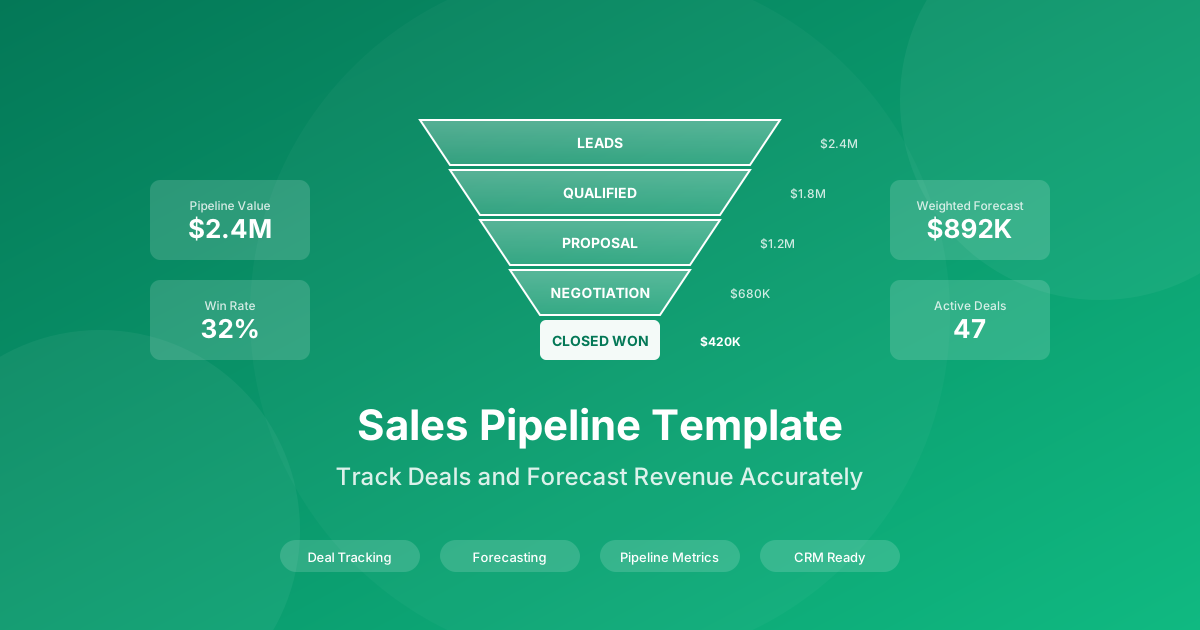
A well-structured sales pipeline is the foundation of predictable revenue growth. Without clear visibility into your deals, accurate forecasting becomes guesswork, and opportunities slip through the cracks. Whether you are a sales manager overseeing a growing team or a founder building your first sales process, having a professional sales pipeline template transforms how you track opportunities and close deals. For comprehensive sales and marketing resources, visit our Sales Operations Playbook.
Why Sales Pipeline Management Matters
Organizations with mature sales pipeline management consistently outperform their competitors. The data is compelling:
- Companies with formal sales processes experience 18% more revenue growth than those without
- Accurate pipeline visibility reduces forecast variance by 25-40%
- Deal velocity tracking helps identify and remove bottlenecks that slow revenue
- Stage-based probability enables weighted forecasting for better financial planning
- Historical pipeline data reveals patterns that improve future sales strategies
The cost of poor pipeline management
Without structured pipeline management, sales organizations face chronic forecasting inaccuracy, missed quota targets, inefficient resource allocation, and ultimately, unpredictable revenue that makes business planning nearly impossible.
Understanding Sales Pipeline Stages
Every effective sales pipeline follows a logical progression from initial contact to closed deal. While the specific stages may vary by industry and sales cycle complexity, the fundamental structure remains consistent across most B2B sales organizations.
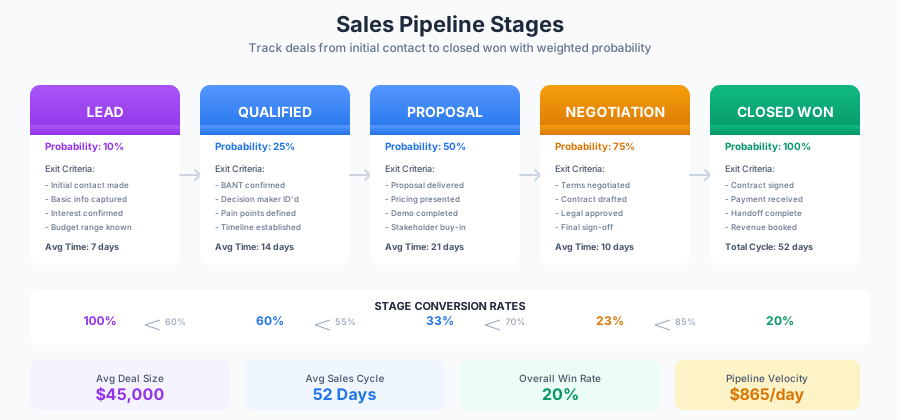
Stage 1: Lead
The lead stage represents new opportunities that have entered your pipeline. At this point, you have made initial contact but have not yet determined whether the prospect is a genuine fit for your solution.
Exit Criteria:
- Initial contact has been made (call, email, or meeting)
- Basic company and contact information captured
- Interest in your product or service confirmed
- Preliminary budget range identified
Probability Weighting: 10% - At this stage, the likelihood of closing is low because many leads will not progress further.
Key Activities:
- Research the company and contact before outreach
- Document the lead source for attribution tracking
- Schedule discovery call within 48 hours of initial contact
- Enter all relevant data into your CRM system
Stage 2: Qualified
A qualified lead has passed your initial qualification criteria and represents a legitimate sales opportunity. This is where you apply frameworks like BANT (Budget, Authority, Need, Timeline) or MEDDIC to validate the opportunity.
Exit Criteria:
- BANT or equivalent qualification confirmed
- Decision maker identified and engaged
- Specific pain points documented
- Buying timeline established
- Budget confirmed to be within your price range
Probability Weighting: 25% - Qualified opportunities have a significantly higher chance of closing, but considerable work remains.
Key Activities:
- Conduct thorough discovery calls
- Map the buying committee and stakeholders
- Quantify the business impact of the prospect's challenges
- Document compelling events driving the purchase decision
Stage 3: Proposal
At the proposal stage, you have presented a formal solution and pricing to the prospect. This is a critical juncture where many deals stall or die, making it essential to maintain momentum.
Exit Criteria:
- Formal proposal or quote delivered
- Pricing and terms clearly communicated
- Product demonstration completed
- Key stakeholders have reviewed the proposal
- Initial feedback received
Probability Weighting: 50% - At this stage, the prospect has invested significant time and is seriously considering your solution.
Key Activities:
- Customize proposals to address specific pain points identified in discovery
- Deliver compelling product demonstrations
- Provide ROI calculations and business case documentation
- Follow up within 48 hours of proposal delivery
- Address any questions or concerns promptly
Stage 4: Negotiation
The negotiation stage indicates the prospect has decided to move forward, and you are working through final terms, pricing, and contract details. This stage requires careful attention to maintain deal value while closing the sale.
Exit Criteria:
- Terms negotiated and agreed upon
- Contract drafted and reviewed
- Legal and procurement approval obtained
- Final sign-off from decision maker secured
Probability Weighting: 75% - Deals at this stage have a high likelihood of closing, though they can still fall through.
Key Activities:
- Maintain flexibility while protecting deal value
- Engage your legal team for contract review
- Coordinate with procurement contacts
- Set clear deadlines for contract execution
- Prepare for handoff to implementation or customer success
Stage 5: Closed Won
The deal has been successfully closed, contract signed, and payment received or invoiced. This stage triggers revenue recognition and the transition to customer onboarding.
Exit Criteria:
- Contract fully executed
- Payment received or invoiced per terms
- Implementation or onboarding initiated
- Revenue booked in your financial system
Probability Weighting: 100% - The deal is complete.
Building Your Sales Pipeline Template in Excel
A well-designed Excel template provides the flexibility to track deals without the cost and complexity of enterprise CRM systems. Here is how to structure your pipeline spreadsheet for maximum effectiveness.
Core Template Structure
Deal Information Tab: Create columns for essential deal data:
| Column | Purpose | Example |
|---|---|---|
| Deal ID | Unique identifier | D-2025-001 |
| Company Name | Account name | Acme Corporation |
| Contact Name | Primary contact | John Smith |
| Deal Name | Opportunity description | Enterprise License |
| Deal Value | Potential revenue | $50,000 |
| Stage | Current pipeline stage | Proposal |
| Probability | Weighted close likelihood | 50% |
| Weighted Value | Deal Value x Probability | $25,000 |
| Close Date | Expected close | 2025-03-15 |
| Days in Stage | Time at current stage | 7 |
| Owner | Assigned sales rep | Sarah Johnson |
| Lead Source | Origin of opportunity | Trade Show |
| Next Action | Required follow-up | Send revised proposal |
| Next Action Date | When to follow up | 2025-02-20 |
Essential Formulas
Weighted Pipeline Value:
=IF(Stage="Lead",Value*0.10,
 IF(Stage="Qualified",Value*0.25,
 IF(Stage="Proposal",Value*0.50,
 IF(Stage="Negotiation",Value*0.75,
 IF(Stage="Closed Won",Value*1.0,0)))))
Days in Current Stage:
=TODAY()-StageEntryDate
Expected Close Variance:
=CloseDate-TODAY()
Win Rate by Stage:
=COUNTIFS(Stage,"Closed Won",InitialStage,"Lead")/COUNTIF(InitialStage,"Lead")
Pipeline Summary Dashboard
Create a summary tab with key metrics:
Total Pipeline Value:
=SUMIF(Stage,"<>Closed Lost",DealValue)
Weighted Forecast:
=SUM(WeightedValue)
Pipeline by Stage:
=SUMIF(Stage,"Proposal",DealValue)
Average Deal Size:
=AVERAGE(IF(Stage="Closed Won",DealValue))
Average Sales Cycle:
=AVERAGE(IF(Stage="Closed Won",CloseDate-CreateDate))
Weighted Forecasting Methodology
Weighted forecasting transforms your pipeline from a simple deal list into a powerful revenue prediction tool. By applying probability weights to each deal based on its stage, you create a more accurate picture of expected revenue.
Calculating Weighted Pipeline
The weighted pipeline formula is straightforward:
Weighted Value = Deal Value x Stage Probability
For a pipeline with the following deals:
- Deal A: $100,000 at Proposal stage (50%) = $50,000 weighted
- Deal B: $75,000 at Negotiation stage (75%) = $56,250 weighted
- Deal C: $50,000 at Qualified stage (25%) = $12,500 weighted
Total Weighted Pipeline = $118,750
This weighted approach provides a more realistic forecast than simply summing all deal values, which would suggest $225,000 in potential revenue.
Adjusting Probability Based on Deal Characteristics
While stage-based probability provides a baseline, sophisticated forecasting adjusts weights based on additional factors:
Positive Indicators (Increase Probability):
- Champion identified and engaged
- Clear compelling event driving purchase
- Budget confirmed and allocated
- Competitive evaluation completed
- Executive sponsor involvement
Negative Indicators (Decrease Probability):
- Extended time in current stage
- Key stakeholder changes
- Budget not yet approved
- Unclear decision timeline
- Strong competitive pressure
Forecast Categories
Beyond weighted probability, many organizations use forecast categories to segment their pipeline:
| Category | Definition | Confidence Level |
|---|---|---|
| Commit | Will close this period | 90%+ |
| Best Case | Likely to close if all goes well | 70-89% |
| Pipeline | Possible but not committed | 30-69% |
| Upside | Stretch goals | 0-29% |
Organizations using weighted forecasting combined with forecast categories achieve 42% better forecast accuracy than those using unweighted methods.
Critical Pipeline Metrics to Track
Effective pipeline management requires monitoring key performance indicators that reveal the health of your sales process and highlight areas for improvement.
Pipeline Coverage Ratio
Pipeline coverage measures whether you have enough opportunities to meet your quota target. The formula is:
Coverage Ratio = Total Pipeline Value / Quota Target
A healthy coverage ratio typically ranges from 3x to 4x your quota, depending on your historical win rate. If your win rate is 25%, you need 4x pipeline coverage to reliably hit quota.
Pipeline Velocity
Pipeline velocity measures the speed at which deals move through your pipeline and generate revenue. The formula is:
Velocity = (Number of Deals x Average Deal Value x Win Rate) / Sales Cycle Length
For example:
- 50 deals in pipeline
- $40,000 average deal value
- 20% win rate
- 60-day average sales cycle
Velocity = (50 x $40,000 x 0.20) / 60 = $6,667 per day
Improving any of these variables increases pipeline velocity and accelerates revenue generation.
Stage Conversion Rates
Track the percentage of deals that successfully move from one stage to the next:
- Lead to Qualified: 60%
- Qualified to Proposal: 55%
- Proposal to Negotiation: 70%
- Negotiation to Closed Won: 85%
Identifying stages with low conversion rates reveals bottlenecks that deserve attention and coaching focus.
Average Time in Stage
Monitor how long deals spend at each stage to identify stalled opportunities:
| Stage | Target Time | Warning Threshold |
|---|---|---|
| Lead | 7 days | 14 days |
| Qualified | 14 days | 28 days |
| Proposal | 21 days | 35 days |
| Negotiation | 10 days | 21 days |
Deals exceeding warning thresholds require immediate attention and may indicate risk factors that could prevent closure.
Win/Loss Analysis
Track and analyze why deals close or fail:
Win Reasons:
- Strong ROI demonstrated
- Champion advocacy
- Superior product fit
- Competitive pricing
Loss Reasons:
- Lost to competitor
- Budget constraints
- No decision made
- Timing not right
This analysis informs messaging, competitive positioning, and qualification improvements. Review our Sales Playbook Guide for detailed strategies.
CRM Integration Considerations
While Excel templates provide an excellent starting point, growing sales organizations eventually benefit from dedicated CRM systems. Here is how to plan for that transition.
When to Move from Spreadsheet to CRM
Consider a CRM investment when:
- Your sales team exceeds 5 representatives
- Deal volume makes spreadsheet management cumbersome
- You need automated workflows and task management
- Multiple stakeholders require real-time pipeline access
- Reporting requirements exceed Excel capabilities
- Integration with marketing automation becomes necessary
Template-to-CRM Migration
When you are ready to implement a CRM, your well-structured template becomes your migration blueprint:
- Export clean data from your template with consistent formatting
- Map fields from your spreadsheet to CRM fields
- Import historical data to preserve deal history
- Recreate formulas as CRM calculated fields
- Build dashboards that replicate your Excel reports
- Train users on new system and processes
CRM Selection Criteria
When evaluating CRM platforms, consider:
- Ease of use for sales rep adoption
- Mobile access for field sales teams
- Integration capabilities with your tech stack
- Reporting flexibility for custom analytics
- Scalability for future growth
- Total cost including implementation and training
For more on CRM strategy, explore our CRM Implementation Resources.
Advanced Pipeline Management Strategies
Multi-Touch Attribution
Track how multiple marketing and sales touches contribute to pipeline generation:
- First touch: Initial lead source (trade show, content download, referral)
- Last touch: Final interaction before deal creation
- Multi-touch: Weighted credit across all touchpoints
Understanding attribution helps optimize marketing spend and sales activities.
Pipeline Aging Analysis
Segment your pipeline by deal age to identify at-risk opportunities:
| Age Bucket | Action Required |
|---|---|
| 0-30 days | Normal progression |
| 31-60 days | Review and verify engagement |
| 61-90 days | Intensive follow-up |
| 90+ days | Qualification review or removal |
Aging analysis prevents pipeline bloat from stale opportunities that artificially inflate forecasts.
Scenario Planning
Use your pipeline data to model different outcomes:
Conservative Scenario:
- Only Negotiation and Commit deals close
- 50% of expected Negotiation deals fall through
Expected Scenario:
- Weighted pipeline forecast
- Historical conversion rates applied
Optimistic Scenario:
- Weighted pipeline plus upside deals
- Best-case timing assumptions
Scenario planning prepares leadership for multiple outcomes and informs resource allocation decisions.
Common Pipeline Management Mistakes
1. Inflated Deal Values
Sales reps often overestimate deal sizes early in the process. Require documented evidence before increasing deal values.
2. Stale Close Dates
Continuously pushing close dates forward masks pipeline problems. Implement strict rules for date adjustments.
3. Skip-Stage Deals
Deals that jump stages (Lead directly to Proposal) often lack proper qualification and have lower win rates. Enforce stage progression.
4. Zombie Deals
Opportunities that linger indefinitely without movement should be archived or closed lost to maintain forecast accuracy.
5. Inconsistent Data Entry
Establish clear definitions for each field and stage to ensure consistent pipeline data across your team.
Pipeline Review Best Practices
Weekly Pipeline Reviews
Conduct weekly team reviews focused on:
- Deals moving forward this week
- Stalled deals requiring attention
- New opportunities added
- Deals at risk of slipping
- Upcoming close dates
Monthly Pipeline Analysis
Monthly reviews should examine:
- Pipeline coverage and quota attainment trajectory
- Stage conversion rate trends
- Average deal size and sales cycle changes
- Win/loss ratio analysis
- Forecast accuracy review
Quarterly Strategic Reviews
Quarterly sessions focus on:
- Pipeline composition by product, segment, and territory
- Team performance patterns
- Process improvement opportunities
- Forecasting methodology refinement
- Territory and quota adjustments
Ready-to-Use Sales Pipeline Templates
Our comprehensive sales toolkit provides everything you need for professional pipeline management:
- Sales Pipeline Template - Complete deal tracking and forecasting
- Sales Playbook Resources - Methodology and process documentation
- CRM Implementation Guide - System setup and configuration
- Lead Generation Templates - Pipeline building strategies
- Sales & Marketing Hub - All sales resources and tools
Each template is battle-tested, fully customizable, and includes implementation guidance to accelerate your sales success.
Transform Your Sales Process Today
Effective pipeline management is not optional for organizations serious about revenue growth. A professional sales pipeline template provides the structure and visibility needed to track deals accurately, forecast with confidence, and consistently hit quota targets.
Do not let disorganized deal tracking undermine your sales potential. Implement structured pipeline management today and build the foundation for predictable, scalable revenue growth.
Ready to optimize your sales pipeline? Explore our Sales & Marketing Hub and Sales Playbook Resources to build a world-class sales operation that drives consistent results.