Customer Development CRM Template for Startups & Product Teams

Building a successful startup is not about having a brilliant idea and executing it perfectly. The harsh reality is that most startups fail not because they cannot build products, but because they build products nobody wants. Steve Blank's customer development methodology provides a systematic framework to validate your business hypotheses before investing significant resources in product development. For comprehensive sales and marketing resources, visit our Sales & Marketing Hub and explore our CRM templates and startup resources.
Why Customer Development Matters More Than Ever
In a startup environment where resources are scarce and runway is limited, the traditional approach of building first and selling later is a recipe for failure. Customer development flips this model on its head.
The statistics are sobering:
- 42% of startups fail because there is no market need for their product
- 29% of startups run out of cash before finding product-market fit
- Only 1 in 10 startup ideas succeed without significant pivots
Customer development provides a structured approach to de-risk your startup by validating assumptions before building. A dedicated Customer Development CRM becomes the central repository for all your learning, helping you track progress toward product-market fit.
The difference between customer development and traditional approaches
Traditional product development assumes you know what customers want. You write a business plan, raise funding, build the product, and then discover whether anyone wants to buy it. This approach treats the startup journey as a linear execution process.
Customer development recognizes that startups operate in conditions of extreme uncertainty. Rather than executing a plan, successful founders search for a repeatable and scalable business model. This search requires systematic experimentation, continuous learning, and the willingness to pivot based on evidence.
Steve Blank's Customer Development Framework
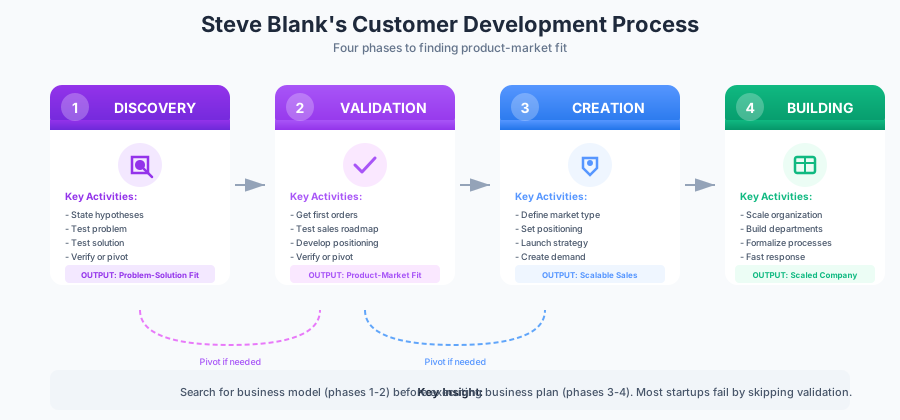
Steve Blank, a serial entrepreneur and Stanford professor, developed the customer development methodology after observing patterns in both successful and failed startups. The framework consists of four distinct phases, each with specific goals and exit criteria.
Phase 1: Customer Discovery
Customer discovery is about testing whether your problem and solution hypotheses match real customer needs. This is not about validating that your product idea is good, it is about discovering whether you understand the problem deeply enough to solve it.
Key activities in customer discovery:
- State your hypotheses - Document your assumptions about the problem, customer segment, value proposition, and business model
- Test the problem - Conduct problem interviews to understand if customers experience the pain you think they do
- Test the solution - Share your proposed solution to gauge initial interest and gather feedback
- Verify or pivot - Analyze interview data to determine whether to proceed or adjust your hypotheses
Exit criteria for customer discovery: You have evidence that customers acknowledge they have the problem you are solving and are actively seeking a solution. Early adopters express interest in your proposed approach.
Phase 2: Customer Validation
Customer validation tests whether you have found a repeatable sales process. This is where you prove you can actually sell your product before scaling your sales and marketing efforts.
Key activities in customer validation:
- Get first orders - Acquire paying customers or signed letters of intent
- Test your sales roadmap - Validate your assumptions about how customers buy
- Develop positioning - Refine your messaging based on what resonates with buyers
- Verify or pivot - Determine if you have achieved product-market fit
Customer validation is complete when you have a repeatable sales process and can predict customer acquisition costs and conversion rates.
Phase 3: Customer Creation
Customer creation scales demand for your validated product. This phase begins only after you have proven product-market fit in the validation phase.
Key activities in customer creation:
- Define your market type (existing, new, or resegmented)
- Establish brand positioning and competitive differentiation
- Develop and execute launch strategy
- Create sustained demand through marketing programs
Phase 4: Company Building
Company building transitions from a learning organization to an execution organization. This is where you scale operations, build formal departments, and establish processes for repeatable growth.
Building Your Customer Development CRM
A Customer Development CRM differs significantly from a traditional sales CRM. While sales CRMs optimize for deal progression and revenue forecasting, a customer development CRM optimizes for learning and hypothesis validation.
Essential CRM components for customer development
1. Hypothesis Tracking Module
Your CRM should centralize all business model hypotheses:
- Problem hypotheses - What problem are you solving and for whom?
- Solution hypotheses - How does your solution address the problem?
- Customer segment hypotheses - Who experiences this problem most acutely?
- Value proposition hypotheses - What unique value do you deliver?
- Channel hypotheses - How will customers discover and purchase?
- Revenue model hypotheses - How will you generate revenue?
Each hypothesis should include:
- Original assumption statement
- Validation criteria (what would prove it true)
- Invalidation criteria (what would prove it false)
- Current status (untested, testing, validated, invalidated)
- Supporting evidence and interview references
2. Interview Tracking System
Track every customer conversation systematically:
| Field | Purpose |
|---|---|
| Contact Information | Name, company, role, contact details |
| Interview Type | Problem interview, solution interview, MVP feedback |
| Date and Duration | When and how long |
| Hypotheses Tested | Which assumptions were explored |
| Key Insights | Verbatim quotes and observations |
| Evidence Weight | Strong support, weak support, contradicts |
| Follow-up Actions | Next steps and scheduled callbacks |
3. Customer Segment Management
Organize contacts by segment characteristics:
- Early adopter indicators - Signs someone is an early adopter
- Pain intensity score - How severely they experience the problem
- Current solution - What they use today and its limitations
- Decision-making authority - Their ability to purchase
- Engagement level - Responsiveness and interest shown
4. Pivot Tracking
Document every significant strategy change:
- Date of pivot decision
- Original hypothesis or approach
- Evidence that triggered the pivot
- New hypothesis or approach
- Results after the pivot
- Lessons learned
Interview Tracking Best Practices
The quality of your customer development process depends on the quality of your interviews and how well you capture and analyze the insights.
Structuring problem interviews
Problem interviews validate whether the problem you are solving is real, painful, and worth solving. Follow this structure:
Opening (5 minutes)
- Thank them for their time
- Explain the purpose (learning, not selling)
- Get permission to take notes
Problem exploration (15-20 minutes)
- Tell me about your current workflow for [domain]
- What are the biggest challenges you face?
- How do you currently solve this problem?
- What happens if this problem is not solved?
- How much time or money does this cost you?
Solution discussion (10 minutes)
- If you could wave a magic wand, what would the ideal solution look like?
- What features would be most valuable?
- What has stopped you from solving this already?
Closing (5 minutes)
- Summarize key points and confirm understanding
- Ask for referrals to others with similar challenges
- Schedule potential follow-up
Recording and analyzing interviews
Immediately after each interview, complete these tasks:
- Capture verbatim quotes - Direct quotes are more powerful than summaries
- Score hypothesis impact - Rate how each hypothesis fared
- Identify patterns - Note recurring themes across interviews
- Update contact status - Mark interest level and follow-up priority
- Extract actionable insights - What should you do differently?
Pro tip: Use a simple scoring system for each hypothesis: +1 for supporting evidence, 0 for neutral, -1 for contradicting evidence. Track cumulative scores to visualize which hypotheses are being validated or invalidated.
Hypothesis Testing Framework
Systematic hypothesis testing transforms customer development from casual conversations into rigorous business research.
Creating testable hypotheses
Good hypotheses are specific, measurable, and falsifiable. Compare these examples:
Weak hypothesis: Customers want our product.
Strong hypothesis: Marketing managers at B2B SaaS companies with 50-200 employees spend more than 10 hours per week on manual reporting tasks and would pay $200/month for an automated solution.
Validation thresholds
Establish clear criteria for hypothesis validation:
- Minimum interview count - At least 15-20 interviews per segment before drawing conclusions
- Confidence threshold - Percentage of interviews supporting the hypothesis (aim for 70%+)
- Willingness to pay - Percentage who express genuine purchase intent (not just "nice to have")
- Early adopter identification - At least 3-5 potential first customers identified
The pivot framework
Not every pivot is created equal. Categorize pivots by type:
- Customer segment pivot - Same problem, different customer
- Problem pivot - Same customer, different problem
- Solution pivot - Same problem, different approach
- Business model pivot - Same offering, different revenue model
- Channel pivot - Same product, different distribution
- Technology pivot - Same outcome, different technical approach
For each pivot, document:
- What evidence triggered the decision
- Why this specific pivot type was chosen
- Expected outcome and success metrics
- Timeline for testing the new direction
Template Structure for Your Customer Development CRM
Here is a detailed structure you can implement in spreadsheets, Notion, Airtable, or dedicated CRM software:
Sheet 1: Master Hypothesis Board
Track all business model assumptions:
| Column | Description |
|---|---|
| Hypothesis ID | Unique identifier (H001, H002, etc.) |
| Category | Problem, Solution, Customer, Value Prop, Channel, Revenue |
| Statement | The specific assumption being tested |
| Status | Untested, Testing, Validated, Invalidated, Pivoted |
| Evidence Score | Cumulative score from interviews (+/-) |
| Interview Count | Number of interviews addressing this hypothesis |
| Validation Date | When status changed to validated |
| Related Hypotheses | Dependencies with other hypotheses |
| Notes | Additional context and observations |
Sheet 2: Interview Database
Record every customer conversation:
| Column | Description |
|---|---|
| Interview ID | Unique identifier (I001, I002, etc.) |
| Date | Interview date |
| Contact ID | Link to contact record |
| Interview Type | Problem, Solution, MVP Feedback, Sales |
| Duration | Length of conversation |
| Hypotheses Tested | List of hypothesis IDs explored |
| Key Quotes | Verbatim customer statements |
| Pain Score | 1-10 rating of problem severity |
| Interest Level | Cold, Warm, Hot, Early Adopter |
| Follow-up | Next steps and timeline |
| Interviewer Notes | Observations and impressions |
Sheet 3: Contact Management
Manage your prospect universe:
| Column | Description |
|---|---|
| Contact ID | Unique identifier (C001, C002, etc.) |
| Name | Contact name |
| Company | Organization name |
| Role | Job title and function |
| Segment | Customer segment classification |
| Source | How you found them |
| Interview Count | Number of conversations |
| Status | Prospect, Interviewed, Early Adopter, Customer |
| Pain Score | Average pain intensity |
| Last Contact | Most recent interaction |
| Next Steps | Planned follow-up |
Sheet 4: Pivot Log
Document strategic changes:
| Column | Description |
|---|---|
| Pivot ID | Unique identifier (P001, P002, etc.) |
| Date | Decision date |
| Type | Segment, Problem, Solution, Model, Channel, Tech |
| From | Original hypothesis or approach |
| To | New hypothesis or approach |
| Evidence | What data triggered the pivot |
| Outcome | Results of the new direction |
| Learnings | Key takeaways |
Metrics That Matter in Customer Development
Track these key performance indicators throughout your customer development process:
Discovery phase metrics
- Interviews completed per week - Maintain velocity of 5-10 interviews weekly
- Problem validation rate - Percentage confirming the problem exists
- Solution interest rate - Percentage expressing interest in your approach
- Referral rate - New contacts generated per interview
- Hypothesis validation velocity - Time to validate or invalidate hypotheses
Validation phase metrics
- Conversion rate - Percentage moving from interview to trial or purchase
- Time to first sale - Days from first contact to closed deal
- Customer acquisition cost - Resources spent to acquire each customer
- Letter of intent count - Pre-commitments secured
- Sales cycle length - Average time to close
The goal of customer development is not to prove you are right. It is to learn what is true.
Common Pitfalls and How to Avoid Them
Pitfall 1: Confirmation bias
Founders often hear what they want to hear. Combat this by:
- Having someone else review interview notes
- Looking specifically for disconfirming evidence
- Asking follow-up questions when you hear supporting evidence
- Setting falsification criteria before interviews
Pitfall 2: Solution pitching instead of problem exploring
It is tempting to describe your solution and gauge reactions. Instead:
- Spend 80% of interview time on problems, 20% on solutions
- Let customers describe their ideal solution first
- Listen more than you talk
- Save detailed product discussions for later phases
Pitfall 3: Premature scaling
The pressure to show growth metrics can push teams to scale before achieving product-market fit. Remember:
- Customer discovery and validation are about learning, not revenue
- Premature scaling wastes resources and obscures feedback
- One passionate customer is worth more than ten lukewarm ones
- Focus on depth of engagement, not breadth
Pitfall 4: Insufficient interview volume
Statistical confidence requires adequate sample sizes:
- Plan for 50-100+ interviews across customer discovery
- Interview multiple people per target company
- Cover diverse perspectives within your segment
- Continue interviews even after initial patterns emerge
Integrating Customer Development with Product Development
Customer development does not operate in isolation. Coordinate with your product team to:
Create a learning loop
- Product team builds minimum viable features
- Customer development team tests with early adopters
- Feedback informs next iteration
- Repeat until product-market fit is achieved
Share customer intelligence
Make interview insights accessible to everyone:
- Weekly summaries of key learnings
- Direct quotes in product requirement documents
- Customer personas updated with real interview data
- Video clips of customer pain point descriptions
Align milestone definitions
Ensure everyone understands what success looks like:
- Clear exit criteria for each phase
- Shared metrics dashboard
- Regular cross-functional reviews
- Celebrate learning milestones, not just launches
Tools and Resources for Customer Development
CRM and tracking tools
Several tools work well for customer development tracking:
- Spreadsheets (Google Sheets, Excel) - Flexible and free for early stages
- Notion - Combines database and documentation capabilities
- Airtable - Powerful for relational data with multiple views
- Dedicated CRMs (HubSpot, Pipedrive) - Can be adapted with custom fields
Interview recording and analysis
- Otter.ai or Rev - Transcription services for interview recordings
- Dovetail - Purpose-built for user research analysis
- Miro or Figjam - Visual collaboration for synthesis sessions
Learning resources
Continue developing your customer development skills:
- The Four Steps to the Epiphany by Steve Blank
- The Startup Owner's Manual by Steve Blank and Bob Dorf
- The Mom Test by Rob Fitzpatrick
- Running Lean by Ash Maurya
Ready-to-Use Customer Development Resources
Our comprehensive startup toolkit includes templates and frameworks to accelerate your customer development process:
- Sales Playbook Template - Sales methodology documentation
- CRM Implementation Guide - CRM setup and configuration
- Lead Generation Framework - Pipeline development
- Business Plan Templates - Complete business planning resources
Each template is designed for real-world application, fully customizable, and includes implementation guidance.
Start Validating Your Business Today
The most successful startups are not the ones with the best ideas. They are the ones that learn fastest. A structured customer development process, supported by a well-designed CRM, gives you the framework to systematically validate your assumptions and find product-market fit before your runway runs out.
Do not build products in isolation hoping customers will come. Get out of the building, talk to customers, and let evidence guide your decisions. Your Customer Development CRM will be the system of record for your startup's most important journey: the search for a repeatable and scalable business model.
Ready to accelerate your customer development process? Explore our Sales & Marketing Hub for comprehensive templates, or dive into our startup business plan resources to build your complete go-to-market strategy.