Sales Funnel Template: Map Pipeline Stages + Track Conversions

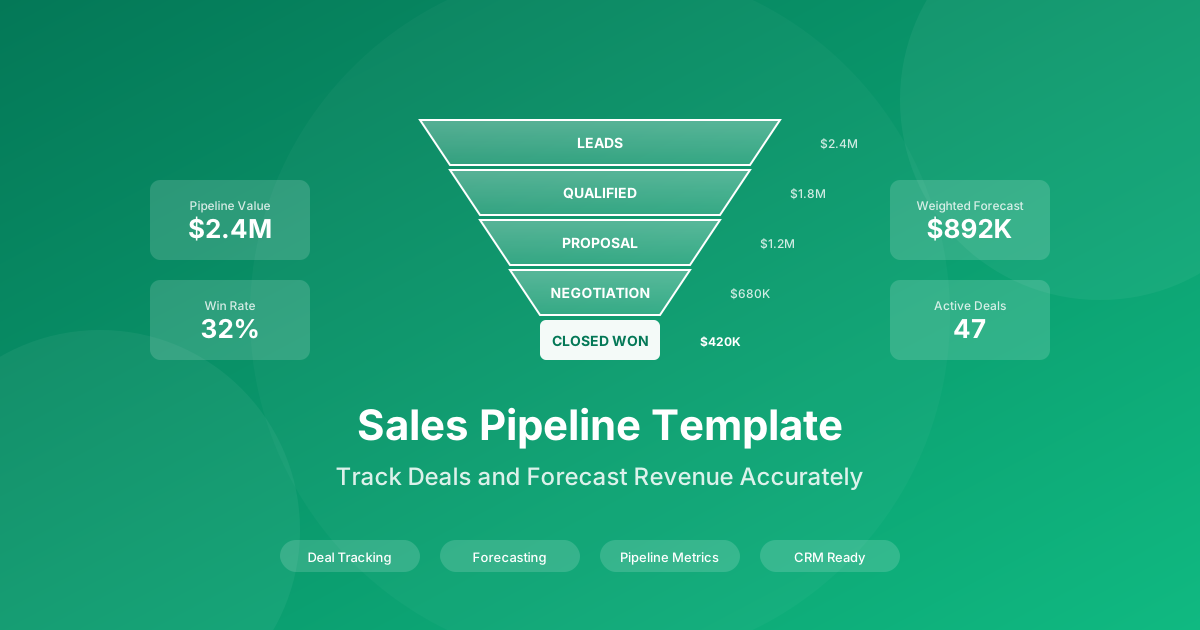
Most sales teams know their total pipeline number. Far fewer know their MQL-to-SQL conversion rate — or whether that rate is good or catastrophically low. A sales funnel template fixes that. It turns a list of deals into a diagnostic map that shows exactly where prospects are entering, where they're dropping off, and what it's costing you. For a free starting point, grab our Sales Pipeline Tracker and build from there.
What Is a Sales Funnel?
A sales funnel maps the journey from first contact to closed deal. It tracks how many prospects enter at each stage, how many advance, and — crucially — how many drop off. That drop-off data is where the value lives.
Most people use "funnel" and "pipeline" interchangeably. There's a technical difference: a pipeline tracks individual deals and their status, while a funnel visualizes aggregate conversion rates between stages (wide at the top, narrow at the bottom). In practice, both tools serve the same manager. You need the pipeline to manage deals day-to-day and the funnel to diagnose whether your process is working.
Every B2B team needs a funnel. Without one, you're spending money on lead generation without knowing whether your problem is volume (not enough leads) or velocity (leads stall at a specific stage). Those require completely different fixes.
Start by tracking deals through your Sales Pipeline Tracker — that data feeds directly into a funnel analysis.
The 6 Standard Sales Funnel Stages
According to Salesforce's State of Sales report, 79% of B2B organizations use a 5-to-7 stage funnel. The standard B2B model has six stages: Lead → MQL → SQL → Opportunity → Proposal → Closed Won. Each stage has specific entry criteria and distinct conversion benchmarks.
Stage 1 — Lead
Anyone who enters your system: form fill, trade show scan, inbound inquiry, outbound contact. Volume is high, intent is unknown. Don't over-invest here.
Entry criteria: Contact info captured, lead source documented. Benchmark conversion to MQL: 20–30%.
Stage 2 — MQL (Marketing-Qualified Lead)
The lead meets demographic and behavioral criteria — right job title, right company size, meaningful engagement with content or ads. Marketing owns this stage.
Entry criteria: Fits ICP, has shown intent signals (content download, pricing page visit, demo request). Benchmark conversion to SQL: 40–60%.
Stage 3 — SQL (Sales-Qualified Lead)
Sales has validated the opportunity against BANT or MEDDIC criteria. Budget exists (or is plausible). Authority is confirmed. Need is real. Timeline is defined.
Entry criteria: Discovery call completed, qualification criteria met. Benchmark conversion to Opportunity: 50–70%.
Stage 4 — Opportunity
An active deal with an identified budget, timeline, and decision-maker engaged. This is where your weighted pipeline starts to mean something.
Entry criteria: Budget confirmed, decision-maker engaged, next steps agreed. Benchmark conversion to Proposal: 60–75%.
Stage 5 — Proposal
Formal proposal or SOW sent. Pricing has been shared. You're competing for a decision.
Entry criteria: Proposal delivered, implementation timeline discussed. Benchmark conversion to Closed Won: 40–60%.
Stage 6 — Closed Won
Contract signed. Revenue recognized. Handoff to onboarding or customer success triggered.
Entry criteria: Signed contract, payment terms confirmed.
Sales Funnel Benchmarks: What Good Looks Like
The average B2B sales funnel converts 2–5% of leads to customers, but the best teams consistently achieve 8–12%, according to research from HubSpot and Databox. The gap isn't luck — it's process at specific stages.
Here are stage-by-stage benchmarks across three industries. Use these to identify where your funnel is underperforming:
| Stage Transition | SaaS | Professional Services | Manufacturing |
|---|---|---|---|
| Lead → MQL | 25% | 20% | 15% |
| MQL → SQL | 50% | 45% | 35% |
| SQL → Opportunity | 60% | 55% | 50% |
| Opportunity → Proposal | 70% | 65% | 60% |
| Proposal → Closed Won | 45% | 55% | 50% |
| Lead → Closed Won | ~3.8% | ~3.2% | ~1.6% |
Deal velocity by stage matters as much as conversion rate. Industry median time-in-stage for SaaS B2B:
- Lead to MQL: 1–3 days
- MQL to SQL: 3–7 days
- SQL to Opportunity: 5–14 days
- Opportunity to Proposal: 14–30 days
- Proposal to Closed Won: 14–45 days
How to calculate your own rates: Take the number of deals that exited a stage as "won" (advanced) divided by total deals that entered that stage in a given period. Run this for the last 90 days minimum. Spot the stage where your rate falls furthest below benchmark — that's where to start.
Sales Funnel Template: Download + Walkthrough
Our Sales Funnel Optimization Template ($49) is built specifically around the benchmark framework above. It's not a blank grid — it includes pre-loaded industry benchmarks so you can immediately compare your funnel to what good looks like.
What's included:
Tab 1 — Funnel Analysis. Enter your deal volume and conversion rates at each stage. The sheet calculates your actual conversion against benchmarks and flags the underperforming stages in red.
Tab 2 — Velocity Dashboard. Track average days-in-stage for your last 90 deals. Stages with high velocity (fast movement) are healthy. Stages with bloated time-in-stage are your bottlenecks.
Tab 3 — Revenue Forecast. Weighted pipeline forecast built from your funnel data. Enter deal count, average deal size, and stage win probabilities — the forecast updates automatically.
Tab 4 — Optimization Plan. Pre-built action framework for each stage. When the Funnel Analysis tab flags a leak, Tab 4 gives you the diagnostic questions and fix recommendations for that stage.
If you want a lighter starting point before committing to the full optimization template, the Sales Funnel Blueprint ($29) covers the core funnel structure and conversion tracking without the forecasting layer.
Pair either template with the Sales Playbook Template ($49), which gives you the process and scripts that sit behind each funnel stage — discovery frameworks, objection handling, proposal structure.
How to Diagnose a Leaking Funnel
If your funnel converts 60% or less at one stage compared to industry benchmarks, that's your bottleneck. Fix it before spending more on lead generation — adding volume to a leaking funnel is expensive and ineffective.
According to CSO Insights, 68% of B2B organizations report that their biggest pipeline problem is a single stage where conversion falls below expectations, yet only 26% have a documented fix for it.
High Lead → MQL Drop-Off
Symptom: You're generating leads, but most don't meet MQL criteria.
Causes: Poor targeting in paid channels, weak lead magnets attracting the wrong audience, ICP definition too broad.
Fix: Tighten your ICP criteria in the MQL definition. Add company size, job title, and industry as hard filters. Audit which lead sources produce the highest MQL rates — double down there and cut the rest.
High MQL → SQL Drop-Off
Symptom: Marketing is delivering MQLs, but sales isn't converting them.
Causes: No follow-up within 24 hours (lead response time is the #1 SQL conversion factor), weak qualification process, reps skipping discovery calls.
Fix: Implement a hard SLA — MQLs get a response within 4 business hours. Build a structured discovery call script. Track SQL conversion by rep to identify who needs coaching.
Use the Sales Playbook Template to document your discovery framework and qualification criteria so every rep runs the same process.
High SQL → Opportunity Drop-Off
Symptom: Deals get qualified but don't become real opportunities.
Causes: Discovery calls lack structure, no demo framework, reps aren't confirming budget before advancing deals.
Fix: Implement BANT or MEDDIC gate criteria. A deal shouldn't move to Opportunity unless budget, authority, need, and timeline are all documented. Add a "qualification scorecard" to your template — deals below 3/4 criteria stay in SQL.
High Opportunity → Closed Won Drop-Off
Symptom: Deals reach Proposal but stall or lose.
Causes: Pricing objections handled poorly, slow proposal turnaround (every extra day in Proposal stage reduces win probability by ~2%), no close plan.
Fix: Standardize your proposal template. Set a 48-hour turnaround SLA. Build a close plan for every deal above a threshold deal size — list every remaining step, who owns it, and the due date.
Sales Funnel Revenue Forecasting
Multiply deal count by average deal size by stage win probability to get a weighted pipeline forecast. The best teams don't guess at quarterly revenue — they calculate it from funnel data. Gartner research shows that organizations using stage-weighted forecasting methods are 2.3× more likely to achieve accurate revenue projections than those using unweighted methods.
The formula:
Weighted Revenue = Deals in Stage × Avg Deal Size × Stage Win Probability
Weighted vs. unweighted forecasting: An unweighted forecast sums all deals in your pipeline at face value — $500K in Proposal and $500K in Lead gives you "$1M pipeline." Weighted forecasting applies win probabilities: $500K at 50% probability + $500K at 10% probability = $300K expected revenue. The weighted number is always more accurate.
Setting stage-level probabilities: Don't use generic benchmarks — use your own historical data. For each stage, look at the last 12 months of deals and calculate what percentage actually closed. That's your real probability. Update it quarterly.
Scenario modeling with the template: The Revenue Forecast tab in our Sales Funnel Optimization Template lets you run three scenarios:
- Base case: Current conversion rates applied to current pipeline
- Upside case: 10% improvement at your weakest stage
- Conservative case: 10% degradation at your strongest stage
The upside scenario is particularly useful for board presentations. A 10% improvement at the MQL → SQL stage, for example, might add $200K–$400K to quarterly forecast depending on your pipeline volume. That's the business case for investing in better qualification training.
Sales Funnel Template vs. CRM: When to Use Each
A spreadsheet funnel is for analysis and strategy. A CRM is for daily deal management. You need both — they're not competing tools.
This is the most common mistake new sales managers make: they try to run funnel analysis in their CRM and wonder why it's painful, or they track deals in a spreadsheet and wonder why they can't generate reliable reports.
Use your sales funnel template for:
- Stage-level conversion analysis (weekly or monthly review)
- Benchmarking your funnel against industry standards
- Revenue forecasting and scenario planning
- Board and leadership reporting
- Diagnosing bottlenecks and building fix plans
Use your CRM for:
- Daily deal tracking and activity logging
- Rep-level pipeline management
- Task management and follow-up reminders
- Real-time pipeline views
- Deal history and contact records
The workflow is: your reps manage deals in the CRM → you pull aggregate data into your funnel template monthly → you use the funnel template to diagnose, forecast, and report. The two tools complement each other.
Start with the Sales Pipeline Tracker (free) if you don't have a CRM yet. It handles deal tracking and generates the data you need for funnel analysis.
Frequently Asked Questions
How many stages should a sales funnel have?
Five to seven for B2B. Fewer than five stages means you lose diagnostic power — you can't identify where deals are stalling. More than seven and reps won't update them consistently, which corrupts your data. The six-stage model (Lead → MQL → SQL → Opportunity → Proposal → Closed Won) hits the right balance for most B2B teams.
What is a good sales funnel conversion rate?
Overall (lead to close), 2–5% is typical for B2B; top performers hit 8–12%. But the overall rate is less useful than stage-by-stage benchmarking. A 3% overall rate with a healthy Lead → MQL conversion and a broken SQL → Opportunity rate tells you something completely different than a 3% rate with a broken MQL → SQL stage. The table in this post gives you the benchmarks for each stage by industry.
How do I calculate sales funnel velocity?
Pipeline velocity = (number of deals in stage × average deal size × win rate) ÷ average days in stage. The output is revenue per day. For example: 20 deals × $25,000 average deal size × 25% win rate ÷ 30 days = $4,167 per day. Improving any of these four variables — more deals, bigger deals, higher win rate, or faster cycle — increases velocity. The formula helps you prioritize which lever to pull.
What's the difference between a sales funnel and a sales pipeline?
A funnel visualizes conversion rates between stages — it's wide at the top (many leads) and narrow at the bottom (few closed deals), showing you percentage drop-off at each gate. A pipeline tracks individual deals and their current status. In practice, most teams use the terms interchangeably, but analytically they're different: the funnel is aggregate and diagnostic, the pipeline is granular and operational.
Build a Funnel That Tells You Something
A sales funnel template is only valuable if it connects stage data to action. The teams that actually improve their conversion rates are the ones who review funnel metrics monthly, benchmark against industry standards, diagnose the leaking stage, and make one targeted fix at a time.
Download the Sales Funnel Optimization Template ($49) to get the benchmark-driven funnel with built-in revenue forecasting. If you want a lighter starting point, the Sales Funnel Blueprint ($29) covers funnel structure and conversion tracking without the full forecasting layer.
And if your funnel diagnosis reveals that the fix is in your sales process — discovery calls, objection handling, proposal quality — the Sales Playbook Template ($49) gives you the documented frameworks for each stage.
Your funnel is already leaking somewhere. Now you have the tools to find it.