From Forecast Roulette to Predictable Revenue: The Sales Manager's Guide to Systematic Sales Operations

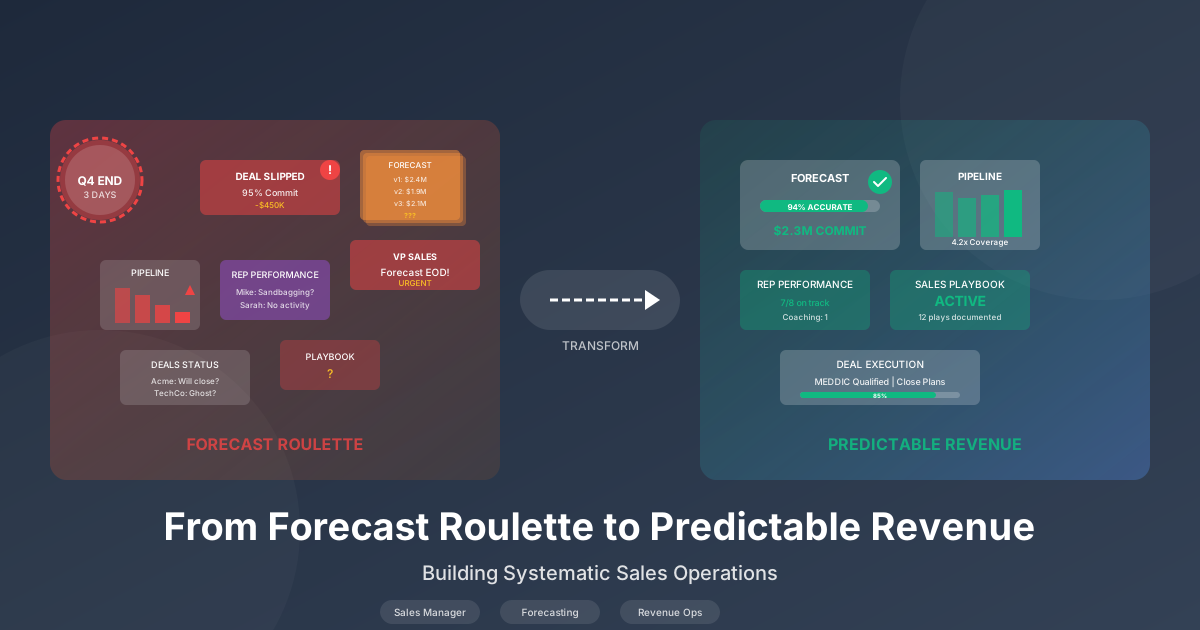
It's the last week of quarter. Your "95% commit" deal just slipped. Two reps appear to be sandbagging. Your VP of Sales wants the updated forecast by EOD. And as you stare at your pipeline, you realize you're not actually sure which deals are going to close.
The CRM shows 47 opportunities in "Negotiation" stage, but you know at least a third of them haven't had meaningful activity in weeks. Your top performer is sitting at 140% of quota while two others are barely at 60%. Someone's asking about competitive positioning for a deal you didn't even know existed. And somewhere in your inbox is a Slack message from finance asking why the forecast changed again.
Sound familiar?
If you're a sales manager, you know this chaos intimately. The end-of-quarter scramble. The deals that were "definitely closing" until they weren't. The reps who surprise you with wins you didn't see coming and losses you should have predicted. The constant tension between coaching your team and managing up to leadership.
This isn't just stressful. It's unsustainable. And it's costing you deals, credibility, and quite possibly your best people.
This guide incorporates insights from sales operations leaders and VPs of Sales across SaaS, technology, and professional services who have built predictable revenue organizations.
The Reality of Sales Management Chaos
Let's be honest about what's actually happening in most sales organizations.
The Forecast Roulette
Every week, the numbers change. Deals move in and out of commit. Reps update their probability estimates based on gut feel rather than defined criteria. By the time you roll up to leadership, you're essentially placing bets rather than reporting forecasts. Your CFO looks at the variance between forecast and actual and wonders if anyone in sales knows what they're doing.
The Pipeline Paradox
You have 4x coverage on paper. But how many of those opportunities are real? How many are zombies that should have been disqualified months ago? How many are sitting in "Discovery" with no next steps scheduled? You don't know, because your stage definitions are vague and nobody enforces exit criteria.
The Performance Puzzle
Some reps consistently crush quota while others perpetually struggle. You suspect the difference isn't just talent; it's methodology. But when you ask your top performers how they win, you get vague answers about "relationships" and "hustle." The knowledge that makes them great stays locked in their heads, unavailable to the rest of the team.
The Coaching Conundrum
You know you should spend more time coaching. Every leadership book says so. But between forecast calls, deal reviews, CRM hygiene sessions, and putting out fires, when exactly does that happen? Your 1:1s become status updates. Your team meetings become forecast reviews. Development conversations get pushed to "next quarter."
The New Hire Nightmare
A new rep joins the team. They ask for the playbook. You hand them a folder of random collateral and tell them to shadow your top performer. Six months later, they're still ramping while your competitors' reps are closing deals in half that time.
You didn't sign up for this chaos. You signed up to build a winning sales team. But instead, you're stuck in perpetual firefighting mode, so busy reacting that you never get to lead.
The Hidden Costs of Sales Operations Chaos
Let's quantify what this chaos actually costs you and your organization. For comprehensive resources on building systematic sales operations, explore our Sales & Marketing Hub.
Time Cost: Where Selling Time Actually Goes
The average sales rep spends only 35% of their time actually selling. The rest goes to administrative tasks, CRM updates, internal meetings, and searching for content. For a sales team of 10 reps, that's the equivalent of 6.5 full-time employees doing non-selling work.
The math is brutal: If your fully-loaded cost per rep is $150,000/year, you're spending roughly $975,000 annually on activities that don't directly generate revenue.
Forecast Accuracy Cost
Companies with poor forecasting accuracy lose 10-30% of potential revenue. Overforecasting leads to excess inventory, overhiring, and cash flow problems. Underforecasting means missed opportunities, understaffing, and disappointed customers.
When your forecast is off by 20%, here's what happens:
- Finance makes wrong assumptions about cash flow
- Operations scales incorrectly for demand
- Leadership makes poor strategic decisions
- Your credibility erodes with every miss
Win Rate Cost
Organizations with documented sales playbooks see win rates 15-20% higher than those without. For a team closing $10M annually at a 25% win rate, improving to 30% means an additional $2M in closed revenue with no increase in pipeline.
The difference between systematic selling and improvised selling is measurable in dollars.
Rep Attrition Cost
The cost of a bad sales hire exceeds $100,000 when you factor in:
- Recruiting and hiring costs ($15-25K)
- Training and ramp time (3-6 months of salary)
- Lost deals during ramp
- Opportunity cost of territory coverage gaps
- Team morale impact
But here's the hidden cost: good reps leave bad sales organizations. When your top performer quits because they're frustrated with pipeline chaos, forecast games, or lack of coaching, you're not just losing one person. You're losing their deals, their relationships, and their institutional knowledge.
Competitive Cost
Your competitors with better sales operations aren't just more efficient. They're faster. They respond to leads quicker. They move deals through pipeline faster. They onboard new reps faster. In competitive deals, speed often determines the winner.
When you're playing forecast roulette while they're running a predictable revenue machine, you're bringing a knife to a gunfight.
The Framework: Building a Sales Operations System
Here's the good news: there's a better way. Sales managers who've escaped forecast roulette didn't get better at guessing. They built systems. Methodical, documented, repeatable systems that transform chaos into predictability.
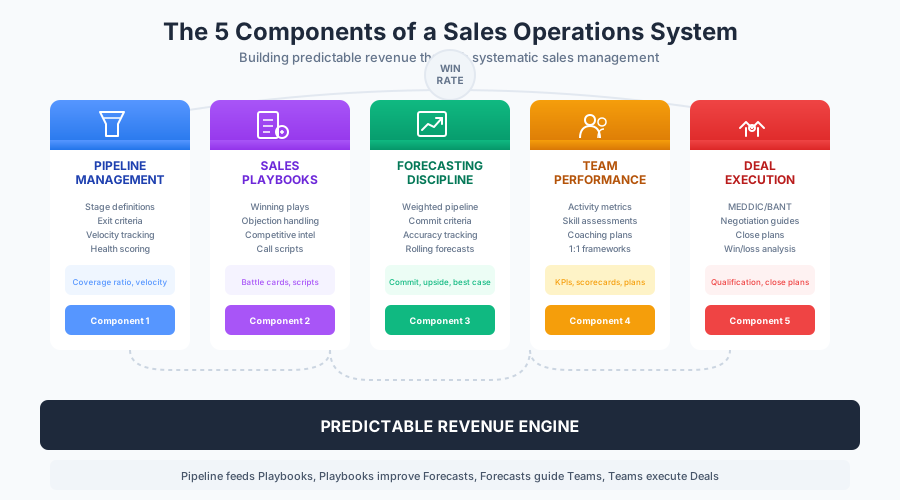
Let me walk you through the five components of a Sales Operations System.
Component 1: Pipeline Management
Your pipeline is your inventory. If you don't know what's in it, how healthy it is, and how fast it moves, you're flying blind.
Stage Definitions with Exit Criteria:
Vague stages like "Qualified" or "Negotiation" mean different things to different reps. Define each stage with specific, observable exit criteria:
| Stage | Exit Criteria |
|---|---|
| Discovery | Pain identified, budget range confirmed, timeline discussed |
| Qualification | Decision maker engaged, success criteria defined, competitive landscape known |
| Solution | Demo completed, proposal requested, buying process mapped |
| Negotiation | Verbal commitment received, terms under discussion, contract in legal |
| Commit | Signature pending, implementation timeline agreed, start date set |
When a deal can only move forward if specific criteria are met, your pipeline becomes real.
Velocity Tracking:
How long do deals stay in each stage? Where do they stall? Where do they die? Velocity metrics reveal bottlenecks in your sales process that no amount of "pushing harder" will fix.
Pipeline Health Scoring:
Not all opportunities are equal. Build a health score based on:
- Days since last meaningful activity
- Stakeholder engagement level
- Competitive positioning
- Timeline alignment with your forecast
Deals with low health scores need intervention or disqualification. No more zombie opportunities inflating your coverage ratios.
Explore our Lead Generation Resources for pipeline building strategies.
Component 2: Sales Playbooks
Your best reps know how to win. The question is whether anyone else can access that knowledge.
Winning Plays Documentation:
For each common scenario, document the play that works:
- Enterprise vs. SMB approach
- Competitive displacement strategy
- Expansion within existing accounts
- Reactivating churned customers
A play includes the triggers that indicate opportunity, the sequence of actions, the talk track, and the expected outcome.
Objection Handling Library:
Every rep hears the same objections. "It's too expensive." "We're happy with our current vendor." "We need to think about it." "The timing isn't right."
Document the responses that work. Not scripts, but frameworks. The psychology behind the objection and the approach that resolves it. New reps shouldn't have to figure this out from scratch.
Competitive Battle Cards:
When you're up against Competitor X, what do you need to know? Their weaknesses. Your differentiators. The questions to ask that expose their limitations. The proof points that demonstrate your advantages.
Battle cards should be living documents, updated with every competitive win and loss.
Call Scripts and Email Templates:
First call structure. Discovery question frameworks. Follow-up email sequences. Proposal delivery approach. These templates don't make reps robotic; they make them consistent and fast.
Browse our Sales Playbook Resources for templates and examples.
Component 3: Forecasting Discipline
Forecasting isn't prediction. It's pattern recognition plus process discipline.
Weighted Pipeline Methodology:
Instead of asking reps "what's your commit?", calculate it:
- Stage 3 deals at 20% probability
- Stage 4 deals at 50% probability
- Stage 5 deals at 80% probability
Apply historical conversion rates, not optimistic guesses. Weighted pipeline gives you a mathematical starting point for forecast discussion.
Commit Criteria:
A deal is in commit only if:
- Verbal commitment received from economic buyer
- Contract terms substantially agreed
- Close date within the forecast period
- No known blockers to signature
This isn't negotiable. Deals that don't meet commit criteria belong in upside or pipeline, not commit.
Forecast Categories:
| Category | Definition | Probability |
|---|---|---|
| Commit | Will close this period barring unforeseen events | 90%+ |
| Upside | Strong probability, may close this period | 60-90% |
| Pipeline | Possible, but depends on discovery outcomes | 20-60% |
| Longshot | Unlikely this period, but worth pursuing | <20% |
Accuracy Tracking:
Track forecast accuracy by rep, by team, and over time. Reps who consistently overforecast need coaching on commit criteria. Reps who consistently underforecast need encouragement to project confidence. Patterns in accuracy reveal training opportunities.
Rolling Forecasts:
Don't wait for month-end to update the forecast. Weekly or even daily forecast reviews keep everyone aligned and reveal problems early when they can still be addressed.
Component 4: Team Performance Management
Your team's performance is your performance. Building a high-performing sales team requires systematic development, not just hiring.
Activity Metrics:
Leading indicators predict future results. Track the activities that matter:
- Prospecting activities (calls, emails, social touches)
- Discovery meetings completed
- Demos delivered
- Proposals sent
- Close attempts made
When activity metrics are strong but results lag, you have an effectiveness problem. When activity metrics are weak, you have an effort problem. Different problems require different solutions.
Skill Assessments:
Rate each rep on core competencies:
- Prospecting and lead qualification
- Discovery and needs analysis
- Presentation and demonstration
- Negotiation and closing
- Account management and expansion
Skill gaps inform coaching priorities. A rep struggling with discovery needs different development than one struggling with closing.
Coaching Plans:
Each rep should have a documented development plan:
- Identified skill gaps
- Specific improvement actions
- Success metrics
- Timeline and checkpoints
Coaching without a plan is just conversation. Coaching with a plan is development.
1:1 Framework:
Your weekly 1:1s should follow a consistent structure:
- Deal review (focus on 2-3 key opportunities)
- Pipeline health check
- Activity and metric review
- Skill development discussion
- Obstacles and support needed
This framework ensures 1:1s are productive, not just friendly chats about "how things are going."
Component 5: Deal Execution
Winning deals consistently requires a systematic approach to opportunity management.
Qualification Frameworks:
MEDDIC, BANT, SPICED, or your own methodology. Pick one and enforce it:
MEDDIC:
- Metrics: What's the measurable impact?
- Economic Buyer: Who signs the check?
- Decision Criteria: How will they decide?
- Decision Process: What's the buying process?
- Identify Pain: What problem are we solving?
- Champion: Who's advocating internally?
Deals that can't answer these questions aren't qualified. They're hopes.
Negotiation Templates:
Structure your approach to commercial discussions:
- Initial proposal format
- Discount approval process
- Term negotiation boundaries
- Concession strategy framework
When negotiation is systematic, you give away less margin and close more deals.
Close Plans:
For every deal in the final stages, document:
- All remaining steps to signature
- Owner and due date for each step
- Potential blockers and mitigation plans
- Fallback position if timeline slips
A close plan transforms "we're almost there" into a trackable project with clear accountability.
Win/Loss Analysis:
After every significant deal (win or loss), conduct a debrief:
- What were the key decision factors?
- Where did we excel or fall short?
- What would we do differently?
- What can we share with the team?
Win/loss data feeds playbook updates, training content, and competitive intelligence.
Visit our CRM Resources for deal management best practices.
The Toolkit: Templates That Transform
Understanding the framework is step one. Implementation requires tools. Here's how specific templates solve specific problems:
| Problem | Template Solution | Outcome |
|---|---|---|
| "Deals sit in stages forever" | Stage definitions with exit criteria | Pipeline velocity improves 25-40% |
| "Reps all sell differently" | Sales playbook templates | Consistent methodology, higher win rates |
| "Forecast is always wrong" | Forecast methodology framework | Accuracy improves to within 10% |
| "New hires take too long to ramp" | Sales onboarding checklist | Ramp time reduced by 30-50% |
| "I don't know what to coach" | Rep skill assessment matrix | Targeted development conversations |
| "Deals stuck in negotiation" | Qualification and close plan templates | More deals close, fewer stall |
| "We lose to competitors" | Competitive battle card templates | Win rate against key competitors increases |
| "1:1s are unproductive" | 1:1 meeting framework | Focused coaching, better outcomes |
The Integration Advantage:
These tools work as an integrated system. Playbooks define how to execute. Pipeline management tracks execution. Forecasting aggregates results. Performance management develops the team. Deal execution closes the business.
Start with our Sales Manager Resource Page for a comprehensive toolkit.
Quick Wins: Start Today
Transformation doesn't happen overnight. But momentum starts with action. Here's your roadmap:
This Week: Audit Stage Definitions and Exit Criteria
Time required: 2-3 hours
Pull your current pipeline. For each stage, answer these questions:
- Is there a written definition?
- Are there specific exit criteria?
- Are reps consistently applying them?
You'll likely find that stages mean different things to different people. Document what each stage should mean and what must be true before a deal advances. Share it with the team on Friday.
This Month: Document Your Top 3 Winning Plays
Time required: 4-6 hours
Interview your top performers. Ask them:
- "Walk me through your last three wins."
- "What do you do differently in enterprise deals?"
- "How do you handle [common objection]?"
- "What's your approach when competing against [competitor]?"
Capture the patterns. Document the plays. Create one-page battle cards that any rep can reference. You've just started building your playbook.
This Quarter: Implement a Forecast Methodology
Time required: 8-12 hours initially, then ongoing
Define your forecast categories (commit, upside, pipeline). Establish commit criteria that are specific and enforceable. Implement weighted pipeline calculations based on historical stage-to-close rates.
Train the team on the new methodology. Hold a weekly forecast call that reviews by category, not just by rep. Start tracking forecast accuracy by rep.
Within 90 days, you'll have dramatically better visibility into what's actually going to close.
Ongoing: Weekly Deal Reviews and 1:1s
Time required: 2-3 hours per week
Block time for structured deal reviews on key opportunities. Conduct 1:1s using a consistent framework. Document coaching conversations and follow up on development commitments.
This isn't extra work. This is the core work of sales management. Everything else is administration.
5-Minute Assessment: Where Do You Stand?
Rate your current state honestly. Check each item you can confidently answer "yes" to:
- Do you have documented stage definitions with specific exit criteria? (Not just stage names, but criteria)
- Can you predict quarterly revenue within 10% accuracy? (Consistently, not occasionally)
- Is your sales process documented and followed by all reps? (Not just known by top performers)
- Do you know each rep's pipeline coverage ratio and velocity metrics? (In real-time, not just at month-end)
- Can new reps access playbooks for common scenarios? (Written guides, not just tribal knowledge)
- Do you have a standardized qualification framework that reps actually use? (MEDDIC, BANT, or similar)
- Are win/loss reasons tracked and analyzed? (Systematically, not anecdotally)
- Do you have competitive battle cards that are actually used? (Updated and referenced in deals)
Score yourself:
- 0-2 checked: Foundation building needed. Start with stage definitions and exit criteria this week.
- 3-4 checked: Building blocks exist but gaps remain. Focus on playbook documentation and forecast methodology.
- 5-6 checked: Solid foundation in place. Time for optimization and performance management systems.
- 7-8 checked: Mature sales operations. Shift focus to continuous improvement and scaling.
Be honest with yourself. Every unchecked item represents predictable revenue you're leaving on the table.
The Transformation: What Predictable Revenue Looks Like
Picture the last week of quarter with a different ending.
Your VP asks for the forecast. You open the dashboard. Commit is $2.1M, supported by 12 deals that all meet documented commit criteria. Upside is $800K with three deals that could pull in. You've been within 5% accuracy for the last four quarters. The conversation takes five minutes and focuses on strategy, not data cleanup.
A deal hits a snag. Your rep pulls up the competitive battle card for exactly this situation. They know the questions to ask, the proof points to share, the positioning that works. They've practiced this scenario. They execute it.
A new rep joins the team. On day one, they receive the onboarding checklist. By week two, they've completed playbook training. By month two, they're running discovery calls using the documented framework. By month four, they close their first deal. Half the ramp time of their predecessor.
You spend your Monday in 1:1s that actually develop your team. You know each rep's skill gaps and have coaching plans to address them. Your deal reviews focus on strategy and support, not status updates. You're building a team, not managing chaos.
End of quarter arrives. You know what's closing because you've tracked it all quarter. Deals that were going to slip, you identified in week one and either accelerated or moved to next quarter. Your commit is real. Your team delivers. Leadership trusts the numbers you give them.
This is what predictable revenue looks like:
For your VP of Sales: You're a reliable operator who delivers what you commit. Forecast conversations become strategic discussions, not interrogations. Your team is a model for the rest of the organization.
For your reps: They have clear expectations, documented processes, and the coaching to improve. They spend less time on administrative work and more time selling. They hit quota more consistently because the system supports them.
For your customers: They experience a professional, consistent sales process. They get answers quickly because your team has the resources. They trust your organization because your people are prepared.
For you: You sleep better on Sunday nights. You spend less time firefighting and more time building. You're developing as a leader, not just surviving as a manager. You're on the path to sales director, VP, and beyond.
Your Next Steps
You've read this far because something resonated. The chaos, the frustration, the feeling that there has to be a better way. There is.
Here's how to move forward:
1. Choose your starting point. Based on your assessment, identify which component needs the most attention. Don't try to fix everything at once.
2. Download the tools. Visit our Sales & Marketing Hub for templates, frameworks, and guides organized by function:
3. Block the time. Schedule your first "sales operations" work block this week. Even four hours is a start. Protect it like a customer meeting.
4. Document one thing. Stage definitions, a winning play, a qualification framework. Pick one and finish it. Momentum builds from completion.
5. Measure your progress. Revisit the assessment in 90 days. Track forecast accuracy. Monitor win rates. Watch the metrics improve as your systems mature.
The transition from forecast roulette to predictable revenue won't happen overnight. But every playbook you document, every process you implement, every rep you develop systematically brings you closer to the sales organization you want to lead.
Stop gambling. Start building.
Related Resources
Ready to dive deeper into specific areas? Explore these comprehensive guides:
- Sales & Marketing Hub - All Resources
- Sales Playbook Templates and Best Practices
- Lead Generation Strategy Guide
- CRM Best Practices for Sales Teams
- Sales Manager Resource Center
Your transformation starts with a single documented process. Which one will you tackle first?