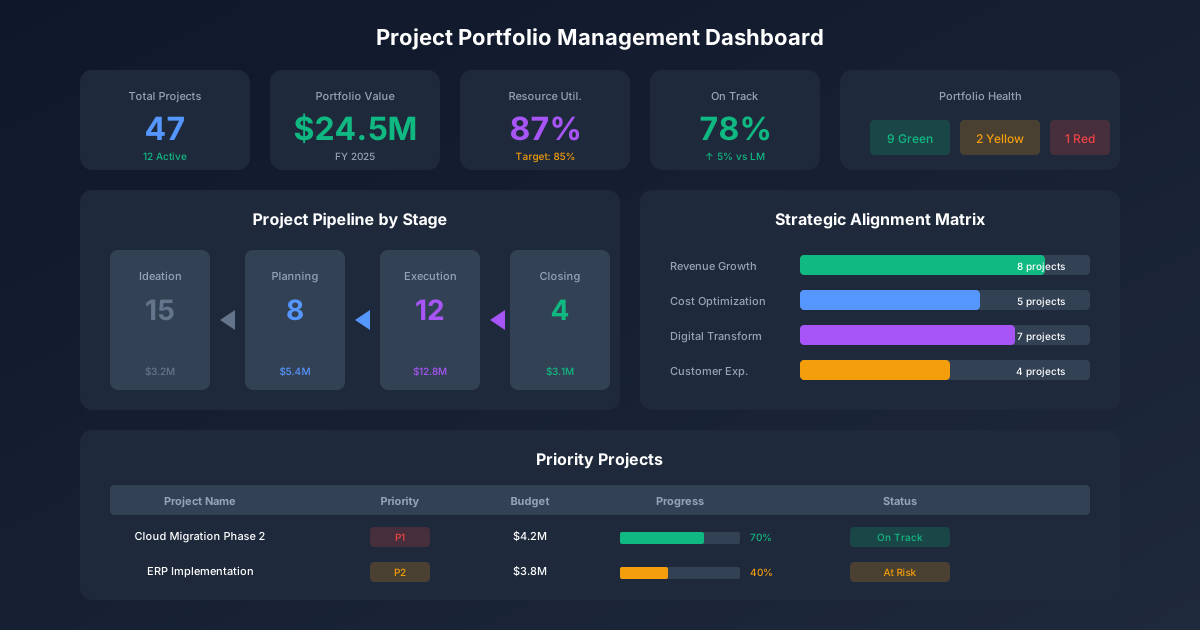
Organizations execute projects, but strategy is delivered through portfolios. Without portfolio-level management, companies chase too many projects, spread resources too thin, and fail to deliver strategic value. The result: project chaos without business outcomes.
Project Portfolio Management (PPM) brings strategic discipline to project investment decisions. This guide provides templates for project intake, prioritization, resource allocation, and portfolio governance—ensuring your projects align with strategy and deliver results.
For related project management resources, explore our Project Management Hub, Resource Planning Template, and Agile Project Management Templates. For templates, see our Project Tracker Template and Risk Register Template.
PPM Framework Overview
Portfolio Management Lifecycle
| Phase | Purpose | Key Activities | Outputs |
|---|
| Identify | Capture project ideas | Intake forms, business cases | Project proposals |
| Evaluate | Assess alignment and value | Scoring, prioritization | Ranked project list |
| Select | Choose what to fund | Portfolio balancing, approval | Authorized portfolio |
| Plan | Allocate resources | Capacity planning, scheduling | Resource assignments |
| Execute | Deliver projects | Monitoring, governance | Project deliverables |
| Review | Assess performance | Benefits realization, lessons learned | Portfolio metrics |
Portfolio Governance Structure
| Level | Role | Frequency | Decisions |
|---|
| Executive Portfolio Board | Strategic direction, major approvals | Quarterly | Portfolio strategy, large investments |
| Portfolio Steering Committee | Prioritization, resource allocation | Monthly | Project selection, trade-offs |
| Portfolio Management Office | Operations, reporting, standards | Weekly | Process compliance, escalations |
| Project Managers | Project delivery | Daily | Project-level decisions |
Project Intake Templates
| Section | Field | Description |
|---|
| Basic Information | | |
| Project Name | Descriptive title |
| Requestor | Name, department, contact |
| Date Submitted | |
| Sponsor | Executive accountable |
| Problem/Opportunity | | |
| Business Need | What problem does this solve? |
| Strategic Alignment | Which strategic objectives? |
| Urgency | □ Critical □ High □ Medium □ Low |
| Solution | | |
| Proposed Solution | High-level approach |
| Alternatives Considered | Other options evaluated |
| Key Deliverables | What will be produced |
| Investment | | |
| Estimated Cost | Range acceptable |
| Resource Requirements | Skills, headcount needed |
| Duration | Estimated timeline |
| Benefits | | |
| Financial Benefits | Revenue, cost savings |
| Non-Financial Benefits | Quality, compliance, customer |
| Benefit Timing | When benefits realized |
| Risks | | |
| Key Risks | Top 3-5 risks |
| Dependencies | Other projects, systems |
Project Scoring Model
Scoring Criteria:
| Criterion | Weight | Score Range | Description |
|---|
| Strategic Alignment | 25% | 1-5 | Supports strategic objectives |
| Financial Value | 20% | 1-5 | ROI, payback period |
| Risk Level | 15% | 1-5 | Technical, execution risk (inverse) |
| Resource Availability | 15% | 1-5 | Can we staff this project? |
| Urgency | 10% | 1-5 | Time-sensitive drivers |
| Compliance/Regulatory | 10% | 1-5 | Required by law/regulation |
| Dependencies | 5% | 1-5 | Enables other initiatives |
Scoring Scale:
- 5: Exceptional - Exceeds criteria significantly
- 4: Strong - Clearly meets criteria
- 3: Adequate - Meets minimum requirements
- 2: Weak - Partially meets criteria
- 1: Poor - Does not meet criteria
Project Scoring Example:
| Project | Strategic | Financial | Risk | Resources | Urgency | Compliance | Deps | Weighted Score |
|---|
| Project A | 5 | 4 | 4 | 3 | 4 | 2 | 3 | 3.85 |
| Project B | 4 | 5 | 3 | 4 | 3 | 1 | 4 | 3.70 |
| Project C | 3 | 3 | 5 | 5 | 2 | 5 | 2 | 3.50 |
| Project D | 4 | 2 | 4 | 2 | 5 | 4 | 3 | 3.30 |
Prioritization Matrices
Value vs. Effort Matrix
                    High Value
                         │
       QUICK WINS        │        BIG BETS
     (Do first)          │    (Plan carefully)
                         │
Low ─────────────────────┼───────────────────── High
Effort                   │                    Effort
                         │
       FILL-INS          │        THANKLESS
     (If capacity)       │     (Avoid or defer)
                         │
                    Low Value
| Quadrant | Projects | Strategy |
|---|
| Quick Wins | Low effort, high value | Prioritize, execute now |
| Big Bets | High effort, high value | Plan thoroughly, phase if possible |
| Fill-Ins | Low effort, low value | Only if excess capacity |
| Thankless | High effort, low value | Eliminate, push back |
Risk vs. Reward Matrix
| Project | Risk Score | Reward Score | Quadrant | Recommendation |
|---|
| CRM Upgrade | Low | High | Star | Approve |
| AI Initiative | High | High | Gamble | Pilot first |
| Process Improvement | Low | Low | Safe bet | If capacity |
| Platform Migration | High | Low | Avoid | Reject/defer |
Portfolio Balance View
| Category | Current % | Target % | Gap | Action |
|---|
| By Type | | | | |
| Growth | 35% | 40% | -5% | Add growth projects |
| Efficiency | 40% | 30% | +10% | Complete or cut |
| Compliance | 25% | 30% | -5% | Required, maintain |
| By Risk | | | | |
| Low Risk | 60% | 50% | +10% | Can take more risk |
| Medium Risk | 30% | 35% | -5% | Add some medium |
| High Risk | 10% | 15% | -5% | Room for innovation |
| By Business Unit | | | | |
| Sales | 30% | 25% | +5% | Over-invested |
| Operations | 25% | 30% | -5% | Under-invested |
| IT | 25% | 25% | 0% | Balanced |
| HR | 20% | 20% | 0% | Balanced |
Resource Capacity Planning
Before allocating resources across your portfolio, break each project into manageable components. A Work Breakdown Structure Template helps you decompose projects into tasks and deliverables so capacity estimates are grounded in real work.
Portfolio Capacity Overview
| Role/Skill | Available FTE | Allocated FTE | Available % | Gap |
|---|
| Project Managers | 8 | 7.5 | 93.8% | OK |
| Business Analysts | 6 | 6.5 | 108.3% | -0.5 FTE |
| Developers | 20 | 22 | 110.0% | -2 FTE |
| QA Engineers | 8 | 7 | 87.5% | OK |
| Data Analysts | 4 | 4.5 | 112.5% | -0.5 FTE |
| Total | 46 | 47.5 | 103.3% | -1.5 FTE |
Resource Demand by Project
| Project | PM | BA | Dev | QA | Data | Total FTE | Q1 | Q2 | Q3 | Q4 |
|---|
| CRM Upgrade | 1.0 | 0.5 | 4.0 | 1.0 | 0.5 | 7.0 | ✓ | ✓ | ✓ | |
| Data Warehouse | 0.5 | 1.0 | 2.0 | 0.5 | 2.0 | 6.0 | ✓ | ✓ | | |
| Mobile App | 1.0 | 1.0 | 6.0 | 2.0 | 0 | 10.0 | | ✓ | ✓ | ✓ |
| Process Automation | 0.5 | 0.5 | 3.0 | 1.0 | 0.5 | 5.5 | ✓ | ✓ | ✓ | |
| Total | 3.0 | 3.0 | 15.0 | 4.5 | 3.0 | 28.5 | | | | |
Capacity Scenario Planning
| Scenario | Description | Projects Impacted | Action Required |
|---|
| Baseline | Current approved portfolio | None | None |
| Add Project X | High-priority addition | Projects Y, Z delayed | Hire 2 devs or outsource |
| Lose 2 devs | Attrition scenario | Mobile app at risk | Backfill or rescope |
| Budget cut 20% | Reduced funding | Cut 3-4 projects | Prioritize ruthlessly |
Portfolio Dashboard
Executive Portfolio Summary
┌─────────────────────────────────────────────────────────────┐
│              PROJECT PORTFOLIO DASHBOARD                     │
│                     Q1 2025                                  │
├─────────────┬─────────────┬─────────────┬───────────────────┤
│  PROJECTS   │   BUDGET    │  RESOURCES  │     HEALTH        │
├─────────────┼─────────────┼─────────────┼───────────────────┤
│   Active: 12│ Total: $8.5M│  46 FTEs    │   🟢 8 On Track   │
│ Pipeline: 18│  Spent: $3.2M│ Allocated: │   🟡 3 At Risk    │
│Completed: 4 │Remain: $5.3M│    103%     │   🔴 1 Critical   │
└─────────────┴─────────────┴─────────────┴───────────────────┘

┌───────────────────────────┬─────────────────────────────────┐
│   PORTFOLIO BALANCE       │        KEY MILESTONES           │
├───────────────────────────┤                                 │
│ Growth: ███████ 35%       │ ✓ CRM Phase 1 (Jan 31)          │
│ Efficiency: █████████ 40% │ ◐ Data Warehouse Go-Live (Feb)  │
│ Compliance: █████ 25%     │ ○ Mobile App Beta (Mar 15)      │
│                           │ ○ Automation Release (Apr 1)    │
└───────────────────────────┴─────────────────────────────────┘
Project Status Summary
| Project | Budget | Schedule | Scope | Overall | Phase | Next Milestone |
|---|
| CRM Upgrade | 🟢 | 🟢 | 🟢 | 🟢 | Execute | Go-live 3/15 |
| Data Warehouse | 🟡 | 🟡 | 🟢 | 🟡 | Execute | UAT 2/15 |
| Mobile App | 🟢 | 🔴 | 🟡 | 🟡 | Plan | Design complete 2/1 |
| Process Automation | 🟢 | 🟢 | 🟢 | 🟢 | Execute | Phase 2 deploy 3/1 |
| Security Upgrade | 🟢 | 🟢 | 🟢 | 🟢 | Close | Audit 2/28 |
Portfolio Health Metrics
| Metric | Target | Actual | Status | Trend |
|---|
| On-Time Delivery | 80% | 75% | 🟡 | ↗ |
| On-Budget Delivery | 85% | 82% | 🟡 | → |
| Benefits Realization | 90% | 88% | 🟢 | ↗ |
| Resource Utilization | 85% | 91% | 🟡 | → |
| Pipeline Coverage | 2.0x | 1.8x | 🟡 | ↗ |
| Portfolio ROI | 150% | 165% | 🟢 | ↗ |
Governance Templates
Portfolio Review Meeting Agenda
| Topic | Time | Presenter | Decision Needed |
|---|
| Previous actions review | 10 min | PMO | Status update |
| Portfolio status | 15 min | PMO | None |
| Project escalations | 20 min | PMs | Resolution |
| New project requests | 20 min | Requestors | Approval |
| Resource conflicts | 15 min | PMO | Allocation |
| Upcoming decisions | 10 min | Chair | Prep assignments |
Stage Gate Review Template
| Gate | Criteria | Evidence Required | Decision |
|---|
| G0: Idea | Business case viable | Intake form, initial estimate | □ Proceed □ Reject □ Hold |
| G1: Initiate | Detailed plan complete | Full business case, project plan | □ Proceed □ Reject □ Hold |
| G2: Execute | Ready for execution | Resources confirmed, risks mitigated | □ Proceed □ Reject □ Hold |
| G3: Validate | Ready for deployment | Testing complete, users trained | □ Proceed □ Reject □ Hold |
| G4: Close | Benefits achievable | Deployment complete, metrics baselined | □ Close □ Extend |
Portfolio Change Request
| Field | Content |
|---|
| Request | |
| Project | |
| Change Type | □ Add □ Remove □ Scope □ Timeline □ Budget |
| Description | What is changing and why |
| Impact | Effect on portfolio |
| Analysis | |
| Resource Impact | Additional/freed resources |
| Budget Impact | $ change |
| Schedule Impact | Timeline change |
| Risk Impact | New/changed risks |
| Recommendation | |
| PMO Recommendation | Approve / Deny / Modify |
| Trade-offs | If approved, what gives? |
| Decision | |
| Approved By | |
| Decision | □ Approved □ Denied □ Modified |
| Conditions | |
Benefits Realization
Benefits Tracking Template
| Project | Benefit | Metric | Baseline | Target | Actual | Realized |
|---|
| CRM | Revenue increase | Pipeline value | $10M | $15M | $14.2M | 95% |
| CRM | Efficiency | Sales admin time | 20 hrs/wk | 10 hrs/wk | 12 hrs/wk | 80% |
| Data | Decision speed | Report time | 5 days | 1 day | 1.5 days | 88% |
| Automation | Cost savings | FTE equivalent | 0 | 3 FTE | 2.5 FTE | 83% |
Benefits Realization Plan
| Benefit | Owner | Measurement | Timing | Status |
|---|
| Revenue increase | Sales VP | CRM pipeline report | Monthly, start M+3 | Tracking |
| Cost reduction | Ops Director | Finance report | Quarterly | Baseline set |
| Customer satisfaction | CX Manager | NPS survey | Quarterly | Pending launch |
| Compliance | Compliance Officer | Audit findings | Annual | Pending |
Key Takeaways
-
Strategy drives portfolio: Projects should trace to strategic objectives
-
Prioritize ruthlessly: Saying no is as important as saying yes
-
Balance the portfolio: Mix risk levels, time horizons, and investment types
-
Manage capacity: Resource constraints are real—plan for them
-
Track benefits: Project completion isn't success—benefit realization is
-
Govern consistently: Regular reviews prevent drift and surprises
For related resources, explore our Resource Planning Template, Risk Register Template, and Change Management Framework.