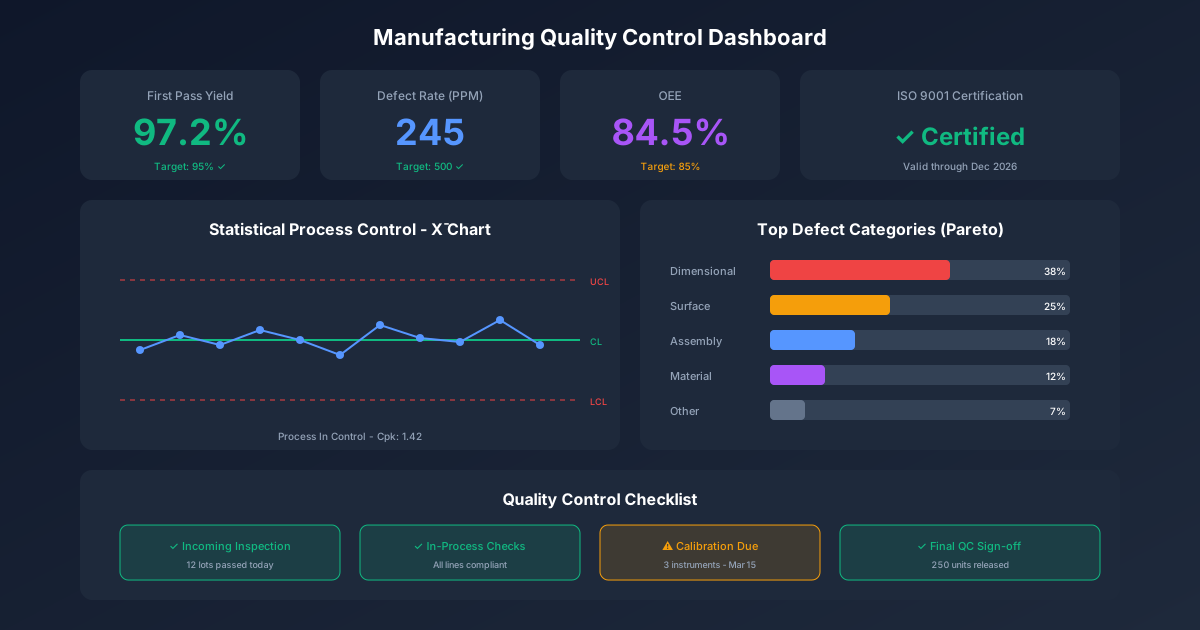
Quality problems in manufacturing don't just cause scrap and rework—they damage customer relationships, trigger regulatory scrutiny, and erode profit margins. Yet many manufacturers operate without systematic quality management, relying on inspection to catch defects rather than preventing them.
A robust quality management system (QMS) prevents defects at the source, ensures regulatory compliance, and drives continuous improvement. This guide provides templates for building ISO 9001-compliant quality processes, from incoming inspection through final release.
For related operations resources, explore our Project Management Hub, Operations KPI Dashboard Guide, and Process Improvement Templates. For templates, see our SOP Template Library.
Quality Management Framework
ISO 9001:2015 Structure
| Clause | Title | Key Requirements |
|---|
| 4 | Context | Organization context, interested parties |
| 5 | Leadership | Policy, roles, management commitment |
| 6 | Planning | Risk, objectives, change planning |
| 7 | Support | Resources, competence, documentation |
| 8 | Operation | Planning, requirements, design, production |
| 9 | Performance | Monitoring, analysis, internal audit |
| 10 | Improvement | Nonconformity, corrective action, continual improvement |
Quality System Components
| Component | Purpose | Key Documents |
|---|
| Quality Policy | Direction and commitment | Policy statement |
| Quality Objectives | Measurable targets | Objective matrix |
| Quality Manual | System overview | Manual document |
| Procedures | How to perform activities | SOPs |
| Work Instructions | Detailed task guidance | Work instructions |
| Records | Evidence of compliance | Forms, logs, reports |
Incoming Quality Control
Receiving Inspection Procedure
| Step | Activity | Responsibility | Record |
|---|
| 1 | Verify documentation (COC, packing list) | Receiving | Checklist |
| 2 | Visual inspection for damage | QC Inspector | Inspection form |
| 3 | Quantity verification | Receiving | Count sheet |
| 4 | Sample selection per AQL | QC Inspector | Sampling record |
| 5 | Dimensional/functional inspection | QC Inspector | Inspection results |
| 6 | Record results | QC Inspector | Inspection report |
| 7 | Disposition (Accept/Reject/Hold) | QC Supervisor | Disposition log |
| 8 | Move to appropriate area | Material Handler | Location update |
AQL Sampling Plan (ANSI/ASQ Z1.4)
| Lot Size | Inspection Level II | Accept | Reject |
|---|
| 2-8 | 2 | 0 | 1 |
| 9-15 | 3 | 0 | 1 |
| 16-25 | 5 | 0 | 1 |
| 26-50 | 8 | 0 | 1 |
| 51-90 | 13 | 1 | 2 |
| 91-150 | 20 | 1 | 2 |
| 151-280 | 32 | 2 | 3 |
| 281-500 | 50 | 3 | 4 |
| 501-1200 | 80 | 5 | 6 |
| 1201-3200 | 125 | 7 | 8 |
| Field | Content |
|---|
| PO Number | |
| Supplier | |
| Part Number | |
| Part Description | |
| Lot/Batch Number | |
| Quantity Received | |
| COC Included | Yes / No |
| Sample Size | |
| Inspection Criteria | Dimensions / Visual / Functional / Other |
| Results | Pass / Fail (detail defects) |
| Defects Found | Type: ___ Qty: ___ |
| Disposition | Accept / Reject / Hold for MRB |
| Inspector | |
| Date | |
| Supervisor Approval (if reject) | |
In-Process Quality Control
Process Control Plan Template
| Process Step | Product Characteristic | Specification | Measurement Method | Sample Size | Frequency | Control Method | Reaction Plan |
|---|
| Machining | Diameter | 25.0 ± 0.05mm | Digital caliper | 5 pcs | Hourly | X-bar R chart | Stop, adjust, verify |
| Assembly | Torque | 15 ± 2 Nm | Torque wrench | 100% | Each unit | Go/No-Go | Rework |
| Welding | Penetration | > 80% | Visual + UT | 3 pcs | Per batch | Attribute chart | Re-weld |
| Coating | Thickness | 50 ± 10 μm | DFT gauge | 5 points | Per part | X-bar R chart | Strip and recoat |
Statistical Process Control (SPC)
X-bar and R Chart Setup
| Parameter | Formula | Value |
|---|
| X-double-bar | Average of subgroup means | Σ X-bar / k |
| R-bar | Average of subgroup ranges | Σ R / k |
| UCL (X-bar) | X-double-bar + A₂ × R-bar | |
| LCL (X-bar) | X-double-bar - A₂ × R-bar | |
| UCL (R) | D₄ × R-bar | |
| LCL (R) | D₃ × R-bar | |
Control Chart Constants (n=5)
| n | A₂ | D₃ | D₄ |
|---|
| 2 | 1.880 | 0 | 3.267 |
| 3 | 1.023 | 0 | 2.574 |
| 4 | 0.729 | 0 | 2.282 |
| 5 | 0.577 | 0 | 2.114 |
| 6 | 0.483 | 0 | 2.004 |
Process Capability Indices
Cp = (USL - LSL) / (6σ)

Cpk = MIN[(USL - X-bar) / (3σ), (X-bar - LSL) / (3σ)]

Target: Cpk ≥ 1.33 (for critical characteristics)
        Cpk ≥ 1.00 (for standard characteristics)
First Article Inspection (FAI)
| Section | Content Required |
|---|
| Header | Part number, revision, FAI number, date |
| Design Records | Drawing with bubbled characteristics |
| Material | Material certifications, traceability |
| Dimensional | All dimensions measured and recorded |
| Special Processes | Process certifications (heat treat, plating, etc.) |
| Functional | Test results per specification |
| Approval | Quality, Engineering, Customer (if required) |
In-Process Inspection Checklist
| Checkpoint | Criteria | Method | Frequency | Results | Notes |
|---|
| Raw material | Per spec | Visual + cert | Start | □ Pass □ Fail | |
| Setup | First piece approval | CMM | Setup | □ Pass □ Fail | |
| Machining | Dimensions per dwg | Caliper/mic | Hourly | □ Pass □ Fail | |
| Heat treat | Hardness 58-62 HRC | Hardness tester | Per batch | □ Pass □ Fail | |
| Assembly | Torque per spec | Torque wrench | 100% | □ Pass □ Fail | |
| Functional | Per test procedure | Test fixture | 100% | □ Pass □ Fail | |
Final Inspection and Release
Final Inspection Procedure
| Step | Activity | Responsibility | Criteria |
|---|
| 1 | Verify all in-process inspections complete | QC Inspector | All checkpoints signed |
| 2 | Visual inspection | QC Inspector | No visible defects |
| 3 | Dimensional verification | QC Inspector | Per sampling plan |
| 4 | Functional test | QC/Test | Per test procedure |
| 5 | Labeling verification | QC Inspector | Correct labels applied |
| 6 | Packaging verification | QC Inspector | Per packaging spec |
| 7 | Documentation review | QC Inspector | All records complete |
| 8 | Release authorization | QC Supervisor | Sign-off |
| Section | Content |
|---|
| Header | |
| Company Name | [Your Company] |
| Document Number | COC-XXXXX |
| Date | |
| Customer Information | |
| Customer Name | |
| Customer PO | |
| Ship To | |
| Product Information | |
| Part Number | |
| Part Description | |
| Revision | |
| Quantity | |
| Lot/Serial Number | |
| Certification | |
| Statement | We hereby certify that the above material conforms to all applicable drawings, specifications, and purchase order requirements. |
| Inspection Type | □ 100% □ Sampling (AQL: ___) |
| Special Processes | □ Heat Treat □ Plating □ NDT □ N/A |
| Test Reports | □ Attached □ On File □ N/A |
| Approval | |
| Quality Representative | Signature: _________ Date: _____ |
| Section | Field | Content |
|---|
| Header | NCR Number | Auto-generated |
| Date Opened | |
| Reported By | |
| Product Info | Part Number | |
| Part Description | |
| Lot/Batch | |
| Quantity Affected | |
| Work Order | |
| Nonconformance | Description | Detailed description of nonconformance |
| Specification | What it should be |
| Actual | What it is |
| Detection Point | Where discovered |
| Category | □ Dimensional □ Visual □ Functional □ Material □ Documentation |
| Disposition | Decision | □ Use As-Is □ Rework □ Repair □ Scrap □ Return to Supplier |
| Justification | Reason for disposition |
| Rework Instructions | If applicable |
| Authorized By | Signature and date |
| Closure | Verification | Disposition implemented and verified |
| Closed By | |
| Date Closed | |
Material Review Board (MRB) Procedure
| Step | Activity | Participants | Outcome |
|---|
| 1 | Identify nonconformance | QC Inspector | NCR opened |
| 2 | Quarantine material | QC Inspector | Material tagged and segregated |
| 3 | Gather information | Quality Engineer | NCR fully documented |
| 4 | MRB meeting | Quality, Engineering, Production | Disposition decision |
| 5 | Customer notification | Quality (if required) | Customer approval |
| 6 | Implement disposition | Production/QC | Work completed |
| 7 | Verify completion | QC Inspector | NCR closed |
Disposition Decision Matrix
| Nonconformance Type | Can Be Reworked? | Affects Function? | Recommended Disposition |
|---|
| Minor visual | N/A | No | Use as-is (document) |
| Dimension out of spec | Yes | No | Rework to spec |
| Dimension out of spec | Yes | Yes | Rework or scrap |
| Dimension out of spec | No | Yes | Scrap |
| Material defect | No | Any | Scrap or return |
| Documentation error | Yes | No | Correct and use |
| Functional failure | Maybe | Yes | Analyze, rework/scrap |
Corrective and Preventive Action (CAPA)
CAPA Procedure
| Phase | Step | Activity | Responsibility | Timing |
|---|
| Initiation | 1 | Identify issue | Anyone | Immediate |
| 2 | Open CAPA | Quality | 24 hours |
| 3 | Assign owner | Quality Manager | 48 hours |
| Investigation | 4 | Containment actions | CAPA Owner | 72 hours |
| 5 | Root cause analysis | CAPA Team | 10 days |
| 6 | Corrective actions | CAPA Team | 10 days |
| Implementation | 7 | Action plan approval | Quality Manager | 5 days |
| 8 | Implement actions | Responsible parties | Per plan |
| Verification | 9 | Verify effectiveness | Quality | 30-90 days |
| 10 | Close CAPA | Quality Manager | After verification |
| Section | Field |
|---|
| Header | |
| CAPA Number: |
| Date Opened: |
| Priority: □ Critical □ Major □ Minor |
| Source: □ Customer Complaint □ Internal NC □ Audit □ Other |
| Problem Description | |
| Issue Description: |
| Affected Products/Processes: |
| Quantity/Extent: |
| Detection Method: |
| Containment | |
| Immediate Actions Taken: |
| Responsible: |
| Due Date: |
| Status: |
| Root Cause Analysis | |
| Method Used: □ 5 Why □ Fishbone □ 8D □ Other |
| Root Cause: |
| Contributing Factors: |
| Corrective Actions | |
| Action 1: |
| Responsible: |
| Action 2: |
| Responsible: |
| Preventive Actions | |
| Action: |
| Responsible: |
| Verification | |
| Verification Method: |
| Results: |
| Effective: □ Yes □ No |
| Closure | |
| Closed By: |
| Lessons Learned: |
5 Whys Template
| Level | Question | Answer |
|---|
| Problem | Why did [problem] occur? | |
| Why 1 | Why did [answer] happen? | |
| Why 2 | Why did [answer] happen? | |
| Why 3 | Why did [answer] happen? | |
| Why 4 | Why did [answer] happen? | |
| Why 5 | Why did [answer] happen? | ← Root Cause |
8D Problem Solving Format
| D | Step | Description |
|---|
| D0 | Prepare | Plan the 8D, identify team |
| D1 | Team | Form cross-functional team |
| D2 | Problem | Describe problem in detail |
| D3 | Containment | Implement interim containment |
| D4 | Root Cause | Identify root cause |
| D5 | Corrective Actions | Define permanent corrective actions |
| D6 | Implementation | Implement and validate |
| D7 | Prevention | Prevent recurrence |
| D8 | Closure | Congratulate team, close |
Quality Metrics Dashboard
Key Quality Metrics
| Metric | Formula | Target | Frequency |
|---|
| First Pass Yield | Good units first pass / Total started | > 95% | Daily |
| Defect Rate | Defects / Total units × 100 | < 2% | Daily |
| DPMO | (Defects / Opportunities) × 1,000,000 | < 3,400 | Monthly |
| Scrap Rate | Scrap units / Total units × 100 | < 1% | Weekly |
| Customer Complaints | Count per month | < 5 | Monthly |
| Supplier PPM | (Defective / Received) × 1,000,000 | < 500 | Monthly |
| CAPA Closure Rate | Closed on time / Total due | > 90% | Monthly |
| Audit Score | Findings cleared / Total findings | > 95% | Per audit |
┌─────────────────────────────────────────────────────────────┐
│              QUALITY DASHBOARD - JANUARY 2025               │
├─────────────┬─────────────┬─────────────┬───────────────────┤
│    FPY      │  DEFECT %   │  SCRAP %    │   COMPLAINTS      │
├─────────────┼─────────────┼─────────────┼───────────────────┤
│   96.5%     │    1.8%     │    0.6%     │       3           │
│   ▲ +1.2%   │   ▼ -0.4%   │   ▼ -0.2%   │     ▼ -2          │
│ Target: 95% │ Target: 2%  │ Target: 1%  │   Target: < 5     │
│     🟢      │     🟢      │     🟢      │       🟢          │
└─────────────┴─────────────┴─────────────┴───────────────────┘

┌───────────────────────┬─────────────────────────────────────┐
│   TOP DEFECT TYPES    │        CAPA STATUS                  │
├───────────────────────┤                                     │
│ 1. Dimensional (42%)  │   Open: 8                           │
│ 2. Visual (28%)       │   Overdue: 2                        │
│ 3. Assembly (18%)     │   Closed MTD: 12                    │
│ 4. Material (12%)     │   Effectiveness verified: 10        │
└───────────────────────┴─────────────────────────────────────┘
Audit Management
Internal Audit Schedule Template
| Area | Scope | Auditor | Frequency | Q1 | Q2 | Q3 | Q4 |
|---|
| Receiving | 7.4, 8.4 | A. Smith | Annual | ✓ | | | |
| Production | 8.5 | B. Jones | Semi-annual | | ✓ | | ✓ |
| Quality | 9.1, 10 | C. Davis | Annual | | | ✓ | |
| Calibration | 7.1.5 | A. Smith | Annual | ✓ | | | |
| Training | 7.2 | B. Jones | Annual | | ✓ | | |
| Document Control | 7.5 | C. Davis | Annual | | | | ✓ |
| Management Review | 9.3 | External | Annual | | | ✓ | |
Audit Checklist Example (ISO 9001 Clause 8.5)
| Req | Question | Evidence to Review | Finding |
|---|
| 8.5.1 | Are production processes controlled under defined conditions? | Work instructions, process parameters | |
| 8.5.1 | Is monitoring and measurement of processes performed? | Inspection records, SPC data | |
| 8.5.1 | Is appropriate infrastructure used? | Equipment maintenance records | |
| 8.5.2 | Are outputs requiring traceability identified? | Lot/serial tracking, records | |
| 8.5.3 | Is customer property identified and protected? | Customer-supplied material records | |
| 8.5.4 | Are products preserved during production? | Handling procedures, storage conditions | |
| 8.5.5 | Are post-delivery requirements met? | Service records, warranty data | |
| 8.5.6 | Are changes reviewed and controlled? | Change records, impact assessments | |
Key Takeaways
-
Prevention over inspection: Build quality into processes rather than inspecting it in
-
Use statistical methods: SPC catches trends before defects escape
-
Document everything: If it's not documented, it didn't happen for quality purposes
-
Close the loop: CAPA must verify effectiveness, not just implement actions
-
Track meaningful metrics: Focus on metrics that drive improvement decisions
-
Audit regularly: Internal audits find issues before certification audits do
For related resources, explore our Operations KPI Dashboard Guide, Process Improvement Templates, and SOP Template Library.