Email Marketing Templates: Campaign Templates for Higher Open Rates & Conversions

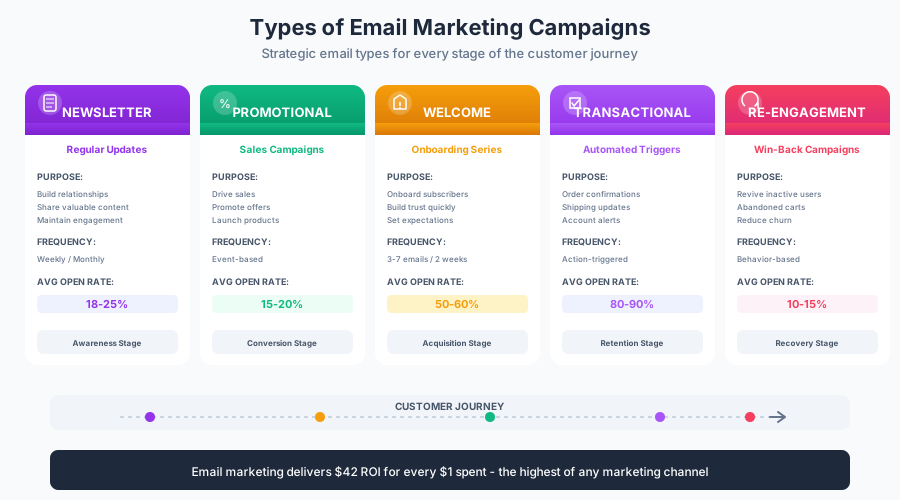
Email marketing remains the most effective digital marketing channel, delivering an average return of $42 for every $1 spent. Yet many businesses struggle to create emails that cut through crowded inboxes and drive meaningful engagement. The difference between average and exceptional email marketing often comes down to having the right templates, frameworks, and optimization strategies. For comprehensive marketing resources, explore our Sales & Marketing Hub and Sales Operations Playbook. For ready-to-use templates, see our Content Marketing Strategy Template and Email Security Policy.
Why Email Marketing Templates Drive Results
Professional email templates provide measurable advantages that compound over time:
- Consistent brand experience across all subscriber touchpoints
- Faster campaign deployment with pre-built, tested structures
- Higher conversion rates from optimized layouts and copy patterns
- Improved deliverability through proven design practices
- Scalable operations that grow with your subscriber list
The Cost of Poor Email Marketing
Without strategic templates and frameworks, businesses experience:
- Low open rates that waste marketing spend and effort
- High unsubscribe rates from irrelevant or poorly timed messages
- Poor deliverability leading to spam folder placement
- Inconsistent results that make optimization impossible
- Missed revenue from underperforming campaigns
Essential Email Campaign Types
1. Newsletter Templates
Newsletters build long-term relationships with your audience through consistent value delivery. The most effective newsletters follow proven structural patterns.
Newsletter Structure Framework:
- Header section - Logo, navigation links, and issue identifier
- Featured content - One primary story or update that provides immediate value
- Secondary stories - 2-3 supporting articles or announcements
- Call-to-action - Clear next step aligned with business goals
- Footer - Social links, unsubscribe option, contact information
Newsletter Best Practices:
| Element | Best Practice | Impact |
|---|---|---|
| Subject Line | 6-10 words, personalized | +26% open rate |
| Preheader | Complement subject, 40-100 chars | +14% open rate |
| Content Length | 200-500 words | +18% click rate |
| Images | 1-3 relevant visuals | +27% engagement |
| Send Time | Tuesday-Thursday, 10am-2pm | +15% open rate |
Pro Tip: Segment your newsletter by subscriber interests and send personalized content to each segment. Segmented campaigns see 14.31% higher open rates than non-segmented campaigns.
2. Promotional Email Templates
Promotional emails drive direct revenue through offers, launches, and sales events. Success requires balancing urgency with value. Visit our marketing campaigns resources for more templates.
Promotional Email Framework:
- Attention-grabbing headline that communicates the core offer
- Value proposition explaining why this matters to the reader
- Offer details with clear terms and conditions
- Social proof such as reviews, testimonials, or usage statistics
- Primary CTA that stands out visually and uses action language
- Urgency element like countdown timer or limited availability
Promotional Email Examples:
Flash Sale Template:
Subject: [First Name], 48 hours only: 40% off everything

Hi [First Name],

Our biggest sale of the season starts now.

For the next 48 hours, take 40% off your entire order with code FLASH40.

[SHOP NOW - 40% OFF]

Why now?
- Free shipping on orders over $50
- Extended returns through end of month
- New arrivals included

This offer expires Thursday at midnight.

[SHOP THE SALE]
3. Welcome Sequence Templates
Welcome sequences are your highest-performing emails, with open rates reaching 50-60%. This is your best opportunity to convert new subscribers into engaged customers.
5-Email Welcome Sequence Framework:
Email 1 (Immediate): The Warm Welcome
- Thank subscriber for joining
- Deliver promised lead magnet
- Set expectations for future emails
- Include one soft CTA
Email 2 (Day 2): The Value Email
- Share your most helpful content
- Demonstrate expertise and authority
- Build trust through education
- No sales pitch
Email 3 (Day 4): The Story Email
- Share brand origin story or mission
- Create emotional connection
- Highlight what makes you different
- Include customer testimonials
Email 4 (Day 6): The Transformation Email
- Showcase customer success stories
- Present before/after scenarios
- Address common objections
- Soft product mention
Email 5 (Day 8): The Offer Email
- Present special welcome offer
- Create urgency with time limit
- Clear value proposition
- Strong call-to-action
Welcome sequences generate 320% more revenue per email than standard promotional emails.
4. Abandoned Cart Email Templates
Abandoned cart emails recover lost revenue with an average recovery rate of 10-15%. The key is timing and personalization.
Abandoned Cart Sequence:
| Timing | Focus | Expected Recovery | |
|---|---|---|---|
| Email 1 | 1 hour | Reminder | 5-7% of carts |
| Email 2 | 24 hours | Assistance | 3-4% of carts |
| Email 3 | 72 hours | Incentive | 2-3% of carts |
Abandoned Cart Email 1 Template:
Subject: You left something behind, [First Name]

Hi [First Name],

We noticed you were checking out [Product Name] but didn't complete your order.

[PRODUCT IMAGE]

Your cart is saved and waiting for you.

[COMPLETE MY ORDER]

Need help? Our team is here to answer any questions.

Reply to this email or call us at [phone number].
Abandoned Cart Email 3 Template (with incentive):
Subject: Complete your order + get 10% off

Hi [First Name],

Your [Product Name] is still waiting.

We'd hate for you to miss out, so here's 10% off to complete your order.

Use code: COMEBACK10

[PRODUCT IMAGE]

[GET 10% OFF NOW]

This offer expires in 24 hours.
5. Re-engagement Campaign Templates
Re-engagement campaigns revive inactive subscribers before they become permanent losses. These campaigns protect your sender reputation and recover revenue.
Re-engagement Sequence:
Email 1: The "We Miss You" Email
- Acknowledge absence without guilt
- Remind them why they subscribed
- Highlight what they've missed
- Easy one-click re-engagement
Email 2: The "What's Changed" Email
- Showcase new features or products
- Share recent content highlights
- Offer preference update option
- Include subscriber-only benefit
Email 3: The "Last Chance" Email
- Clear unsubscribe warning
- Final incentive if appropriate
- Simple yes/no response option
- Respect their decision
Important: If subscribers don't engage after your re-engagement sequence, remove them from your list. Maintaining a clean list improves deliverability for engaged subscribers.
Subject Line Formulas That Drive Opens
Subject lines determine whether your email gets opened or ignored. These proven formulas consistently outperform generic approaches.
High-Performing Subject Line Formulas
The Question Formula:
- "Are you making this [topic] mistake?"
- "What's stopping your [goal]?"
- "[Name], ready for [benefit]?"
The Number Formula:
- "7 ways to [achieve benefit]"
- "3 mistakes killing your [goal]"
- "The 5-minute [topic] fix"
The Curiosity Gap:
- "The [topic] secret no one talks about"
- "Why [unexpected thing] works for [goal]"
- "This one change doubled our [metric]"
The Urgency Formula:
- "Ending tonight: [offer]"
- "[Hours] left to claim your [benefit]"
- "Last chance for [specific thing]"
The Personalization Formula:
- "[First Name], your [item] is waiting"
- "Based on your interest in [topic]..."
- "[Company Name], here's your custom [resource]"
Subject Line Best Practices
| Practice | Guideline | Why It Works |
|---|---|---|
| Length | 30-50 characters | Mobile optimization |
| Personalization | Use first name | +22% open rate |
| Emojis | 1 max, if on-brand | +56% unique opens |
| Preview text | Write intentionally | +24% open rate |
| A/B testing | Test 2-3 versions | Data-driven improvement |
Words to Avoid:
- "Free" (spam trigger when overused)
- "Buy now" (too aggressive)
- "Urgent" (often feels manipulative)
- ALL CAPS (looks like spam)
- Multiple exclamation points (reduces credibility)
A/B Testing Framework for Email Optimization
Systematic A/B testing transforms email marketing from guesswork into science. Follow this framework for continuous improvement.
What to Test (Priority Order)
- Subject lines - Highest impact on open rates
- Send times - Varies significantly by audience
- Call-to-action - Button color, text, placement
- Email length - Short vs. detailed
- Personalization - Name, company, behavior-based
- From name - Person vs. brand
- Content format - Text-heavy vs. visual
- Offer presentation - Percentage vs. dollar amount
A/B Testing Methodology
Step 1: Hypothesis Formation
- What do you want to learn?
- What do you expect to happen?
- How will you measure success?
Step 2: Test Design
- Change only one variable per test
- Split audience randomly (50/50 minimum)
- Ensure statistical significance (minimum 1,000 per variant)
Step 3: Execution
- Run test for full campaign duration
- Don't peek and stop early
- Document test parameters
Step 4: Analysis
- Compare primary metric (open rate, click rate, conversion)
- Check for statistical significance
- Consider secondary metrics
Step 5: Implementation
- Apply winning variant to future campaigns
- Document learnings
- Plan next test
Sample A/B Test Results Tracking
| Test | Variable A | Variable B | Winner | Lift | Confidence |
|---|---|---|---|---|---|
| Subject Line | Question | Statement | A | +18% | 95% |
| CTA Color | Blue | Orange | B | +12% | 92% |
| Send Time | 10am | 2pm | A | +8% | 88% |
| From Name | Brand | Person | B | +15% | 96% |
Email Metrics and Benchmarks
Understanding email metrics helps you identify improvement opportunities and measure success accurately.
Key Email Marketing Metrics
Open Rate
- Definition: Percentage of delivered emails opened
- Industry Average: 20-25%
- Good: Greater than 25%
- Excellent: Greater than 35%
- Factors: Subject line, sender reputation, send time
Click-Through Rate (CTR)
- Definition: Percentage of delivered emails with clicks
- Industry Average: 2-3%
- Good: Greater than 3%
- Excellent: Greater than 5%
- Factors: Content relevance, CTA strength, design
Click-to-Open Rate (CTOR)
- Definition: Clicks divided by opens
- Industry Average: 10-15%
- Good: Greater than 15%
- Excellent: Greater than 20%
- Factors: Email content quality, CTA clarity
Conversion Rate
- Definition: Percentage of clicks that convert
- Industry Average: 2-5%
- Good: Greater than 5%
- Excellent: Greater than 10%
- Factors: Landing page, offer strength, audience targeting
Unsubscribe Rate
- Definition: Percentage who unsubscribe per email
- Healthy: Less than 0.5%
- Concerning: 0.5-1%
- Critical: Greater than 1%
- Factors: Relevance, frequency, expectation setting
Industry Benchmark Comparison
| Industry | Open Rate | CTR | Unsubscribe |
|---|---|---|---|
| Software/SaaS | 21% | 2.4% | 0.4% |
| E-commerce | 18% | 2.1% | 0.3% |
| Finance | 24% | 2.8% | 0.2% |
| Healthcare | 23% | 2.6% | 0.3% |
| B2B Services | 22% | 2.5% | 0.3% |
| Media/Publishing | 20% | 3.2% | 0.2% |
| Nonprofit | 26% | 2.9% | 0.2% |
Email Deliverability Best Practices
High deliverability ensures your emails reach subscriber inboxes rather than spam folders.
Technical Requirements
Authentication Setup:
- SPF Record - Authorizes sending servers
- DKIM Signing - Verifies email authenticity
- DMARC Policy - Instructs receiving servers on handling
List Hygiene:
- Remove bounced emails immediately
- Clean inactive subscribers quarterly
- Use double opt-in for new subscribers
- Monitor spam complaints (keep below 0.1%)
Content Best Practices
Spam Filter Avoidance:
- Maintain 60/40 text-to-image ratio
- Avoid spam trigger words in subject lines
- Include physical mailing address
- Make unsubscribe easy and obvious
- Use reputable email service provider
Engagement Optimization:
- Send at consistent times
- Segment by engagement level
- Personalize content based on behavior
- Respect subscriber preferences
- Provide genuine value in every email
Advanced Email Marketing Strategies
Behavioral Trigger Campaigns
Trigger campaigns send automated emails based on subscriber actions, delivering highly relevant messages at optimal times.
Common Trigger Types:
- Browse abandonment - Viewed product but didn't add to cart
- Purchase follow-up - Post-purchase review request
- Milestone triggers - Birthday, anniversary, subscription renewal
- Engagement triggers - High engagement unlocks special content
- Inactivity triggers - No opens in 30/60/90 days
Dynamic Content Personalization
Beyond first name personalization, dynamic content adapts entire email sections based on subscriber data.
Personalization Variables:
- Demographics - Location, company size, industry
- Behavior - Past purchases, browsing history, email engagement
- Preferences - Content interests, communication frequency
- Lifecycle stage - New subscriber, active customer, at-risk
Email Automation Workflows
Automation workflows nurture subscribers through complete journeys without manual intervention. Learn more about marketing automation in our lead generation guide.
Essential Automation Workflows:
- Welcome sequence (new subscribers)
- Lead nurturing (marketing qualified leads)
- Customer onboarding (new customers)
- Cross-sell/upsell (existing customers)
- Re-engagement (inactive subscribers)
- Win-back (lapsed customers)
Email Marketing Tools and Integration
Recommended Email Platforms
For Small Business:
- Easy-to-use templates and drag-and-drop editors
- Basic automation capabilities
- Affordable pricing tiers
- Good deliverability out of box
For Growing Companies:
- Advanced segmentation and personalization
- Comprehensive automation builders
- CRM integration capabilities
- A/B testing features
For Enterprise:
- Unlimited contacts and sends
- Advanced analytics and reporting
- Custom integrations and APIs
- Dedicated deliverability support
CRM Integration Benefits
Integrating email with your CRM unlocks powerful capabilities. See our CRM implementation guide for detailed strategies.
- Unified customer view across all touchpoints
- Sales-marketing alignment through shared data
- Advanced segmentation based on CRM fields
- Trigger automation from CRM events
- Revenue attribution to specific campaigns
Ready-to-Use Email Marketing Resources
Our comprehensive Sales & Marketing Hub includes:
- Campaign Planning Templates - Email calendar and content planning tools
- Lead Generation Resources - Landing pages and capture forms
- CRM Implementation Guides - Integration and workflow setup
- Sales Playbook Templates - Follow-up sequences and scripts
Each resource is optimized for conversions and includes implementation guidance and best practices.
Start Improving Your Email Marketing Today
Effective email marketing doesn't require starting from scratch. Professional templates, proven frameworks, and systematic testing transform your email program from a cost center into a revenue driver.
Ready to elevate your email marketing? Explore our Sales & Marketing Hub and discover the templates and strategies that drive consistent results. Begin with our campaign planning resources to build your email marketing foundation.