Lead Generation Funnel Guide: Templates and MQL to SQL Optimization

Lead generation is the lifeblood of business growth, but creating effective marketing funnels from scratch can be overwhelming. The secret to consistent lead generation lies in understanding funnel stages, optimizing conversion at each step, and building a seamless MQL to SQL process that aligns marketing and sales. This guide provides the frameworks, templates, and optimization strategies you need for predictable pipeline growth. For comprehensive sales resources, visit our Sales & Marketing Hub and Sales Pipeline Guide. For ready-to-use templates, see our Content Marketing Strategy Template, CRM Implementation Guide, and Customer CRM Database Template.
The Lead Generation Funnel Framework
Understanding Funnel Stages
A well-designed lead generation funnel moves prospects through distinct stages, each requiring different tactics and content:
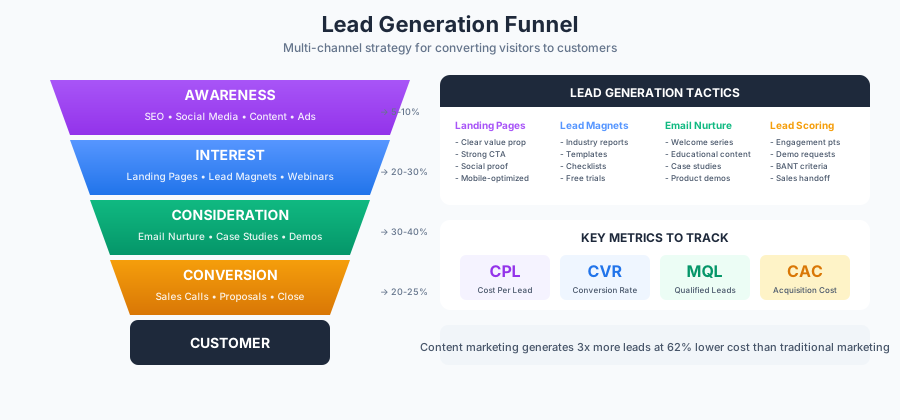
Stage 1: Awareness (Top of Funnel - TOFU)
- Prospect becomes aware of a problem or opportunity
- First interaction with your brand
- Content focus: Educational, thought leadership
- Channels: SEO, social media, paid ads, PR
Stage 2: Interest (Middle of Funnel - MOFU)
- Prospect actively researches solutions
- Engages with your content
- Content focus: Solution-oriented, comparative
- Channels: Email, webinars, case studies, demos
Stage 3: Consideration (Middle of Funnel - MOFU)
- Prospect evaluates specific vendors
- Requests detailed information
- Content focus: Product-specific, ROI-focused
- Channels: Sales calls, proposals, trials
Stage 4: Decision (Bottom of Funnel - BOFU)
- Prospect ready to purchase
- Final evaluation and negotiation
- Content focus: Validation, risk reduction
- Channels: Direct sales, contracts, onboarding
Funnel Metrics by Stage
| Stage | Key Metrics | Benchmark | Calculation |
|---|---|---|---|
| Awareness | Traffic, Impressions | Varies by channel | Unique visitors, ad impressions |
| Interest | Leads captured, Engagement | 2-5% of traffic | Form submissions / Visitors |
| Consideration | MQLs generated | 20-30% of leads | Qualified leads / Total leads |
| Decision | SQLs, Opportunities | 30-50% of MQLs | Sales-accepted / MQLs |
| Close | Customers won | 20-30% of SQLs | Closed-won / SQLs |
Overall Funnel Health:
Funnel Efficiency = (Customers / Total Leads) × 100

Example:
- 10,000 website visitors
- 500 leads captured (5% conversion)
- 150 MQLs (30% of leads)
- 60 SQLs (40% of MQLs)
- 18 customers (30% of SQLs)

Funnel efficiency: 18/500 = 3.6% lead-to-customer
Cost per customer: Total spend / 18 customers
MQL to SQL: The Critical Handoff
Defining MQLs and SQLs
The transition from Marketing Qualified Lead (MQL) to Sales Qualified Lead (SQL) is where many funnels break down. Clear definitions prevent friction:
Marketing Qualified Lead (MQL): A lead that has demonstrated interest through engagement and meets basic demographic criteria, indicating readiness for sales follow-up.
| MQL Criteria | Example Threshold |
|---|---|
| Engagement score | Over 50 points |
| Content consumption | 3+ pieces of gated content |
| Website behavior | Pricing page visit |
| Email engagement | Opens + clicks |
| Demographics | Matches ICP |
Sales Qualified Lead (SQL): An MQL that sales has accepted and validated as having genuine potential to become a customer.
| SQL Criteria | Validation |
|---|---|
| Budget | Confirmed or likely |
| Authority | Decision-maker identified |
| Need | Pain point articulated |
| Timeline | Active buying window |
| Fit | Matches target customer profile |
Lead Scoring Model
Assign points based on behavioral and demographic signals:
Behavioral Scoring (Engagement):
| Action | Points | Rationale |
|---|---|---|
| Website visit | +1 | Basic interest |
| Blog read | +2 | Content engagement |
| Resource download | +5 | Active research |
| Pricing page view | +10 | Purchase intent |
| Demo request | +25 | High intent |
| Free trial signup | +30 | Serious consideration |
| Webinar attendance | +10 | Time investment |
| Email click | +3 | Ongoing engagement |
| Multiple visits (24hr) | +5 | Active research session |
Demographic Scoring (Fit):
| Attribute | Points | Criteria |
|---|---|---|
| Company size | +10 to +25 | Matches target segment |
| Industry | +10 to +20 | Priority industry |
| Job title | +10 to +25 | Decision-maker level |
| Geography | +5 to +15 | Target region |
| Technology stack | +5 to +10 | Compatible tools |
Negative Scoring:
| Signal | Points | Reason |
|---|---|---|
| Competitor domain | -50 | Not a prospect |
| Student email | -30 | Low purchase intent |
| Unsubscribe | -20 | Disengaged |
| No activity (30 days) | -10 | Going cold |
| Bounced email | -15 | Bad data |
MQL Threshold Example:
MQL Threshold: 50+ points

Lead A:
- Downloaded ebook (+5)
- Attended webinar (+10)
- Visited pricing page (+10)
- VP title at mid-market company (+20)
- Total: 45 points → Not yet MQL

Lead B:
- Downloaded 2 resources (+10)
- Requested demo (+25)
- Director at enterprise company (+20)
- Total: 55 points → MQL ✓
Marketing-Sales SLA
Define expectations for lead handling:
Marketing Commits To:
- Deliver X MQLs per month
- MQL quality score of Y% acceptance
- Lead data accuracy (complete fields)
- Timely lead notifications
Sales Commits To:
- Follow up on MQLs within 4 hours (business hours)
- Minimum 3 contact attempts before recycling
- Update lead status within 48 hours
- Provide rejection reasons for feedback
SLA Metrics Dashboard:
| Metric | Target | Actual | Status |
|---|---|---|---|
| MQLs delivered | 200/month | 215 | ✓ |
| MQL acceptance rate | Over 70% | 72% | ✓ |
| Avg response time | Under 4 hours | 3.2 hours | ✓ |
| SQL conversion rate | Over 35% | 38% | ✓ |
| Lead data accuracy | Over 95% | 94% | ⚠ |
Lead Capture Strategies
High-Converting Landing Pages
The foundation of successful lead generation campaigns. Explore our lead generation templates for more resources:
Essential Elements:
- Attention-grabbing headlines that connect with your audience
- Compelling value propositions that differentiate your offering
- Social proof and testimonials that build trust
- Clear call-to-action buttons that guide visitors to convert
- Mobile-optimized designs for all device types
Landing Page Conversion Benchmarks:
| Industry | Average | Good | Excellent |
|---|---|---|---|
| B2B Software | 2.5% | 5% | 10%+ |
| B2B Services | 3% | 6% | 12%+ |
| E-commerce | 2% | 4% | 8%+ |
| Financial Services | 2% | 4% | 7%+ |
Lead Magnets by Funnel Stage
Top of Funnel (Awareness):
- Industry reports and benchmarks
- Educational blog posts
- Infographics and quick guides
- Podcasts and videos
- Social media content
Middle of Funnel (Interest/Consideration):
- Detailed guides and ebooks
- Webinars and workshops
- Case studies and success stories
- Product comparisons
- ROI calculators and tools
Bottom of Funnel (Decision):
- Free trials and demos
- Consultations and assessments
- Pricing guides
- Implementation roadmaps
- Customer references
Form Optimization
Reduce friction while capturing necessary data:
Progressive Profiling:
First conversion:
- Email (required)
- First name (required)

Second conversion:
- Company name
- Job title

Third conversion:
- Company size
- Phone number
Form Best Practices:
- Keep fields under 5 for TOFU offers
- Use smart defaults and auto-complete
- Show progress for multi-step forms
- Provide clear value exchange
- Test single-column vs. multi-column layouts
Email Nurture Sequences
Welcome Series (New Leads)
Sequence Structure:
| Day | Goal | |
|---|---|---|
| 0 | Welcome + Resource delivery | Deliver value, set expectations |
| 2 | Brand story | Build connection |
| 5 | Educational content | Demonstrate expertise |
| 8 | Case study | Provide proof |
| 12 | Soft offer | Gauge interest |
Welcome Email Template:
Subject: Your [Resource Name] is ready

Hi [First Name],

Thanks for downloading [Resource Name]. Here's your copy: [Link]

While you're diving in, here are 3 quick tips to get the most value:

1. [Tip 1]
2. [Tip 2]
3. [Tip 3]

Over the next few days, I'll share some additional resources
that complement what you just downloaded.

Questions? Just reply to this email.

[Signature]

P.S. If you're looking for [related topic], check out [link to
related content].
Nurture Sequence (Active Leads)
Weekly touchpoint rhythm:
| Week | Content Type | Intent Signal |
|---|---|---|
| 1 | Educational article | Low engagement |
| 2 | Case study | Building interest |
| 3 | Webinar invite | Active engagement |
| 4 | Product overview | Consideration |
| 5 | Demo offer | High intent |
| 6 | Consultation CTA | Decision ready |
Re-engagement Sequence (Cold Leads)
For leads with no activity in 30+ days:
| Day | Approach | |
|---|---|---|
| 1 | "We miss you" | Soft re-introduction |
| 7 | New content offer | Fresh value |
| 14 | Survey/feedback request | Engagement check |
| 21 | Final "stay or go" | Clear choice |
Multi-Channel Lead Generation
Social Media Lead Generation
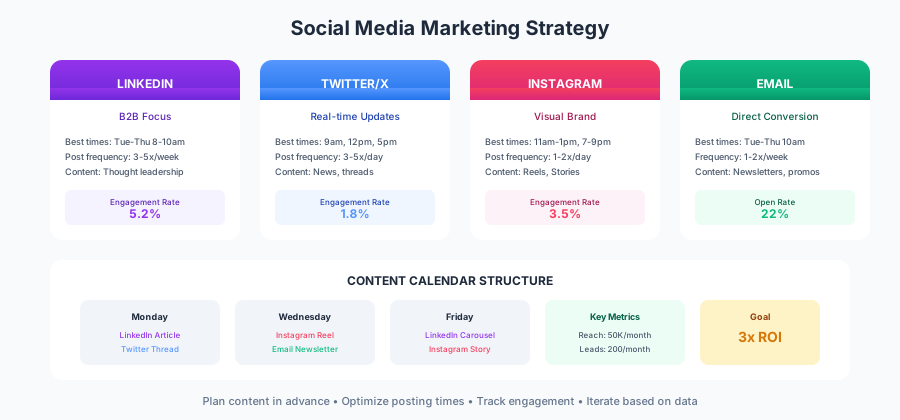
LinkedIn Strategies (B2B):
- Content marketing with valuable industry insights
- LinkedIn ads targeting specific job titles and industries
- InMail campaigns for direct prospect outreach
- LinkedIn Lead Gen forms for seamless capture
- Employee advocacy for extended reach
Facebook and Instagram:
- Lead generation ads with built-in forms
- Retargeting campaigns for website visitors
- Lookalike audiences based on existing customers
- Social proof campaigns featuring testimonials
Content Marketing for Lead Generation
Create valuable content that attracts and converts. See our marketing campaigns guide:
Blog Content Strategy:
- SEO-optimized articles for organic traffic
- How-to guides and tutorials that provide value
- Industry insights and trend analysis
- Comparison posts for consideration stage
Video Marketing:
- Educational webinars and workshops
- Product demo videos and tutorials
- Customer success stories and case studies
- Short-form content for social platforms
Content marketing generates 3x more leads than traditional marketing while costing 62% less.
Paid Acquisition Channels
| Channel | Best For | Avg CPL | Considerations |
|---|---|---|---|
| Google Ads | High-intent search | $50-150 | Keyword competition |
| LinkedIn Ads | B2B targeting | $75-200 | Professional audience |
| Facebook Ads | Broad reach, retargeting | $20-50 | Audience quality varies |
| Display/Programmatic | Awareness, retargeting | $10-30 | Lower intent |
| Content Syndication | Lead volume | $30-80 | Lead quality varies |
Funnel Optimization Strategies
Identifying Drop-Off Points
Funnel Analysis Process:
- Map conversion rates between each stage
- Identify stages with highest drop-off
- Analyze user behavior at problem points
- Test hypotheses for improvement
- Measure impact of changes
Common Drop-Off Points and Fixes:
| Drop-Off Point | Typical Cause | Solution |
|---|---|---|
| Landing page | Poor messaging or slow load | A/B test headlines, optimize speed |
| Form submission | Too many fields | Reduce fields, progressive profiling |
| Email open | Weak subject lines | Test subject lines, timing |
| Email click | Irrelevant content | Segment and personalize |
| MQL to SQL | Poor lead quality | Refine scoring, qualification |
| SQL to Opportunity | Slow follow-up | SLA enforcement, automation |
A/B Testing Framework
What to Test:
| Element | Variables | Expected Impact |
|---|---|---|
| Headlines | Value prop, tone, length | 10-30% lift |
| CTA buttons | Color, text, placement | 5-20% lift |
| Form length | Fields, layout | 10-50% lift |
| Social proof | Testimonials, logos, numbers | 5-15% lift |
| Page length | Short vs. long form | 10-40% lift |
Testing Process:
- Form hypothesis based on data
- Create single-variable test
- Run until statistical significance (min 100 conversions per variant)
- Implement winner
- Document learnings
Conversion Rate Optimization
Quick Wins:
- Add urgency (limited time offers, countdown timers)
- Reduce form fields to essentials
- Add trust signals (security badges, testimonials)
- Improve page load speed (under 3 seconds)
- Test button color and CTA copy
- Add exit-intent popups
Advanced Optimization:
- Personalize content based on traffic source
- Dynamic CTAs based on visitor behavior
- Chatbots for instant engagement
- Heat mapping for behavior analysis
- Session recordings for UX issues
Advanced Lead Generation Tactics
Account-Based Marketing (ABM)
Target high-value prospects with personalized campaigns:
ABM Funnel:
Target Account Identification
    ↓
Account Research & Mapping
    ↓
Personalized Content Creation
    ↓
Multi-Channel Engagement
    ↓
Sales-Marketing Coordination
    ↓
Account Conversion
ABM Components:
- Target account identification and prioritization
- Personalized content for key accounts
- Multi-channel coordination (ads, email, sales)
- Account-specific landing pages
- Executive engagement programs
Intent Data and Predictive Scoring
First-Party Intent Signals:
- Pricing page views
- Multiple return visits
- Long session duration
- High-value content consumption
- Demo/trial requests
Third-Party Intent Signals:
- Research activity on review sites
- Competitor comparison searches
- Industry keyword surges
- Job postings (indicates growth/change)
- Technology installations
Marketing Automation Workflows
Lead Nurture Automation:
Trigger: New lead captured
    ↓
Add to welcome sequence
    ↓
Monitor engagement (opens, clicks, pages viewed)
    ↓
If score > 50: Route to sales
If score < 30 after 14 days: Re-engagement sequence
If score 30-50: Continue nurture
Lead Routing Automation:
New MQL created
    ↓
Check: Is company in target account list?
    → Yes: Route to named account owner
    → No: Check territory assignment
        ↓
Route to territory rep
    ↓
Notify rep via Slack/email
    ↓
Start SLA timer (4 hour response)
    ↓
If no action in 4 hours: Escalate to manager
Sales and Marketing Alignment
Lead Qualification Framework
BANT Criteria:
- Budget - Financial capacity for your solution
- Authority - Decision-making power
- Need - Clear pain point addressed
- Timeline - Active buying window
MEDDIC (Enterprise Sales):
- Metrics - Quantifiable value
- Economic Buyer - Budget holder
- Decision Criteria - Evaluation factors
- Decision Process - Buying steps
- Identify Pain - Business challenge
- Champion - Internal advocate
Lead Status Definitions
| Status | Definition | Owner |
|---|---|---|
| New | Just captured, unworked | Marketing |
| Contacted | Initial outreach made | Sales |
| Engaged | Two-way communication | Sales |
| Qualified | Meets BANT/MEDDIC | Sales |
| Opportunity | Active sales process | Sales |
| Closed Won | Customer | Customer Success |
| Closed Lost | Did not convert | Sales |
| Nurture | Not ready, recycle | Marketing |
| Disqualified | Bad fit, remove | Sales/Marketing |
CRM Integration
Maximize lead value with proper management. Learn more in our CRM section:
- Lead tracking from first touch to closed deal
- Attribution modeling for campaign performance
- Sales pipeline visibility and forecasting
- Customer lifetime value optimization
Lead Generation Metrics and Analytics
Key Performance Indicators
Volume Metrics:
- Total leads generated
- Leads by channel and campaign
- MQLs generated
- SQLs generated
Quality Metrics:
- Lead-to-MQL rate
- MQL-to-SQL rate (sales acceptance)
- SQL-to-opportunity rate
- Lead quality score distribution
Efficiency Metrics:
- Cost per lead (CPL)
- Cost per MQL
- Cost per SQL
- Cost per acquisition (CPA)
Velocity Metrics:
- Time to MQL
- Time from MQL to SQL
- Sales cycle length
- Time to first response
Attribution Models
| Model | Best For | Approach |
|---|---|---|
| First-touch | Awareness campaigns | 100% credit to first interaction |
| Last-touch | Conversion campaigns | 100% credit to last interaction |
| Linear | Balanced view | Equal credit across touchpoints |
| Time-decay | Long sales cycles | More credit to recent touches |
| Position-based | Most common | 40% first, 40% last, 20% middle |
| Custom/Data-driven | Mature orgs | ML-based attribution |
Reporting Dashboard
Weekly Report Elements:
LEAD GENERATION WEEKLY REPORT

VOLUME:
- New leads: XXX (vs. target: XXX)
- MQLs: XXX (vs. target: XXX)
- SQLs: XXX (vs. target: XXX)

CONVERSION:
- Visitor-to-lead: X.X%
- Lead-to-MQL: XX%
- MQL-to-SQL: XX%

CHANNEL PERFORMANCE:
- Organic search: XXX leads, $XX CPL
- Paid search: XXX leads, $XX CPL
- LinkedIn: XXX leads, $XX CPL
- Content syndication: XXX leads, $XX CPL

TOP CONTENT:
1. [Asset name]: XXX leads
2. [Asset name]: XXX leads
3. [Asset name]: XXX leads

PIPELINE CONTRIBUTION:
- New pipeline from marketing: $XXX
- Marketing-sourced opportunities: XX

ACTION ITEMS:
- [Action item based on data]
Templates and Resources
Complete Lead Generation Package
Our comprehensive Sales & Marketing Hub includes:
- Lead Generation Templates - Landing pages, forms, and nurture campaigns
- Campaign Planning Resources - Multi-channel campaign frameworks
- CRM Implementation Guides - Lead scoring and qualification setup
- Sales Playbook Templates - Conversion processes and scripts
Related Guides
- Sales Pipeline Template Guide - Opportunity management
- Sales Operations Playbook - Sales process optimization
- Email Marketing Templates - Campaign best practices
- Marketing Automation Guide - Workflow design
- Marketing KPI Dashboard - Performance tracking
Implementation Checklist
Phase 1: Foundation (Weeks 1-2)
- Define MQL and SQL criteria
- Build lead scoring model
- Create marketing-sales SLA
- Set up CRM lead stages
- Configure lead routing
Phase 2: Content & Capture (Weeks 3-4)
- Audit existing lead magnets
- Create TOFU, MOFU, BOFU offers
- Build landing page templates
- Optimize forms for conversion
- Set up tracking and attribution
Phase 3: Nurture & Automation (Weeks 5-6)
- Build welcome email sequence
- Create nurture workflows by segment
- Set up lead scoring automation
- Configure MQL notifications
- Build re-engagement sequence
Phase 4: Optimization (Ongoing)
- Review funnel metrics weekly
- Run A/B tests continuously
- Refine scoring based on data
- Optimize underperforming channels
- Document and share learnings
Conclusion
Effective lead generation requires more than just capturing contact information—it demands a systematic approach to moving prospects through your funnel, qualifying them appropriately, and ensuring seamless handoff between marketing and sales.
Key Takeaways:
- Map your funnel clearly - Define stages, metrics, and conversion goals
- Score leads systematically - Use behavioral and demographic signals
- Align marketing and sales - Clear definitions, SLAs, and feedback loops
- Optimize continuously - Test, measure, and improve at every stage
- Focus on quality over quantity - Better leads beat more leads
Next Steps:
- Download lead generation templates
- Review sales pipeline guide
- Explore Sales & Marketing Hub
- Build your marketing dashboard
Start building your optimized lead generation funnel today. The compound effect of improved conversion rates at each stage transforms your entire revenue engine.