AI Governance Framework: Enterprise Guide to Responsible AI Management

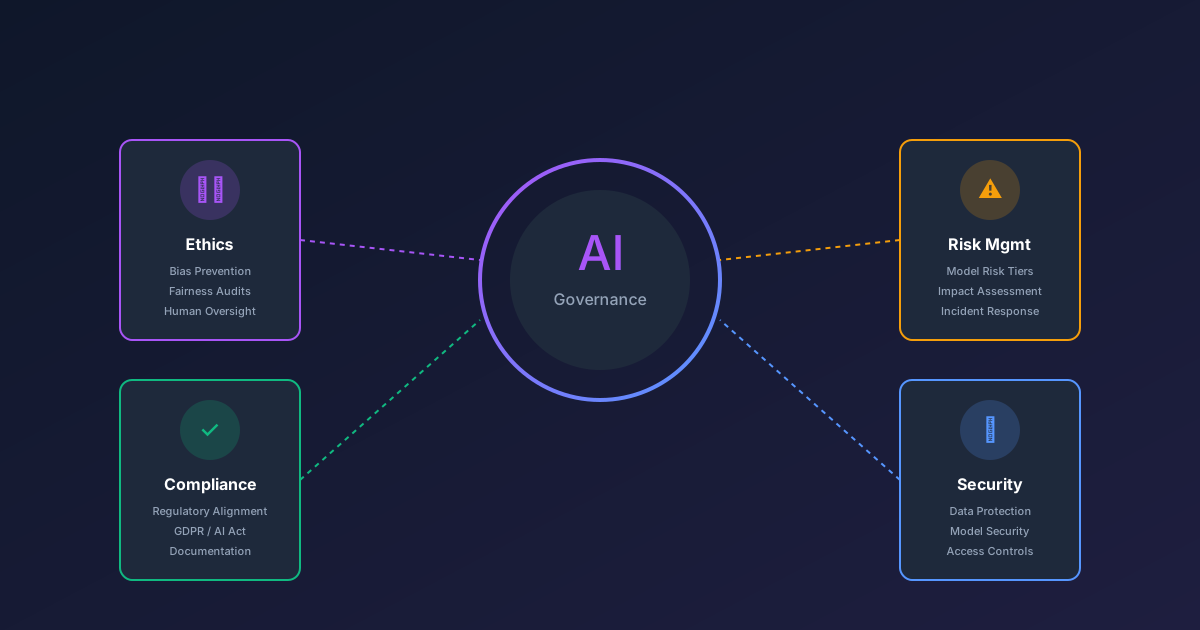
Organizations are racing to deploy AI, but governance is lagging behind. Without proper frameworks, AI initiatives create liability exposure, regulatory risk, and reputational damage. The companies that thrive will be those that balance AI innovation with responsible management.
AI governance isn't about slowing down adoption—it's about enabling sustainable AI at scale. This guide provides a comprehensive framework for governing AI across the enterprise, from ethics policies to model lifecycle management.
For related governance resources, explore our IT Management Hub, IT Governance Framework Guide, and AI Acceptable Use Policy Template. For security policies, see our Security & Compliance Center.
Why AI Governance Matters
The Governance Gap
| Metric | Organizations with AI | Organizations with Governance |
|---|---|---|
| Using AI in production | 75% | 23% |
| Have AI ethics policy | 75% | 45% |
| Have model inventory | 75% | 31% |
| Monitor for bias | 75% | 28% |
| Regulatory compliance program | 75% | 35% |
This gap creates significant risks:
Risk Categories
Operational Risks:
- Model failures causing business disruption
- Inconsistent AI outputs across systems
- Shadow AI proliferating without oversight
- Technical debt from ungoverned AI assets
Compliance Risks:
- EU AI Act violations (up to €35M or 7% revenue)
- SEC requirements for AI in financial decisions
- FDA regulations for AI in healthcare
- State privacy laws applying to AI processing
Ethical Risks:
- Algorithmic bias harming protected groups
- Lack of transparency in AI decisions
- Privacy violations from data misuse
- Displacement of workers without transition planning
Reputational Risks:
- Public AI failures causing brand damage
- Loss of customer trust
- Talent attrition (employees want ethical employers)
- Investor concerns about AI risk management
AI Governance Framework Structure
Framework Components
┌─────────────────────────────────────────────────────────────┐
│                    AI GOVERNANCE FRAMEWORK                   │
├─────────────────────────────────────────────────────────────┤
│                                                              │
│  ┌──────────────────────────────────────────────────────┐   │
│  │              1. GOVERNANCE STRUCTURE                  │   │
│  │  • AI Ethics Board • Roles & Responsibilities         │   │
│  │  • Accountability Framework • Escalation Paths        │   │
│  └──────────────────────────────────────────────────────┘   │
│                                                              │
│  ┌──────────────────────────────────────────────────────┐   │
│  │              2. PRINCIPLES & POLICIES                 │   │
│  │  • AI Ethics Principles • Acceptable Use Policy       │   │
│  │  • Data Governance • Third-Party AI Policy            │   │
│  └──────────────────────────────────────────────────────┘   │
│                                                              │
│  ┌──────────────────────────────────────────────────────┐   │
│  │              3. RISK MANAGEMENT                       │   │
│  │  • AI Risk Assessment • Bias Detection               │   │
│  │  • Model Validation • Incident Response               │   │
│  └──────────────────────────────────────────────────────┘   │
│                                                              │
│  ┌──────────────────────────────────────────────────────┐   │
│  │              4. LIFECYCLE MANAGEMENT                  │   │
│  │  • Model Inventory • Development Standards            │   │
│  │  • Deployment Gates • Monitoring & Retirement         │   │
│  └──────────────────────────────────────────────────────┘   │
│                                                              │
│  ┌──────────────────────────────────────────────────────┐   │
│  │              5. COMPLIANCE & AUDIT                    │   │
│  │  • Regulatory Mapping • Documentation                 │   │
│  │  • Audit Trail • Reporting & Metrics                  │   │
│  └──────────────────────────────────────────────────────┘   │
│                                                              │
└─────────────────────────────────────────────────────────────┘
Component 1: Governance Structure
AI Governance Organization
Recommended Structure:
                    ┌─────────────────┐
                    │   Board of      │
                    │   Directors     │
                    └────────┬────────┘
                             │
                    ┌────────▼────────┐
                    │  AI Ethics      │
                    │  Board/Council  │
                    └────────┬────────┘
                             │
            ┌────────────────┼────────────────┐
            │                │                │
    ┌───────▼─────┐  ┌───────▼──────┐  ┌──────▼──────┐
    │ AI Center   │  │ Legal &      │  │ Business    │
    │ of Excellence│ │ Compliance   │  │ Units       │
    └───────┬─────┘  └──────────────┘  └─────────────┘
            │
    ┌───────┴───────┐
    │               │
┌───▼───┐      ┌───▼───┐
│ Data  │      │ MLOps │
│ Science│      │ Team  │
└───────┘      └───────┘
Key Roles and Responsibilities
| Role | Responsibilities | Typical Placement |
|---|---|---|
| Chief AI Officer (CAIO) | Overall AI strategy and governance | C-suite, reports to CEO |
| AI Ethics Board | Policy approval, ethical guidance, escalation decisions | Cross-functional committee |
| AI Program Manager | Governance implementation, coordination | AI CoE |
| Model Risk Manager | Risk assessment, validation oversight | Risk Management |
| AI Legal Counsel | Regulatory compliance, contracts, IP | Legal department |
| Data Steward | Data quality, lineage, consent management | Data Governance |
| MLOps Lead | Model deployment, monitoring, operations | Technology/IT |
AI Ethics Board Charter
Purpose: Provide strategic oversight and ethical guidance for AI initiatives
Composition:
- Chief AI Officer (Chair)
- Chief Risk Officer
- Chief Legal Officer
- Chief Data Officer
- Business unit representatives
- External ethics advisor (optional)
Responsibilities:
- Approve AI ethics principles and policies
- Review high-risk AI use cases
- Adjudicate ethical dilemmas
- Monitor AI risk metrics
- Report to Board of Directors
Meeting Cadence:
- Monthly operational reviews
- Quarterly strategic reviews
- Ad-hoc for urgent matters
Decision Rights:
| Decision Type | Authority |
|---|---|
| New AI policy | Board approval required |
| High-risk AI deployment | Board approval required |
| Medium-risk AI deployment | CAIO approval, Board notification |
| Low-risk AI deployment | Business unit approval |
| AI incident response | Immediate CAIO authority, Board notification |
Component 2: Principles and Policies
AI Ethics Principles
Core Principles Template:
1. Fairness and Non-Discrimination
- AI systems will not discriminate based on protected characteristics
- We actively test for and mitigate algorithmic bias
- Disparate impact will be measured and addressed
2. Transparency and Explainability
- AI decision-making logic will be documented
- Stakeholders can request explanations of AI decisions affecting them
- Black-box models in high-stakes decisions require additional scrutiny
3. Privacy and Data Protection
- AI development follows data minimization principles
- Personal data use in AI requires proper consent and legal basis
- AI systems respect data subject rights
4. Accountability
- Every AI system has an accountable owner
- Human oversight appropriate to risk level
- Clear escalation paths for AI concerns
5. Safety and Security
- AI systems are tested for security vulnerabilities
- Fail-safe mechanisms prevent harmful outcomes
- Adversarial attacks are considered in design
6. Human Oversight
- Humans remain in control of AI decisions
- AI augments rather than replaces human judgment for high-stakes decisions
- Override capabilities exist for all AI systems
Policy Framework
| Policy | Scope | Owner | Review Cycle |
|---|---|---|---|
| AI Ethics Policy | Enterprise-wide principles | AI Ethics Board | Annual |
| AI Acceptable Use Policy | Employee AI tool usage | HR + IT | Semi-annual |
| AI Development Standards | Model building requirements | AI CoE | Quarterly |
| AI Procurement Policy | Third-party AI evaluation | Procurement + Legal | Annual |
| AI Data Governance | Training data requirements | Data Governance | Annual |
| AI Incident Response | Handling AI failures | Risk Management | Annual |
Use Case Classification
Classify AI use cases by risk level:
High Risk (Require Board Review):
- Decisions affecting employment, credit, housing
- Healthcare diagnostics or treatment recommendations
- Law enforcement or surveillance applications
- Critical infrastructure control
- Autonomous systems with safety implications
Medium Risk (CAIO Approval):
- Customer-facing recommendations
- Fraud detection and prevention
- Pricing optimization
- Content moderation
- Predictive maintenance with safety implications
Low Risk (Business Unit Approval):
- Internal productivity tools
- Document classification
- Meeting transcription
- Code completion assistance
- Marketing content generation
Component 3: Risk Management
AI Risk Assessment Framework
Risk Assessment Matrix
| Risk Category | Probability | Impact | Risk Score | Mitigation Priority |
|---|---|---|---|---|
| Bias/discrimination | Medium | High | High | Immediate |
| Privacy violation | Medium | High | High | Immediate |
| Model failure | Low | High | Medium | Planned |
| Regulatory non-compliance | Medium | High | High | Immediate |
| Reputational harm | Low | High | Medium | Planned |
| Security breach | Low | Critical | High | Immediate |
Risk Assessment Questionnaire
For each AI use case, answer:
Data Risks:
- What personal data is used for training/inference?
- Is data consent documented and valid?
- Are there data quality concerns?
- Does data represent all affected populations?
Model Risks:
- Has the model been tested for bias?
- Are model explanations available?
- What is the error rate and failure mode?
- How was the model validated?
Deployment Risks:
- Who is affected by AI decisions?
- Is human override available?
- How are errors detected and corrected?
- What is the rollback plan?
Compliance Risks:
- Which regulations apply?
- Is required documentation complete?
- Has legal review been conducted?
- Are audit trails maintained?
Bias Detection and Mitigation
Types of AI Bias:
| Bias Type | Description | Detection Method |
|---|---|---|
| Selection bias | Training data not representative | Dataset analysis |
| Measurement bias | Incorrect feature measurement | Feature audit |
| Algorithmic bias | Model amplifies existing bias | Fairness metrics |
| Evaluation bias | Test data not representative | Cross-validation |
| Deployment bias | Model applied to different population | Monitoring |
Fairness Metrics to Track:
Demographic Parity:
P(positive outcome | Group A) = P(positive outcome | Group B)

Equalized Odds:
P(positive prediction | positive outcome, Group A) =
P(positive prediction | positive outcome, Group B)

Disparate Impact Ratio:
Positive rate (disadvantaged group) / Positive rate (advantaged group) >= 0.8

Individual Fairness:
Similar individuals receive similar predictions
Bias Mitigation Strategies:
| Stage | Technique | Description |
|---|---|---|
| Pre-processing | Resampling | Balance training data across groups |
| Pre-processing | Data augmentation | Generate synthetic minority samples |
| In-processing | Fairness constraints | Add fairness terms to optimization |
| In-processing | Adversarial debiasing | Train to prevent group prediction |
| Post-processing | Threshold adjustment | Different thresholds per group |
| Post-processing | Calibration | Adjust outputs for equal accuracy |
Model Validation Requirements
| Validation Type | Low Risk | Medium Risk | High Risk |
|---|---|---|---|
| Technical validation | Required | Required | Required |
| Bias testing | Recommended | Required | Required + external |
| Security review | Standard | Enhanced | Penetration testing |
| Legal review | Optional | Recommended | Required |
| Ethics review | Optional | Recommended | Required |
| Independent audit | Optional | Recommended | Required |
Component 4: Lifecycle Management
AI Model Inventory
Maintain a registry of all AI systems:
| Field | Description | Example |
|---|---|---|
| Model ID | Unique identifier | AI-2024-0042 |
| Name | Descriptive name | Customer Churn Predictor |
| Business Unit | Owning department | Marketing Analytics |
| Owner | Accountable person | Jane Smith |
| Risk Level | High/Medium/Low | Medium |
| Status | Development/Production/Retired | Production |
| Training Data | Data sources used | CRM, transactions, surveys |
| Use Case | How model is used | Predict customer churn probability |
| Decision Impact | What decisions it informs | Retention campaign targeting |
| Deployment Date | When deployed | 2024-06-15 |
| Last Review | Last validation date | 2024-12-01 |
| Next Review | Scheduled review | 2025-06-01 |
Development Standards
Model Documentation Requirements:
| Document | Purpose | When Required |
|---|---|---|
| Model Card | Summarize model for stakeholders | All models |
| Data Sheet | Document training data | All models |
| Fairness Report | Bias testing results | Medium/High risk |
| Validation Report | Technical validation results | All models |
| Risk Assessment | Risk analysis and mitigations | All models |
Model Card Template:
# Model Card: [Model Name]

## Model Details
- Developer: [Team/Individual]
- Version: [Version number]
- Type: [Classification/Regression/etc.]
- License: [Internal/Commercial/Open source]

## Intended Use
- Primary use case: [Description]
- Out-of-scope uses: [What it shouldn't be used for]
- Users: [Who uses this model]

## Training Data
- Sources: [Data sources]
- Size: [Dataset size]
- Features: [Input features]
- Collection: [How data was collected]

## Performance
- Metrics: [Accuracy, F1, AUC, etc.]
- Evaluation data: [Test set description]
- Limitations: [Known weaknesses]

## Fairness
- Protected attributes tested: [Groups]
- Fairness metrics: [Results]
- Mitigations: [Actions taken]

## Ethical Considerations
- Risks: [Potential harms]
- Mitigations: [How addressed]
Deployment Gates
Stage-Gate Review Process:
| Gate | Stage | Criteria | Approver |
|---|---|---|---|
| G1 | Ideation | Business case, risk classification | Business Owner |
| G2 | Development | Technical design, data approval | AI CoE |
| G3 | Validation | Testing complete, bias checked | Model Risk |
| G4 | Deployment | Security review, legal sign-off | CAIO (if high risk) |
| G5 | Production | Monitoring configured, runbook ready | MLOps |
Deployment Checklist:
- Model documentation complete
- Risk assessment approved
- Bias testing passed thresholds
- Security review completed
- Legal review completed (if required)
- Data governance requirements met
- Monitoring and alerting configured
- Rollback procedure documented
- Incident response plan in place
- Stakeholder notification sent
Monitoring and Retirement
Continuous Monitoring:
| Metric | Threshold | Action |
|---|---|---|
| Prediction accuracy | < baseline - 5% | Alert, investigate |
| Data drift | Significant drift detected | Retrain consideration |
| Fairness metrics | Outside acceptable range | Immediate review |
| Latency | > SLA | Technical investigation |
| Error rate | > 1% | Alert, investigate |
| User complaints | Any | Review and respond |
Model Retirement Criteria:
- Performance degraded beyond acceptable threshold
- Business need no longer exists
- Replaced by superior model
- Regulatory or policy change makes it non-compliant
- Security vulnerability cannot be mitigated
Retirement Process:
- Document retirement rationale
- Notify stakeholders
- Transition to replacement (if applicable)
- Archive model artifacts
- Update model inventory
- Retain records per policy
Component 5: Compliance and Audit
Regulatory Landscape
Key Regulations:
| Regulation | Jurisdiction | Key Requirements | Effective |
|---|---|---|---|
| EU AI Act | European Union | Risk classification, conformity assessment | 2025-2027 |
| NYC Local Law 144 | New York City | Bias audits for hiring AI | 2023 |
| CCPA/CPRA | California | Automated decision-making disclosure | Active |
| Colorado AI Act | Colorado | High-risk AI disclosure, impact assessment | 2026 |
| GDPR Art. 22 | European Union | Right to human review of automated decisions | Active |
| SEC AI Guidance | United States | AI disclosure in financial services | 2024 |
Compliance Mapping:
| Requirement | EU AI Act | NYC LL144 | CCPA | Control |
|---|---|---|---|---|
| Risk classification | ✓ | Use case classification | ||
| Bias testing | ✓ | ✓ | Fairness testing process | |
| Transparency | ✓ | ✓ | ✓ | Model documentation |
| Human oversight | ✓ | ✓ | Human-in-the-loop | |
| Data quality | ✓ | Data governance | ||
| Technical documentation | ✓ | Model cards | ||
| Conformity assessment | ✓ | External audit |
Documentation Requirements
Required Records:
| Record | Retention Period | Purpose |
|---|---|---|
| Model inventory | Life of model + 5 years | Asset tracking |
| Training data logs | Life of model + 7 years | Audit, reproduction |
| Validation reports | Life of model + 7 years | Compliance evidence |
| Deployment approvals | Life of model + 7 years | Accountability |
| Monitoring logs | 3 years rolling | Incident investigation |
| Incident reports | 7 years | Regulatory compliance |
| Bias audit results | 4 years | NYC LL144 compliance |
Audit Trail Requirements
Trackable Events:
| Event Type | What to Log | Example |
|---|---|---|
| Data access | Who, when, what data | User X accessed training dataset Y |
| Model training | Parameters, data, results | Model trained with config Z |
| Deployment | Version, environment, approver | v2.1 deployed to prod by Admin A |
| Predictions | Input, output, timestamp | Prediction for customer 123 at time T |
| Overrides | Human decision, rationale | Override from "reject" to "approve" |
| Changes | Before/after, changer, reason | Threshold changed from 0.5 to 0.6 |
Governance Metrics Dashboard
| Metric | Target | Measurement |
|---|---|---|
| Model inventory coverage | 100% | Models registered / Total models |
| Risk assessments current | 100% | Assessed / Total (within 12 months) |
| Bias testing compliance | 100% | Tested / Required (Medium/High risk) |
| Documentation completeness | 100% | Complete docs / Total models |
| Incident response time | < 4 hours | Average time to triage |
| Training completion | 100% | Completed / Required personnel |
Implementation Roadmap
Phase 1: Foundation (Months 1-3)
| Activity | Owner | Deliverable |
|---|---|---|
| Executive sponsorship | CEO/Board | Governance mandate |
| AI inventory discovery | AI CoE | Draft model inventory |
| Current state assessment | Risk Management | Gap analysis |
| Stakeholder engagement | Program Manager | Buy-in from business units |
| Policy drafting | Legal + AI CoE | Draft policies |
Phase 2: Structure (Months 4-6)
| Activity | Owner | Deliverable |
|---|---|---|
| Form AI Ethics Board | CAIO | Chartered board |
| Define roles/responsibilities | HR + AI CoE | RACI matrix |
| Approve policies | AI Ethics Board | Published policies |
| Implement model registry | MLOps | Operational registry |
| Create risk framework | Risk Management | Assessment process |
Phase 3: Operationalize (Months 7-9)
| Activity | Owner | Deliverable |
|---|---|---|
| Pilot risk assessments | Risk Management | Completed assessments |
| Deploy monitoring | MLOps | Operational monitoring |
| Training rollout | HR + AI CoE | Trained workforce |
| Tool implementation | IT | Governance tools live |
| First audits | Internal Audit | Audit reports |
Phase 4: Mature (Months 10-12)
| Activity | Owner | Deliverable |
|---|---|---|
| Full inventory migration | AI CoE | 100% models registered |
| Process refinement | AI CoE | Updated procedures |
| Metrics baseline | AI Ethics Board | Baseline metrics |
| Regulatory readiness | Legal | Compliance certification |
| External audit (if required) | External | Audit opinion |
Key Takeaways
-
Governance enables, not restricts: Proper governance unlocks AI at scale by managing risk
-
Structure matters: Clear roles, responsibilities, and decision rights prevent confusion
-
Risk-proportionate approach: Not all AI needs the same oversight—classify and act accordingly
-
Document everything: AI governance depends on evidence and audit trails
-
Embed in the lifecycle: Governance checkpoints at each stage, not just deployment
-
Continuous monitoring: AI systems change over time—governance must be ongoing
For related resources, explore our AI Acceptable Use Policy Template, IT Governance Framework Guide, and IT Governance KPIs Dashboard.