Agile Project Charter Template: Lightweight Authorization for Scrum Teams

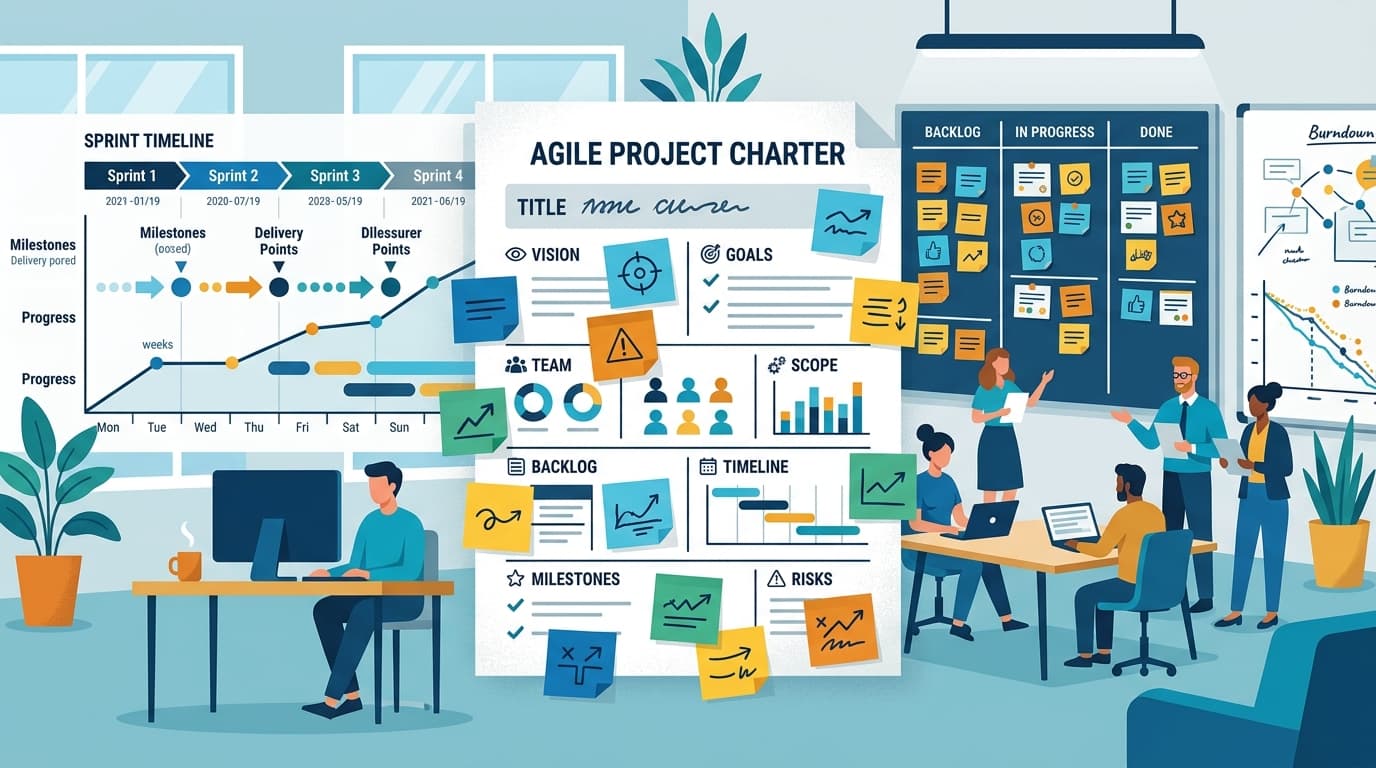
The Standish Group's 2025 CHAOS Report found that agile projects are 64% more likely to succeed than waterfall projects, yet 47% of agile teams still skip the project charter entirely — treating "agile" as permission to skip planning (Standish Group, 2025). That's a misunderstanding of the methodology. Agile doesn't eliminate planning; it makes planning lighter, faster, and more adaptable.
An agile project charter gives your team enough direction to start sprinting without drowning in documentation that'll be obsolete by sprint 3. This guide shows you what to include, how it differs from a traditional charter, and when each approach makes sense. For a ready-to-use document, download our project charter template.
Key Takeaways
- An agile charter is a 1-2 page living document — not a 20-page specification that nobody updates
- Focus on product vision, team composition, boundaries (what's in/out of scope), and definition of done
- Unlike traditional charters, agile charters evolve as the team learns — they're reviewed at retrospectives
- Use a traditional charter for fixed-scope, regulated, or multi-vendor projects; use agile for everything else
How an Agile Charter Differs From a Traditional Charter
A traditional project charter is a formal authorization document. It defines scope, timeline, budget, deliverables, and stakeholder roles in detail before any work begins. It's comprehensive, thorough, and almost always wrong — because requirements change, priorities shift, and the market doesn't wait for your Gantt chart.
An agile project charter takes a different approach:
| Aspect | Traditional Charter | Agile Charter |
|---|---|---|
| Length | 10-30 pages | 1-2 pages |
| Scope definition | Detailed requirements and deliverables | Product vision and initial backlog themes |
| Timeline | Fixed milestones and deadlines | Release targets with flexible scope |
| Budget | Fixed, detailed line items | Time-boxed investment (team cost × duration) |
| Change process | Formal change request and approval | Continuous through backlog refinement |
| Updates | Formal amendments requiring sign-off | Living document reviewed at retrospectives |
| Success metrics | Deliverables completed on time/budget | Business outcomes and value delivered |
The fundamental difference is philosophical. A traditional charter says "here's exactly what we'll build." An agile charter says "here's the problem we're solving and the team authorized to solve it."
Neither approach is universally better. The right choice depends on your context — more on that later.
What to Include in an Agile Project Charter
An effective agile charter has seven sections. Each one should be concise — if any section exceeds a single page, you're over-engineering it.
1. Product Vision
The product vision is a one-paragraph statement that answers: what are we building, for whom, and why does it matter? It's the North Star that keeps the team aligned when tactical decisions get complicated.
Format (Geoffrey Moore's vision template works well):
For [target customer] who [need or opportunity], the [product name] is a [product category] that [key benefit]. Unlike [competitive alternative], our product [key differentiator].
The vision shouldn't change sprint to sprint. If it does, you don't have a product vision — you have a reaction pattern.
2. Business Objectives and Success Metrics
Define 3-5 measurable objectives that the project must achieve to be considered successful. These aren't features — they're business outcomes.
Examples:
- Reduce customer onboarding time from 14 days to 3 days
- Achieve 500 active users within 90 days of launch
- Decrease support tickets related to data import by 60%
- Generate $50K in new MRR from the feature within 6 months
Each objective needs a measurement method and a target. "Improve the user experience" isn't a business objective. "Increase Net Promoter Score from 32 to 45" is.
3. Team Composition and Roles
List every person on the team, their role, and their time commitment. Agile projects fail when team members are spread across five projects at 20% allocation each.
| Role | Person | Commitment | Responsibility |
|---|---|---|---|
| Product Owner | Sarah Chen | 50% | Backlog prioritization, stakeholder management |
| Scrum Master | James Park | 50% | Process facilitation, impediment removal |
| Developer | Maria Rodriguez | 100% | Front-end development |
| Developer | David Kim | 100% | Back-end development, API design |
| Developer | Priya Sharma | 100% | Full-stack development |
| UX Designer | Alex Thompson | 50% | User research, interaction design |
| QA Engineer | Lisa Wang | 75% | Testing strategy, automation |
Critical rule: The charter should explicitly state that the listed team members are committed and won't be pulled to other projects without the Product Owner's agreement. This is the single most violated commitment in agile organizations, and it's worth putting in writing.
4. Project Boundaries (In Scope / Out of Scope)
This is the section that prevents scope creep. List what's explicitly included and — just as important — what's explicitly excluded.
In Scope:
- Customer self-service data import (CSV, Excel)
- Import validation with error reporting
- Import history and audit trail
- Integration with existing customer dashboard
Out of Scope:
- API-based import (future phase)
- Data export functionality
- Migration of existing customer data
- Mobile app support
The out-of-scope list isn't saying "never" — it's saying "not in this authorization." Items can move into scope through backlog prioritization in future iterations.
5. Initial Backlog Themes (Epics)
Don't list detailed user stories — those belong in the product backlog, not the charter. Instead, list the 5-8 high-level themes (epics) that represent the major areas of work.
Example:
- File upload and validation — users upload CSV/Excel files with real-time format validation
- Data mapping — users map imported columns to system fields
- Import processing — system processes validated data with progress tracking
- Error handling — clear error messages with row-level detail for failed records
- Import history — searchable log of past imports with status and summary
Each theme will decompose into user stories during backlog refinement. The charter captures the "what" at the highest level; the backlog handles the "how."
6. Definition of Done
The Definition of Done (DoD) is the team's quality contract. A user story isn't "done" until every item on this list is satisfied.
Example Definition of Done:
- Code written and peer-reviewed (pull request approved)
- Unit tests written with minimum 80% coverage
- Integration tests passing in the staging environment
- UX review completed for user-facing changes
- Documentation updated (API docs, user help, release notes)
- No critical or high-severity bugs outstanding
- Product Owner has accepted the story in the staging environment
The DoD should be agreed upon by the entire team — not imposed by management. It's a collective commitment to quality that prevents the "we'll clean it up later" trap that leads to technical debt. For more agile project management resources, check our agile project management templates.
7. Risks, Assumptions, and Constraints
Keep this lightweight — a bulleted list, not a risk management plan.
Risks:
- Third-party CSV parsing library may not handle all edge cases (mitigation: prototype in sprint 1)
- Product Owner availability at 50% may create prioritization bottlenecks (mitigation: designate a backup decision-maker)
Assumptions:
- The existing database schema can accommodate imported data without major changes
- Users are comfortable with browser-based file upload (no desktop app requirement)
Constraints:
- Must integrate with the existing authentication system (no new auth flow)
- Budget is time-boxed at 4 sprints (8 weeks) with the listed team
- Must meet WCAG 2.1 AA accessibility standards
Agile Project Charter Template: Filled-In Example
Here's a complete example for a real-world project:
Project: Customer Data Import Portal
Product Vision: For mid-market SaaS customers who need to migrate data from legacy systems, the Data Import Portal is a self-service tool that reduces onboarding time from 14 days to under 3 days. Unlike the current manual process requiring support tickets and engineering time, our portal lets customers import, validate, and map their own data with zero IT involvement.
Business Objectives:
- Reduce average customer onboarding time from 14 days to 3 days (measured by CRM onboarding stage duration)
- Eliminate 80% of data import support tickets (currently 120/month)
- Increase 30-day activation rate from 62% to 80%
Team: [See table above]
Duration: 4 sprints (8 weeks), starting April 14, 2026
In Scope: CSV/Excel upload, column mapping, validation, processing, error reporting, import history
Out of Scope: API import, data export, mobile support, bulk migration services
Epics: File upload & validation, Data mapping, Import processing, Error handling, Import history
Definition of Done: Code reviewed, 80%+ test coverage, integration tests green, UX approved, docs updated, PO accepted
Key Risks: CSV parsing edge cases (mitigate: sprint 1 prototype), PO availability (mitigate: backup decision-maker designated)
Authorized Budget: $120,000 (team cost for 8 weeks)
Sponsors: VP of Product (Jessica Martinez), VP of Customer Success (Robert Chen)
That's the entire charter — one page. It took 2 hours to write, not 2 weeks. And it gives the team everything they need to start sprint planning. For more charter examples across industries, see our guide on project charter examples.
When to Use an Agile Charter vs. a Traditional Charter
The choice isn't about methodology preference — it's about project characteristics.
Use an Agile Charter When:
- Requirements will evolve. The team will learn from early iterations and adjust course.
- The team is co-located or well-connected. Communication happens continuously, not through documents.
- Speed matters more than predictability. Getting to market fast is more valuable than knowing exactly what you'll deliver in month 6.
- The project is internal or single-vendor. You control the team and the process.
- Stakeholders trust the team. They're comfortable with "we'll figure out the details as we go" within guardrails.
Use a Traditional Charter When:
- Scope is fixed and well-understood. Regulatory compliance, infrastructure migration, or replicating an existing system.
- Multiple vendors or contracts are involved. You need documented expectations that serve as the basis for contractual obligations.
- Regulatory or audit requirements demand it. Some industries (government, defense, healthcare) require formal project authorization documentation.
- The project is large-scale and cross-organizational. When 50+ people across multiple departments are involved, you need more structure.
- Budget approval requires detailed justification. Some CFOs won't approve $500K without a detailed work breakdown structure.
Many organizations use a hybrid: an agile charter for the product team's day-to-day work, wrapped in a traditional charter for governance and budget approval. That works, as long as the two documents don't contradict each other. Download our project charter template which includes both agile and traditional formats.
Making the Charter a Living Document
The biggest difference between an agile charter and a traditional one is that the agile version evolves. Here's how to keep it alive:
Review at retrospectives. Every 3-4 sprints, ask: "Is our product vision still accurate? Are we still working toward the right business objectives? Has anything moved in or out of scope?" Update the charter if the answer is yes.
Update the DoD as the team matures. Early in a project, the Definition of Done might not include performance testing. As the product approaches production, add it. The DoD should get stricter over time, not looser.
Track scope changes visibly. When something moves from "out of scope" to "in scope," update the charter and note why. This creates a clear record of scope evolution that's far healthier than pretending scope never changed.
Keep it accessible. Pin the charter in your team's Slack channel, put it on the wiki landing page, reference it in sprint planning. A charter nobody reads is as useless as no charter at all.
For sprint-level planning that complements your charter, check out our sprint planning kit.
Frequently Asked Questions
Does an agile project charter replace the product backlog?
No. The charter and the backlog serve different purposes. The charter is an authorization and alignment document — it answers "why are we doing this, who's involved, and what are the boundaries?" The product backlog is a detailed, prioritized list of work items — it answers "what will we build next?" The charter's initial backlog themes (epics) decompose into user stories in the backlog. Think of the charter as the constitution and the backlog as the legislation. You can learn more in our glossary entry on project charters.
Who writes the agile project charter?
The Product Owner typically drafts the charter with input from the Scrum Master and key stakeholders. The entire team should review and agree to it — especially the Definition of Done and scope boundaries. Sponsors (usually the executive who's funding the project) approve and sign the charter. Don't outsource charter writing to a PMO that won't be involved in the project. The people who write it should be the people who live with it.
How long should an agile charter take to create?
Two to four hours, including stakeholder input. If it's taking longer, you're probably trying to include too much detail. The charter should capture decisions that are already made — product vision, team, boundaries. If those decisions haven't been made yet, the time is spent on decision-making, not documentation. Schedule a 2-hour workshop with the Product Owner, Scrum Master, key stakeholders, and at least one developer. Walk through each section and make decisions in real-time.
Should we update the charter mid-project?
Yes — that's the whole point of a living document. But not every sprint. Review the charter every 3-4 sprints or when there's a significant change: a team member leaving, a major scope adjustment, a pivot in business objectives. Small changes to the backlog don't warrant charter updates. A fundamental shift in product vision does. When you update, note the date and reason for the change. This creates a lightweight audit trail without the overhead of formal change management.
Can we use an agile charter for a fixed-price contract?
It gets tricky. Fixed-price contracts inherently conflict with agile's flexibility because the client expects defined deliverables for a defined price. If you must use a fixed-price contract, consider a hybrid approach: use the traditional charter for contractual obligations (scope, price, timeline) and an agile charter internally for the team's day-to-day work. The key is managing the gap — when the agile team learns something that affects the contracted scope, trigger the contract's change process early rather than absorbing scope changes silently.
What's the minimum viable charter for a small team?
For a team of 3-5 people working on an internal project, you can reduce the charter to five elements on a single page: (1) product vision in one sentence, (2) three success metrics, (3) team names and roles, (4) in-scope/out-of-scope bullet lists, and (5) definition of done. That's enough to align the team and set boundaries. You can write it on a whiteboard, take a photo, and pin it in Slack. Don't let perfect be the enemy of good — a rough charter that exists beats a polished charter that never gets written.