Agile & Scrum Methodology for IT Projects

Teams using Agile methodologies deliver software 37% faster and are 28% more successful than those using traditional methods. Agile's iterative approach enables rapid delivery, continuous feedback, and flexibility to change. This comprehensive guide shows you how to implement Agile and Scrum for your IT projects with practical templates and examples. For more resources, visit our IT Management Hub and IT Project Management section.
Understanding Agile
What is Agile?
Agile Definition: An iterative approach to software development that emphasizes flexibility, collaboration, and customer feedback.
Agile Manifesto Values:
- Individuals and interactions over processes and tools
- Working software over comprehensive documentation
- Customer collaboration over contract negotiation
- Responding to change over following a plan
12 Agile Principles:
- Satisfy customers through early and continuous delivery
- Welcome changing requirements
- Deliver working software frequently
- Business and developers work together daily
- Build projects around motivated individuals
- Face-to-face conversation is best
- Working software is primary measure of progress
- Sustainable development pace
- Continuous attention to technical excellence
- Simplicity—maximize work not done
- Self-organizing teams
- Regular reflection and adjustment
Agile vs. Waterfall:
| Aspect | Waterfall | Agile |
|---|---|---|
| Approach | Sequential | Iterative |
| Planning | Upfront, detailed | Continuous, adaptive |
| Requirements | Fixed early | Evolving |
| Delivery | Single, at end | Incremental, frequent |
| Change | Difficult, costly | Expected, welcomed |
| Customer | Involvement at milestones | Continuous collaboration |
| Risk | Discovered late | Mitigated early |
| Documentation | Comprehensive | Just enough |

Scrum Framework
What is Scrum?
Scrum Definition: An Agile framework for managing complex projects through iterative sprints, defined roles, and ceremonies.
Scrum Pillars:
- Transparency: All aspects visible to those responsible
- Inspection: Regular examination of progress
- Adaptation: Adjust when deviations detected
Scrum Values:
- Commitment: Team commits to goals
- Courage: Do the right thing and tackle tough problems
- Focus: Focus on sprint work
- Openness: Open about work and challenges
- Respect: Respect each other as capable professionals
Scrum Roles
Product Owner:
- Responsibility: Maximize value of product
- Activities:
- Define product vision
- Manage product backlog
- Prioritize features
- Accept or reject work
- Stakeholder liaison
- Skills: Business knowledge, decision-making, communication
Scrum Master:
- Responsibility: Facilitate Scrum process
- Activities:
- Coach team on Scrum
- Remove impediments
- Facilitate ceremonies
- Protect team from distractions
- Promote continuous improvement
- Skills: Servant leadership, coaching, conflict resolution
Development Team:
- Responsibility: Deliver potentially shippable increments
- Size: 3-9 people optimal
- Characteristics:
- Self-organizing
- Cross-functional
- No sub-teams or titles
- Collectively accountable
- Skills: Technical expertise, collaboration, estimation
Scrum Artifacts
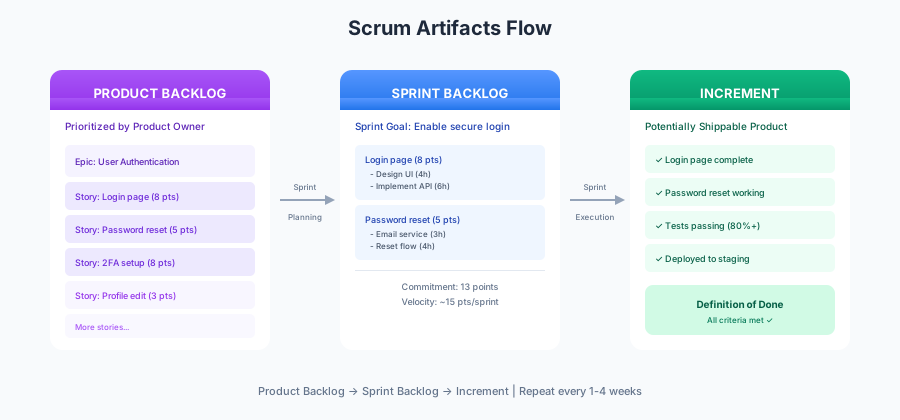
Product Backlog
Definition: Ordered list of everything needed in the product.
Backlog Items (User Stories):
User Story Format:
As a [type of user]
I want [some goal]
So that [some reason/benefit]

Example:
As a customer
I want to reset my password
So that I can regain access to my account

Acceptance Criteria:
- User receives email with reset link
- Link expires after 24 hours
- Password meets security requirements
- User receives confirmation of password change
Story Points:
- Relative sizing (not hours)
- Fibonacci sequence: 1, 2, 3, 5, 8, 13, 21
- Team-specific meaning
- Include complexity, effort, uncertainty
INVEST Criteria for Good Stories:
- Independent: Can be developed separately
- Negotiable: Details can be discussed
- Valuable: Delivers business value
- Estimable: Team can estimate size
- Small: Can complete in one sprint
- Testable: Clear acceptance criteria
Backlog Refinement:
- Ongoing activity (5-10% of sprint time)
- Add detail to upcoming stories
- Estimate stories
- Split large stories
- Remove obsolete items
- Re-prioritize based on value
Sprint Backlog
Definition: Product backlog items selected for the sprint plus plan for delivering them.
Sprint Backlog Contents:
- Selected user stories
- Tasks to complete stories
- Sprint goal
- Estimates
Task Breakdown Example:
User Story: Password Reset Feature (8 points)

Tasks:
- Design password reset UI (4 hours)
- Create email template (2 hours)
- Implement reset token generation (4 hours)
- Build reset password API endpoint (6 hours)
- Add token expiration logic (3 hours)
- Create password validation (3 hours)
- Write unit tests (4 hours)
- Integration testing (4 hours)
- Update documentation (2 hours)

Total Estimate: 32 hours
Assigned To: Team (self-organized)
Product Increment
Definition: Sum of all completed product backlog items in current sprint plus previous sprints.
Definition of Done (DoD):
Definition of Done Checklist:

Code Quality:
☐ Code written and peer reviewed
☐ Unit tests written and passing
☐ Code coverage > 80%
☐ No critical bugs
☐ Code standards followed

Testing:
☐ Integration tests passed
☐ Regression tests passed
☐ User acceptance criteria met
☐ Performance tested

Documentation:
☐ Code comments added
☐ User documentation updated
☐ Release notes updated

Deployment:
☐ Deployed to staging
☐ Stakeholder demo completed
☐ Approved by Product Owner

A story is only "Done" when ALL criteria met.
Scrum Events
Sprint
Duration: 1-4 weeks (2 weeks most common)
Sprint Characteristics:
- Fixed time-box
- Sprint goal defined
- No changes that endanger sprint goal
- Quality doesn't decrease
- Scope can be clarified/renegotiated
Sprint Cycle:
2-Week Sprint Example:

Day 1 (Monday):
- Sprint Planning (4 hours)
- Sprint begins

Days 2-9 (Tue-Wed, Week 2 Tue-Wed):
- Daily Standups (15 min)
- Development work
- Backlog refinement (ongoing)

Day 10 (Thursday):
- Sprint Review (2 hours)
- Sprint Retrospective (1.5 hours)
- Sprint ends

Day 11 (Friday):
- Next Sprint Planning
- New Sprint begins
Sprint Planning
Purpose: Plan work for upcoming sprint
Duration: 2-4 hours (for 2-week sprint)
Agenda:
Sprint Planning Meeting

Part 1: What (1-2 hours)
- Product Owner presents top priority items
- Team asks clarifying questions
- Discuss and agree on Sprint Goal
- Select items for Sprint Backlog
- Check team capacity
- Commit to what can be delivered

Part 2: How (1-2 hours)
- Team breaks down stories into tasks
- Discuss technical approach
- Identify dependencies
- Estimate hours for tasks
- Confirm realistic sprint plan

Outputs:
- Sprint Goal
- Sprint Backlog
- Team commitment
Sprint Goal Example: "Enable users to manage their account passwords independently"
Daily Standup
Purpose: Synchronize team and plan next 24 hours
Duration: 15 minutes maximum
Time: Same time daily (e.g., 9:00 AM)
Format (Each team member answers):
- What did I complete yesterday?
- What will I work on today?
- Are there any impediments blocking me?
Standup Best Practices:
- Stand up (keeps it short)
- Same time, same place
- Everyone attends
- Not for problem-solving (park issues for after)
- Update board/tool during standup
- Scrum Master facilitates
- Optional for stakeholders (listen only)
Common Mistakes:
- Status report to Scrum Master
- Too much detail
- Problem-solving during standup
- Goes over 15 minutes
- Not daily
- Remote team not engaged
Sprint Review
Purpose: Inspect increment and adapt product backlog
Duration: 1-2 hours (for 2-week sprint)
Participants: Scrum team + stakeholders
Agenda:
Sprint Review

1. Sprint Goal Review (5 min)
   - Scrum Master reviews sprint goal
   - What was committed vs. completed

2. Demo (45 min)
   - Team demonstrates completed work
   - Only "Done" items shown
   - Working software (not slides)
   - Stakeholder questions

3. Feedback (30 min)
   - Stakeholders provide feedback
   - Discuss what to build next
   - Impact on timeline/budget

4. Product Backlog Update (15 min)
   - Adjust backlog based on feedback
   - Re-prioritize if needed
   - Estimate release progress

Outputs:
- Updated product backlog
- Feedback incorporated
Sprint Retrospective
Purpose: Reflect on process and identify improvements
Duration: 1-1.5 hours (for 2-week sprint)
Participants: Scrum team only (safe environment)
Format:
Retrospective Template

1. Set the Stage (5 min)
   - Review retrospective purpose
   - Set positive tone
   - Remind of safe space

2. Gather Data (20 min)
   - What went well?
   - What didn't go well?
   - What puzzles us?

3. Generate Insights (20 min)
   - Why did things happen?
   - What patterns do we see?
   - Root cause analysis

4. Decide What To Do (20 min)
   - Select 1-3 improvements
   - Create action items
   - Assign owners
   - Define success metrics

5. Close (5 min)
   - Appreciation round
   - Commitment to actions

Outputs:
- 1-3 actionable improvements
- Owners assigned
- Follow-up planned
Retrospective Techniques:
- Mad, Sad, Glad
- Start, Stop, Continue
- Sailboat (wind & anchors)
- Timeline
- 4Ls (Liked, Learned, Lacked, Longed For)
Scrum Board
Physical/Digital Board
Board Columns:
- To Do: Sprint backlog items not started
- In Progress: Currently being worked
- In Review: Code review, testing
- Done: Meets definition of done
Board Items:
- User stories (larger cards)
- Tasks (smaller cards/sticky notes)
- Color coding (by type, owner, etc.)
- Story points displayed
- Blockers marked (red dot/flag)
Digital Boards:
- Jira
- Azure DevOps
- Trello
- Monday.com
- Asana
Board Best Practices:
- Update in real-time
- Make visible to all
- Review in daily standup
- Clear work-in-progress limits (Kanban)
- Celebrate completions
Agile Estimation
Planning Poker
Purpose: Team-based estimation using consensus
Process:
- Product Owner reads user story
- Team asks clarifying questions
- Each member selects estimate card (privately)
- All reveal simultaneously
- Discuss differences (highest and lowest explain)
- Re-estimate
- Repeat until consensus
Planning Poker Cards:
- 0, 0.5, 1, 2, 3, 5, 8, 13, 20, 40, 100
- ?, ☕ (need break)
Estimation Guidelines:
- 1 point: Very small, simple task
- 2-3 points: Small story, well understood
- 5 points: Medium story
- 8 points: Large story, might split
- 13+ points: Too large, must split
Velocity
Definition: Amount of work team completes in a sprint
Calculation:
Sprint 1: 23 points completed
Sprint 2: 27 points completed
Sprint 3: 25 points completed

Average Velocity: (23 + 27 + 25) / 3 = 25 points per sprint

Use for capacity planning:
- 100-point epic / 25 points per sprint = 4 sprints
Velocity Guidelines:
- Use for planning, not performance metric
- Normalize after 3-5 sprints
- Varies by team composition
- Points are team-specific
- Don't compare teams
Scaling Agile
SAFe (Scaled Agile Framework)
Levels:
- Team: Individual Scrum teams
- Program: Agile Release Train (5-12 teams)
- Large Solution: Multiple release trains
- Portfolio: Strategic themes, epics
Key Concepts:
- Program Increment (PI): 8-12 week period
- PI Planning: 2-day planning event
- Release Train Engineer: Facilitates at program level
- System Demo: Integration of team work
Scrum of Scrums
Purpose: Coordinate multiple Scrum teams
Format:
- Daily or 2-3 times per week
- One representative per team
- 15-30 minutes
- Discuss dependencies and blockers
- Coordinate integration
Questions:
- What has your team done since last meeting?
- What will your team do before next meeting?
- Are there any impediments?
- Are you about to create an impediment for another team?
Common Challenges
Challenge 1: Unclear Product Owner
Symptoms:
- Conflicting priorities
- Lack of decisions
- Multiple "owners"
- Team confusion
Solutions:
- Designate single Product Owner
- Empower with authority
- Train on role responsibilities
- Shield from organizational pressure
- Build backlog collaboratively
Challenge 2: Incomplete Stories
Symptoms:
- Vague acceptance criteria
- Missing details
- Team blocked
- Assumptions made
Solutions:
- Invest in backlog refinement
- Use INVEST criteria
- Include acceptance criteria
- Definition of Ready checklist
- Product Owner availability
Challenge 3: Interruptions and Context Switching
Symptoms:
- Sprint commitments missed
- Team frustrated
- Velocity unpredictable
- Quality issues
Solutions:
- Protect sprint scope
- Handle urgent items next sprint
- Create support rotation
- Educate stakeholders
- Scrum Master shields team
Challenge 4: Technical Debt
Symptoms:
- Increasing bugs
- Slower delivery over time
- Developer frustration
- Difficult to add features
Solutions:
- Include refactoring in sprint
- Allocate capacity (20% guideline)
- Track technical debt backlog
- Make visible to Product Owner
- Continuous improvement
Free Agile/Scrum Resources
Complete Agile Toolkit
Our Agile/Scrum package includes:
- User story templates
- Sprint planning template
- Daily standup format
- Sprint review agenda
- Retrospective templates
- Definition of Done template
- Scrum board template
- Burndown chart template
- Velocity tracker
- Release planning template
Download Free Agile/Scrum Templates →
Related Resources
Project Management Templates:
Conclusion
Agile and Scrum provide powerful frameworks for delivering software iteratively, incorporating feedback, and responding to change. By implementing Scrum ceremonies, roles, and artifacts, IT teams can improve delivery speed, quality, and stakeholder satisfaction.
Implementation Checklist:
- Download Agile/Scrum templates
- Train team on Scrum basics
- Define roles (PO, SM, Dev Team)
- Create product backlog
- Establish Definition of Done
- Set sprint length (recommend 2 weeks)
- Plan first sprint
- Implement daily standups
- Conduct sprint review
- Hold retrospective
- Continuously improve
Success Factors:
- Executive support
- Empowered Product Owner
- Dedicated Scrum Master
- Self-organizing team
- Continuous improvement mindset
- Stakeholder engagement
- Technical excellence focus
- Regular ceremonies
- Transparent communication
- Embrace change
Next Steps:
- Download Agile/Scrum templates →
- Review project management →
- Compare delivery approaches →
- Visit Project Management hub →
Start delivering value faster with Agile and Scrum. Download our comprehensive template package and start your first sprint today.