Project Charter Examples: 5 Real-World Templates You Can Copy

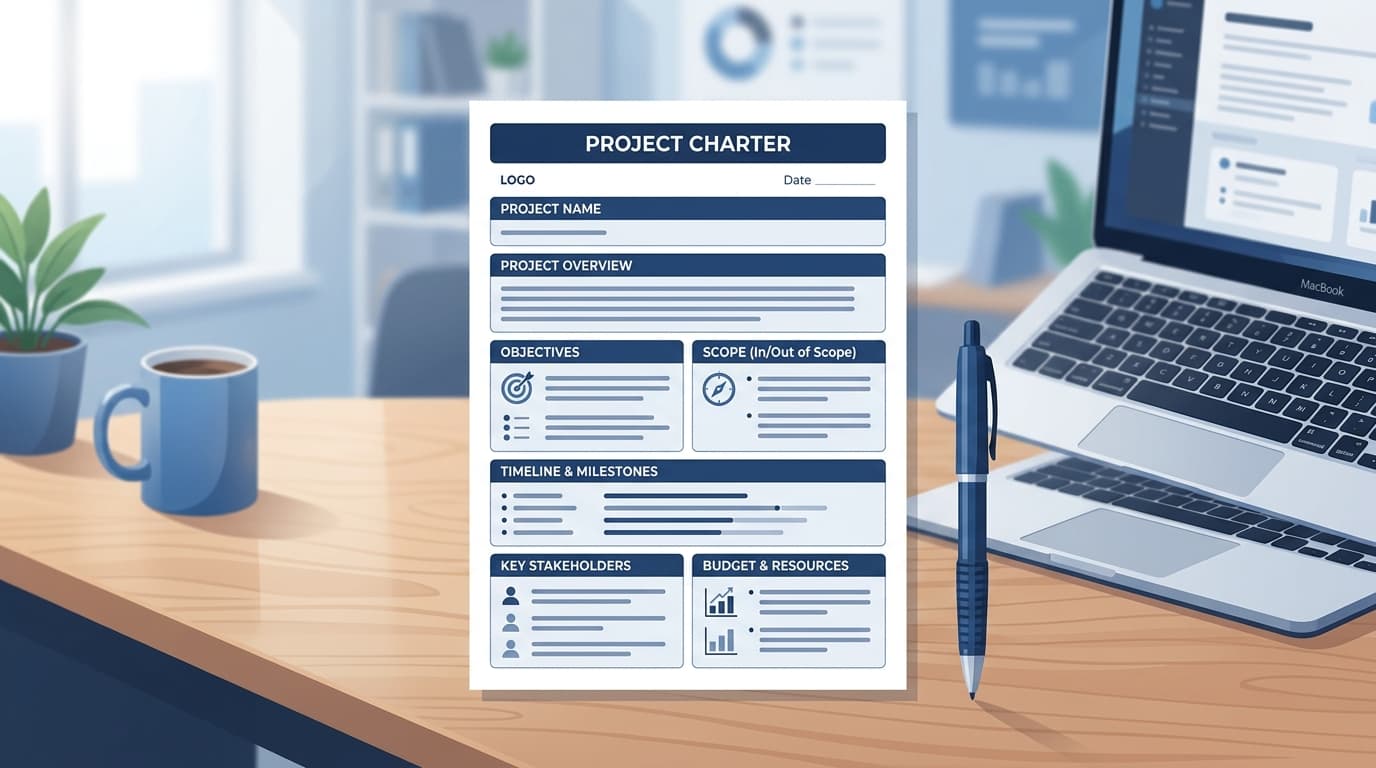
A project charter is the single document that separates projects that get done from projects that drift. Yet 37% of project failures trace directly to a lack of clearly defined objectives and milestones (PMI, 2024). The fix isn't complicated — it's a one-to-five page document that most teams skip because they don't know what a good one looks like.
This guide gives you five complete project charter examples, filled in with realistic data, that you can copy and adapt for your own projects. Whether you're upgrading infrastructure, launching a marketing campaign, or implementing a compliance program, you'll find a charter that matches your situation.
Key Takeaways
- Only 31% of projects finish on time, on budget, and on scope — formal charters dramatically improve these odds (Standish Group, 2020)
- Every charter needs six core sections: purpose, objectives, scope, stakeholders, budget, and timeline
- The five examples below cover IT infrastructure, software development, office relocation, marketing campaigns, and compliance implementation
- Download a free project charter template to start immediately
What Makes a Good Project Charter Example?
A strong project charter answers six questions in under five pages: Why are we doing this? What will success look like? What's in scope and what isn't? Who's involved? How much will it cost? When will it be done?
According to PMI's 2025 Pulse of the Profession report, projects with a clear vision of success achieve a +41 Net Project Success Score, compared to -18 when there's no clear vision (PMI, 2025). That's what a charter provides — documented clarity before a single hour of work begins.
Before we look at specific examples, here are the sections every project charter should include:
| Section | Purpose | Length |
|---|---|---|
| Project Purpose | Why this project exists — the business problem or opportunity | 2-3 sentences |
| Objectives | Measurable success criteria (SMART format) | 3-5 bullets |
| Scope | What's included AND what's excluded | Two lists |
| Key Stakeholders | Sponsor, PM, team leads, and their authority level | Table |
| Budget | Total budget with major category breakdown | Summary + table |
| Timeline | Major milestones with target dates | 4-6 milestones |
Now let's see how these sections look when filled in with real project data.
Example 1: IT Infrastructure Upgrade Charter
This charter authorizes a network and server refresh across three office locations. It's the most common type of IT charter — replacing aging equipment before it causes outages.
PROJECT CHARTER — Network Infrastructure Upgrade
Project Purpose: Replace end-of-life network switches, firewalls, and core servers across the New York, Chicago, and Austin offices. Current equipment is 7+ years old with increasing failure rates — 14 unplanned outages in the past 12 months costing an estimated $340,000 in lost productivity.
Objectives:
- Reduce unplanned network outages by 90% within 6 months of completion
- Achieve 99.95% network availability (up from current 98.7%)
- Support 2x current bandwidth for planned VoIP and video conferencing rollout
- Complete migration with zero data loss and less than 4 hours total planned downtime per site
Scope:
| In Scope | Out of Scope |
|---|---|
| Core switches at 3 offices | End-user devices (laptops, phones) |
| Perimeter firewalls (Palo Alto) | Application-level changes |
| Server room UPS replacement | Office WiFi access points (separate project) |
| Cable management and labeling | Telecom carrier contract renegotiation |
| Network monitoring tool setup |
Key Stakeholders:
| Role | Name | Responsibility |
|---|---|---|
| Executive Sponsor | Maria Chen, CTO | Budget approval, escalation decisions |
| Project Manager | James Wright | Day-to-day coordination, vendor management |
| Network Lead | Sarah Patel | Technical design, implementation |
| Facilities Coordinator | Tom Rivera | Physical access, power coordination |
Budget Summary: $485,000
| Category | Amount |
|---|---|
| Hardware (switches, firewalls, servers) | $312,000 |
| Installation labor | $78,000 |
| Cable infrastructure | $35,000 |
| Monitoring software licenses | $28,000 |
| Contingency (10%) | $32,000 |
Timeline:
| Milestone | Target Date |
|---|---|
| Charter approved | Jan 15 |
| Vendor selection complete | Feb 15 |
| Hardware delivered | Mar 15 |
| New York office migration | Apr 1-3 |
| Chicago office migration | Apr 15-17 |
| Austin office migration | May 1-3 |
| Post-migration monitoring complete | Jun 1 |
Approved by: Maria Chen, CTO — January 12, 2026
This charter works because it quantifies the problem ($340,000 in lost productivity), sets measurable objectives (99.95% availability), and clearly separates what's included from what's not. The WiFi access point exclusion prevents scope creep — a factor that affects 52% of projects (PMI, 2024).
For more IT project management frameworks, see our complete IT project management guide.
Example 2: Software Development Project Charter
Software projects fail at higher rates than any other category. This charter example shows how to authorize a customer portal development effort with clear boundaries.
PROJECT CHARTER — Customer Self-Service Portal
Project Purpose: Build a web-based customer portal that allows clients to view invoices, submit support tickets, track order status, and manage their account settings. Currently, 68% of support calls are for tasks customers could handle themselves, costing $12 per call average.
Objectives:
- Reduce support call volume by 40% within 90 days of launch
- Achieve 70% customer adoption rate within 6 months
- Process 80% of invoice inquiries through self-service (currently 0%)
- Maintain page load time under 2 seconds on mobile devices
Scope:
| In Scope | Out of Scope |
|---|---|
| Invoice viewing and PDF download | Payment processing (Phase 2) |
| Support ticket submission and tracking | Live chat integration |
| Order status with real-time tracking | Mobile native app |
| Account profile management | Customer-to-customer community forum |
| SSO integration with existing auth | API for third-party integrations |
Key Stakeholders:
| Role | Name | Responsibility |
|---|---|---|
| Executive Sponsor | David Kim, VP Operations | Business requirements, go/no-go |
| Project Manager | Lisa Park | Sprint planning, stakeholder updates |
| Tech Lead | Marcus Johnson | Architecture, code reviews |
| UX Designer | Priya Sharma | User research, interface design |
| Customer Success Lead | Rachel Torres | Beta testing, adoption strategy |
Budget Summary: $275,000
| Category | Amount |
|---|---|
| Development team (4 engineers × 4 months) | $192,000 |
| UX design and research | $35,000 |
| Cloud infrastructure (AWS) | $18,000 |
| QA and testing | $15,000 |
| Contingency (5%) | $15,000 |
Timeline:
| Milestone | Target Date |
|---|---|
| Charter approved | Feb 1 |
| User research complete | Feb 28 |
| MVP feature set locked | Mar 15 |
| Alpha release (internal testing) | May 1 |
| Beta release (10 pilot customers) | Jun 1 |
| General availability | Jul 15 |
Approved by: David Kim, VP Operations — January 28, 2026
Notice how the scope exclusions prevent the most common software scope creep triggers: payment processing, mobile app, and third-party APIs are explicitly deferred to Phase 2. The statement of work template can supplement this charter with detailed technical specifications for the development team.
Example 3: Office Relocation Charter
Office moves are notoriously under-planned. This charter example covers a 150-person office relocation with IT, facilities, and HR coordination.
PROJECT CHARTER — Office Relocation to 500 Commerce Drive
Project Purpose: Relocate headquarters from the current 12,000 sq ft space at 200 Main Street to a new 18,000 sq ft facility at 500 Commerce Drive. Current lease expires September 30. The new space accommodates projected headcount growth of 40% over the next 3 years and includes dedicated server room and collaboration spaces.
Objectives:
- Complete physical move over one weekend with zero business days lost
- All employees operational at new location by Monday morning (Day 1)
- IT systems — phone, network, servers — functional before staff arrival
- Stay within $180,000 relocation budget (excluding new lease costs)
Scope:
| In Scope | Out of Scope |
|---|---|
| Physical move of all furniture and equipment | New furniture purchases (separate PO) |
| IT infrastructure setup at new site | Build-out/construction (landlord responsibility) |
| Phone system migration | New phone system evaluation |
| Employee communication plan | Remote work policy changes |
| Address update across all vendors and services | Brand/marketing material redesign |
| Parking and access badge setup | New cafeteria vendor selection |
Key Stakeholders:
| Role | Name | Responsibility |
|---|---|---|
| Executive Sponsor | Jennifer Walsh, COO | Budget, lease coordination |
| Project Manager | Alex Hoffman | Move logistics, vendor coordination |
| IT Lead | Chris Nakamura | Network, servers, phones |
| HR Lead | Diana Patel | Employee communication, first-day support |
| Facilities Lead | Robert Gomez | Physical space, security, access |
Budget Summary: $178,000
| Category | Amount |
|---|---|
| Moving company (Corrigan Moving) | $45,000 |
| IT relocation and setup | $62,000 |
| New cabling and network drops | $28,000 |
| Temporary signage and wayfinding | $5,000 |
| Employee move kits and communication | $8,000 |
| Weekend overtime for IT team | $12,000 |
| Contingency (10%) | $18,000 |
Timeline:
| Milestone | Target Date |
|---|---|
| Charter approved | Apr 1 |
| IT infrastructure pre-wired at new site | Jul 15 |
| Employee communication and move kits distributed | Aug 1 |
| Server and phone migration (weekend) | Aug 23-24 |
| Physical move (weekend) | Aug 30-31 |
| Day 1 at new office — all employees operational | Sep 1 |
Approved by: Jennifer Walsh, COO — March 28, 2026
The critical insight here is the "zero business days lost" objective. This forces the team to plan parallel IT setup at the new site rather than a sequential move-then-setup approach. Every hour of downtime for 150 employees costs roughly $15,000 in lost productivity.
Example 4: Marketing Campaign Launch Charter
Marketing initiatives often run without formal authorization, leading to budget overruns and unclear success metrics. This charter fixes that.
PROJECT CHARTER — Q3 Product Launch Campaign: AnalyticsPro 2.0
Project Purpose: Plan and execute a multi-channel marketing campaign to launch AnalyticsPro 2.0, targeting mid-market finance teams. The product includes 4 new features (predictive forecasting, natural language queries, automated reporting, mobile dashboard). Goal is to generate 2,000 qualified leads and 50 new enterprise deals within 90 days of launch.
Objectives:
- Generate 2,000 MQLs from campaign activities within 90 days
- Achieve 50 SQLs converting to closed-won deals ($750,000 pipeline)
- Reach 500,000 impressions across paid and organic channels
- Maintain customer acquisition cost (CAC) below $150 per MQL
Scope:
| In Scope | Out of Scope |
|---|---|
| Landing page and product demo video | Product development or feature changes |
| Email nurture sequences (6-email series) | Pricing changes or discount approvals |
| LinkedIn and Google Ads campaigns | Partner co-marketing (separate initiative) |
| 3 customer case studies | Press release (PR team owns separately) |
| Sales enablement deck and battle cards | International market campaigns |
| Launch webinar (live + on-demand) |
Key Stakeholders:
| Role | Name | Responsibility |
|---|---|---|
| Executive Sponsor | Amy Rodriguez, CMO | Budget approval, go-to-market strategy |
| Project Manager | Kevin O'Brien | Campaign execution, timeline |
| Content Lead | Mia Chen | Copy, case studies, email sequences |
| Demand Gen Lead | Jason Taylor | Paid ads, landing page optimization |
| Sales Enablement | Laura Kim | Sales deck, battle cards, training |
Budget Summary: $125,000
| Category | Amount |
|---|---|
| Paid media (LinkedIn + Google Ads) | $65,000 |
| Video production (product demo + testimonials) | $22,000 |
| Design (landing page, email, ads) | $15,000 |
| Webinar platform and promotion | $8,000 |
| Content creation (case studies, blog posts) | $10,000 |
| Contingency (4%) | $5,000 |
Timeline:
| Milestone | Target Date |
|---|---|
| Charter approved | May 1 |
| Case studies and content complete | Jun 15 |
| Landing page and email sequences live | Jul 1 |
| Product demo video final | Jul 10 |
| Launch day — all channels activated | Jul 15 |
| Webinar (live event) | Jul 22 |
| 30-day performance review | Aug 15 |
| 90-day campaign close and ROI report | Oct 15 |
Approved by: Amy Rodriguez, CMO — April 28, 2026
This charter sets a clear CAC target ($150/MQL), which prevents the team from chasing vanity metrics like impressions without accountability. The 90-day review period creates a defined end point — without it, campaigns tend to drift indefinitely.
Example 5: Compliance Implementation Charter
Compliance projects carry legal and regulatory deadlines that can't slip. This charter example authorizes an ISO 27001 certification program.
PROJECT CHARTER — ISO 27001:2022 Certification Program
Project Purpose: Implement an Information Security Management System (ISMS) and achieve ISO 27001:2022 certification within 12 months. Three enterprise prospects (combined $2.4M annual revenue potential) require ISO 27001 certification as a condition of doing business. Current security posture: informal policies, no documented risk register, ad hoc incident response.
Objectives:
- Pass Stage 1 audit (documentation review) by Month 8
- Pass Stage 2 audit (operational effectiveness) by Month 11
- Achieve ISO 27001:2022 certification by Month 12
- Implement documented controls for all 93 Annex A controls
- Reduce security incidents by 50% within first year of ISMS operation
Scope:
| In Scope | Out of Scope |
|---|---|
| ISMS documentation (policies, procedures) | SOC 2 Type II certification (future phase) |
| Risk assessment and treatment plan | Physical security renovations |
| 93 Annex A control implementation | New security tool purchases > $50K (separate approval) |
| Internal audit program | Customer-facing security portal |
| Employee security awareness training | Third-party penetration testing contract |
| Management review process |
Key Stakeholders:
| Role | Name | Responsibility |
|---|---|---|
| Executive Sponsor | Michael Lee, CEO | Board reporting, resource allocation |
| Project Manager | Sarah Mitchell, CISO | ISMS implementation, audit coordination |
| Compliance Lead | Aisha Patel | Policy drafting, gap analysis |
| IT Security Lead | Ryan Kim | Technical control implementation |
| HR Representative | Elena Vasquez | Training program, policy acknowledgments |
| External Consultant | InfoSec Partners LLC | Gap analysis, audit prep, mock audit |
Budget Summary: $210,000
| Category | Amount |
|---|---|
| External consulting (gap analysis + mock audit) | $65,000 |
| Certification body audit fees (Stage 1 + Stage 2) | $35,000 |
| GRC platform (12-month license) | $28,000 |
| Employee training program | $18,000 |
| Policy and procedure development | $22,000 |
| Internal audit resources | $15,000 |
| Documentation and templates | $12,000 |
| Contingency (7%) | $15,000 |
Timeline:
| Milestone | Target Date |
|---|---|
| Charter approved | Jan 15 |
| Gap analysis complete | Mar 1 |
| Risk assessment and treatment plan | Apr 15 |
| ISMS policies and procedures drafted | Jun 1 |
| Employee training delivered | Jul 15 |
| Internal audit complete | Aug 15 |
| Stage 1 audit (documentation) | Sep 15 |
| Corrective actions complete | Oct 15 |
| Stage 2 audit (operational) | Nov 15 |
| Certification issued | Dec 15 |
Approved by: Michael Lee, CEO — January 10, 2026
The $2.4M revenue justification is critical here — it ties the certification cost ($210,000) to concrete business value, giving the project an 11x ROI. For a complete set of security policy templates to support ISO 27001 implementation, see our IT policy templates guide and free IT policy templates collection.
How Do These Five Examples Compare?
Each charter example targets a different project type with different risk profiles, budgets, and stakeholder structures:
| Factor | IT Upgrade | Software Dev | Office Move | Marketing | Compliance |
|---|---|---|---|---|---|
| Budget | $485K | $275K | $178K | $125K | $210K |
| Duration | 5 months | 6 months | 5 months | 6 months | 12 months |
| Team Size | 4 core | 5 core | 5 core | 5 core | 6 core |
| Risk Level | Medium | High | Medium | Low | High |
| Deadline Type | Flexible | Milestone | Hard (lease) | Flexible | Regulatory |
| Key Metric | 99.95% uptime | 40% call reduction | Zero downtime | 2,000 MQLs | Certification |
The pattern is clear: regardless of project type, the charter structure stays the same. Purpose, objectives, scope, stakeholders, budget, timeline. The content changes but the framework doesn't.
How to Create Your Own Project Charter
You don't need to start from scratch. Here's the fastest path:
- Download a template — grab our free project charter template or the premium version with additional sections for risk assessment and assumptions
- Start with the problem — write the Project Purpose section first. If you can't articulate why this project exists in 2-3 sentences, you're not ready for a charter
- Define "done" — write 3-5 measurable objectives using the SMART format
- Draw the boundary — list what's in scope AND what's explicitly out of scope. The out-of-scope list prevents scope creep, which affects 52% of projects
- Name names — every role needs a real person's name, not a department
- Get the signature — a charter without executive approval is just a wish list
For detailed guidance on writing each section, see our guide on what a project charter is and how to use it effectively.
Track your project timeline with a Gantt chart template and define detailed deliverables in a statement of work.
Frequently Asked Questions
How long should a project charter be?
A project charter should be 2-5 pages for most projects. The five examples above range from 1 to 3 pages each. Projects under $50,000 typically need a single page. Enterprise projects over $500,000 may require 5-8 pages with additional sections for risk analysis, assumptions, and constraints. If your charter exceeds 10 pages, you're likely including project plan-level detail that belongs in a separate document.
What's the difference between a project charter and a project plan?
A project charter authorizes the project and answers "why" and "what" at a high level — it's typically 2-5 pages. A project plan details "how," "when," and "who" at a granular level and can be dozens of pages. The charter comes first and must be approved before detailed planning begins. Think of the charter as the project's birth certificate and the plan as its operating manual.
Who writes the project charter?
The project manager typically drafts the charter in collaboration with the project sponsor. The sponsor provides business justification and funding authority, while the PM drafts scope, objectives, and resource requirements. In some organizations, a PMO or business analyst creates the initial draft. The sponsor must sign it — a charter without executive approval carries no authority.
Can a project succeed without a charter?
Projects can proceed without a charter, but they face significantly higher failure rates. Only 31% of projects finish on time, on budget, and on scope (Standish Group, 2020), and projects without formal initiation documents perform even worse. The charter prevents the three most common project killers: unclear objectives (37% of failures), scope creep (52% of projects), and lack of executive sponsorship (67% failure rate without it).
Should agile projects have a charter?
Yes, though agile charters are typically lighter — often called a "project vision" or "product brief." They still need a clear purpose, success metrics, and stakeholder list. The key difference: agile charters define the outcome and boundaries but leave implementation details to sprint planning. Our agile project management guide covers how to adapt traditional charter elements for Scrum and Kanban teams.
How often should a project charter be updated?
A project charter should rarely change after approval — that's the point. If objectives, scope, or budget change significantly, the charter should be re-approved by the sponsor rather than silently updated. Minor clarifications (fixing a date, adding a stakeholder) are fine without re-approval. Major scope changes should trigger a formal change request process, not a charter edit.