Vendor Management Policy Template: Third-Party Risk Management Guide

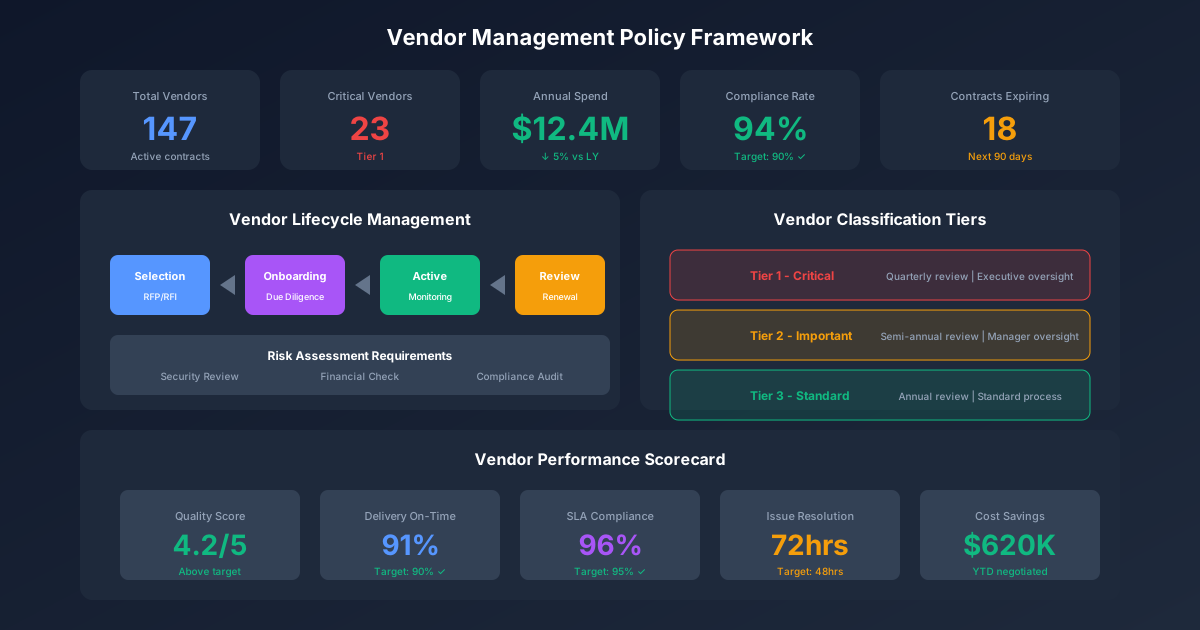
Third-party risk has become a board-level concern. Data breaches at vendors, supply chain disruptions, and regulatory scrutiny have elevated vendor management from a procurement function to a strategic risk discipline. Organizations without structured vendor governance face compliance violations, operational disruptions, and reputational damage.
A comprehensive vendor management policy establishes the framework for selecting, onboarding, monitoring, and offboarding vendors while managing associated risks. This guide provides templates for building a robust third-party risk management program.
For related governance resources, explore our IT Management Hub, IT Governance Framework Guide, and Security & Compliance Center. For policy templates, see our IT Policy Templates.
Why Vendor Management Matters
The Third-Party Risk Landscape
| Statistic | Impact |
|---|---|
| 59% of data breaches | Caused by third parties or vendors |
| 74% of organizations | Experienced third-party disruption |
| Average breach cost | $4.88M when third-party involved |
| Regulatory actions | 40% increase in vendor-related penalties |
Risk Categories
Operational Risk:
- Service interruptions
- Quality failures
- Capacity constraints
- Business continuity gaps
Cybersecurity Risk:
- Data breaches via vendors
- Malware introduction
- Credential compromise
- Network infiltration
Compliance Risk:
- Regulatory violations
- Contractual non-compliance
- Audit failures
- License issues
Financial Risk:
- Vendor insolvency
- Hidden costs
- Contract disputes
- Performance penalties
Reputational Risk:
- Vendor scandals
- ESG violations
- Customer impact
- Media exposure
Strategic Risk:
- Vendor concentration
- Dependency on single vendor
- Lock-in situations
- Innovation gaps
Vendor Management Policy Template
Section 1: Purpose and Scope
1.1 Purpose
This Vendor Management Policy establishes the framework for evaluating, selecting, contracting, monitoring, and offboarding third-party vendors to protect [Company Name] from operational, security, compliance, financial, and reputational risks associated with third-party relationships.
1.2 Scope
This policy applies to:
- All third-party vendors providing goods, services, or access to [Company Name]
- All employees involved in vendor selection, management, or oversight
- All departments engaging external vendors
- Contractors and consultants procured through vendors
1.3 Exclusions
- One-time purchases under $5,000 (covered by procurement policy)
- Employee benefit providers (covered by HR policy)
- Legal counsel (covered by legal department procedures)
1.4 Definitions
| Term | Definition |
|---|---|
| Vendor | Any third party providing goods, services, or access |
| Critical Vendor | Vendor whose failure would significantly impact operations |
| High-Risk Vendor | Vendor with access to sensitive data or critical systems |
| Due Diligence | Investigation of vendor capabilities and risks |
| SLA | Service Level Agreement defining performance standards |
Section 2: Vendor Classification
2.1 Criticality Tiers
| Tier | Criteria | Examples | Oversight Level |
|---|---|---|---|
| Tier 1: Critical | Essential to operations; no ready substitute | Cloud infrastructure, ERP, payment processor | Executive oversight |
| Tier 2: Important | Significant impact if disrupted; substitutes exist | HR software, CRM, specialized services | Manager oversight |
| Tier 3: Standard | Limited impact; easily replaced | Office supplies, standard tools | Standard oversight |
2.2 Risk Categories
| Category | High Risk | Medium Risk | Low Risk |
|---|---|---|---|
| Data Access | PII, PHI, financial, confidential | Internal data only | No data access |
| System Access | Production systems, networks | Test/dev environments | No system access |
| Business Impact | Operations halt if vendor fails | Degraded operations | Minimal impact |
| Regulatory | Regulated data/processes | Some compliance requirements | No regulatory impact |
2.3 Combined Risk Rating
Overall Risk Rating = MAX(Criticality Rating, Data Risk, System Risk, Compliance Risk)

Example:
- Criticality: Tier 2 (Medium)
- Data Access: PII (High)
- System Access: Test only (Low)
- Regulatory: GDPR applies (High)
- Overall Rating: HIGH
Section 3: Vendor Selection
3.1 Sourcing Requirements
| Vendor Risk | Competitive Bids | Selection Committee | Executive Approval |
|---|---|---|---|
| High Risk | 3+ vendors | Required | Required |
| Medium Risk | 2+ vendors | Recommended | Department head |
| Low Risk | 1+ vendor | Optional | Manager |
3.2 Due Diligence Requirements
| Assessment Area | High Risk | Medium Risk | Low Risk |
|---|---|---|---|
| Financial stability | Required | Required | Optional |
| Security assessment | Comprehensive | Standard | Basic |
| Compliance verification | Full audit | Certification check | Self-attestation |
| Business continuity | Full review | Summary review | Questionnaire |
| Reference checks | 3+ references | 2 references | 1 reference |
| On-site audit | Required | Optional | Not required |
3.3 Approval Authority
| Contract Value | Risk Level | Approver |
|---|---|---|
| < $50,000 | Low | Department Manager |
| < $50,000 | Medium/High | Director |
| $50,000 - $250,000 | Any | VP + Procurement |
| $250,000 - $1,000,000 | Any | SVP + Legal + Procurement |
| > $1,000,000 | Any | Executive Committee |
Section 4: Contracting Requirements
4.1 Required Contract Provisions
| Provision | High Risk | Medium Risk | Low Risk |
|---|---|---|---|
| Data protection clause | Required | Required | If data access |
| Security requirements | Detailed | Standard | Basic |
| Audit rights | Full access | Annual audit | Upon request |
| Insurance requirements | Specified limits | Standard limits | Certificate |
| Termination rights | Detailed triggers | Standard 30-day | Standard |
| SLA with penalties | Required | Recommended | Optional |
| Business continuity | Detailed plan | Summary | Statement |
| Subcontractor approval | Prior approval | Notification | N/A |
| Indemnification | Broad | Standard | Standard |
| Limitation of liability | Negotiated | Standard | Standard |
4.2 Standard Contract Terms
Data Protection:
Vendor shall:
- Process Company data only as instructed
- Implement appropriate security measures
- Notify Company within 24 hours of any breach
- Return or destroy data upon termination
- Not subcontract without prior approval
- Allow audits with reasonable notice
Security Requirements:
Vendor shall maintain:
- SOC 2 Type II or equivalent certification
- Annual penetration testing
- Encryption of data at rest and in transit
- Access controls and logging
- Incident response capabilities
- Employee background checks
Service Levels:
| Metric | Target | Measurement | Remedy |
|--------|--------|-------------|--------|
| Availability | 99.9% | Monthly | Service credit |
| Response time | < 2 sec | Continuous | Investigation |
| Support response | < 4 hours | Per incident | Escalation |
| Issue resolution | < 24 hours | Per incident | Credit |
Section 5: Ongoing Monitoring
5.1 Monitoring Frequency
| Vendor Risk | Performance Review | Risk Assessment | Contract Review |
|---|---|---|---|
| High Risk | Monthly | Quarterly | Annual |
| Medium Risk | Quarterly | Semi-annual | Annual |
| Low Risk | Annual | Annual | At renewal |
5.2 Monitoring Activities
| Activity | Description | Responsibility |
|---|---|---|
| SLA tracking | Monitor against agreed metrics | Vendor Manager |
| Financial monitoring | Track vendor financial health | Finance/Risk |
| Security monitoring | Review security posture | Information Security |
| Compliance monitoring | Verify ongoing compliance | Compliance |
| Relationship management | Regular vendor meetings | Vendor Manager |
| Issue management | Track and resolve problems | Vendor Manager |
5.3 Performance Scorecard
| Category | Weight | Metrics | Score |
|---|---|---|---|
| Service Quality | 30% | SLA achievement, defect rate | /10 |
| Security | 25% | Audit findings, incidents | /10 |
| Compliance | 20% | Certifications, audit results | /10 |
| Responsiveness | 15% | Issue resolution, communication | /10 |
| Value | 10% | Cost, innovation, improvement | /10 |
| Overall | 100% | /10 |
Scoring Guide:
- 9-10: Exceptional - Exceeds all expectations
- 7-8: Good - Meets expectations
- 5-6: Acceptable - Minor improvements needed
- 3-4: Concerning - Significant improvements needed
- 1-2: Unacceptable - Remediation or termination
Section 6: Risk Management
6.1 Risk Assessment Template
| Risk Factor | Questions | Risk Level |
|---|---|---|
| Data sensitivity | What data will vendor access? | H/M/L |
| System access | What systems will vendor access? | H/M/L |
| Substitutability | How easily can vendor be replaced? | H/M/L |
| Financial stability | Is vendor financially sound? | H/M/L |
| Security maturity | Does vendor have strong security? | H/M/L |
| Geographic risk | Where is vendor located/operating? | H/M/L |
| Regulatory impact | Does vendor affect compliance? | H/M/L |
| Concentration | What % of category is this vendor? | H/M/L |
6.2 Risk Mitigation Strategies
| Risk | Mitigation |
|---|---|
| Single vendor dependency | Multi-vendor strategy, exit planning |
| Data breach exposure | Data minimization, encryption requirements |
| Service disruption | SLA with penalties, business continuity requirements |
| Financial instability | Financial monitoring, escrow arrangements |
| Compliance failure | Audit rights, certification requirements |
| Security weakness | Security assessments, penetration testing |
6.3 Vendor Concentration Limits
| Category | Maximum Single Vendor Share | Action if Exceeded |
|---|---|---|
| Critical services | 70% | Develop alternative |
| IT infrastructure | 60% | Diversification plan |
| Professional services | 50% | Competitive sourcing |
| Commodity supplies | 80% | Monitor only |
Section 7: Vendor Offboarding
7.1 Offboarding Triggers
| Trigger | Notice Period | Special Requirements |
|---|---|---|
| Contract expiration | Per contract | Transition planning |
| Performance failure | Per contract | Documented issues |
| Security incident | Immediate to 30 days | Investigation |
| Financial distress | Per assessment | Contingency activation |
| Strategic decision | 60-90 days | Transition planning |
| Regulatory requirement | As required | Documented rationale |
7.2 Offboarding Checklist
| Category | Task | Responsible | Complete |
|---|---|---|---|
| Data | Confirm data return/destruction | IT Security | |
| Obtain destruction certificate | Vendor Manager | ||
| Revoke data access | IT | ||
| Access | Terminate system access | IT | |
| Collect credentials/tokens | IT Security | ||
| Disable integrations | IT | ||
| Financial | Final invoice reconciliation | Finance | |
| Return deposits/escrow | Finance | ||
| Update vendor records | Procurement | ||
| Transition | Knowledge transfer complete | Business Owner | |
| Alternative vendor active | Business Owner | ||
| Documentation updated | Vendor Manager | ||
| Compliance | Audit trail archived | Compliance | |
| Contract retained per policy | Legal |
Due Diligence Checklists
Financial Due Diligence
| Item | Source | Pass Criteria |
|---|---|---|
| Financial statements (3 years) | Vendor | Profitable or funded |
| Credit report | D&B, Experian | Score > 650 |
| References (financial) | Banks, investors | No concerns |
| Litigation search | Public records | No material issues |
| Insurance certificates | Vendor | Adequate coverage |
| Ownership structure | Vendor | Transparent |
Security Due Diligence
| Item | Source | Pass Criteria |
|---|---|---|
| SOC 2 Type II report | Vendor | No critical findings |
| Penetration test results | Vendor | Remediation complete |
| Security questionnaire | Vendor | Satisfactory responses |
| ISO 27001 certification | Vendor | Current certification |
| Incident history | Vendor | No unreported breaches |
| Security policies | Vendor | Documented and implemented |
Compliance Due Diligence
| Regulation | Verification | Pass Criteria |
|---|---|---|
| GDPR | DPA review, certifications | Compliant framework |
| HIPAA | BAA availability, HITRUST | Certification or equivalent |
| PCI DSS | AOC review | Current compliance |
| SOX | Control documentation | Adequate controls |
| Industry-specific | Licenses, permits | Current and valid |
Operational Due Diligence
| Item | Verification | Pass Criteria |
|---|---|---|
| Business continuity plan | Document review | Documented and tested |
| Disaster recovery | RTO/RPO review | Meets requirements |
| Staffing levels | Vendor disclosure | Adequate resources |
| Customer references | Direct contact | Positive feedback |
| Service history | Track record | Reliable performance |
Vendor Risk Assessment Template
Assessment Questionnaire
Section A: Company Information
- Legal name and structure
- Years in business
- Ownership (public, private, PE-backed)
- Locations and jurisdictions
- Number of employees
- Annual revenue
- Key customers (similar to us)
Section B: Security Controls
- Security certifications held (SOC 2, ISO 27001, etc.)
- Encryption standards (at rest, in transit)
- Access control mechanisms
- Network security measures
- Endpoint protection
- Incident response capabilities
- Employee security training
- Third-party security assessments
Section C: Data Protection
- Data classification practices
- Data retention policies
- Data disposal procedures
- Cross-border data transfers
- Subcontractor data handling
- Breach notification procedures
- Privacy certifications
Section D: Business Continuity
- Business continuity plan
- Disaster recovery capabilities
- RTO and RPO commitments
- Backup procedures
- Testing frequency
- Geographic redundancy
Section E: Compliance
- Regulatory certifications
- Recent audit results
- Pending legal issues
- Regulatory investigations
- Compliance training programs
Risk Scoring Matrix
| Factor | Weight | 1 (Low) | 2 (Medium) | 3 (High) | Score |
|---|---|---|---|---|---|
| Data sensitivity | 25% | Public only | Internal | PII/PHI/Financial | |
| System access | 20% | None | Limited | Production | |
| Business impact | 20% | Minimal | Moderate | Critical | |
| Substitutability | 15% | Easy | Moderate | Difficult | |
| Regulatory | 20% | None | Some | Significant | |
| Weighted Total | /3.0 |
Risk Rating:
- 1.0-1.5: Low Risk - Standard oversight
- 1.6-2.2: Medium Risk - Enhanced oversight
- 2.3-3.0: High Risk - Intensive oversight
Ongoing Monitoring Templates
Quarterly Review Template
| Area | Question | Rating | Notes |
|---|---|---|---|
| Performance | |||
| SLA achievement | Meeting all SLAs? | Y/N | |
| Quality metrics | Quality acceptable? | Y/N | |
| Issue resolution | Issues resolved timely? | Y/N | |
| Security | |||
| Certifications | Certifications current? | Y/N | |
| Incidents | Any security incidents? | Y/N | |
| Vulnerability mgmt | Vulnerabilities addressed? | Y/N | |
| Compliance | |||
| Regulatory | Any regulatory issues? | Y/N | |
| Contractual | Meeting obligations? | Y/N | |
| Audit findings | Any open findings? | Y/N | |
| Financial | |||
| Financial health | Any concerns? | Y/N | |
| Invoicing | Billing accurate? | Y/N | |
| Value delivery | Delivering value? | Y/N | |
| Relationship | |||
| Communication | Communication effective? | Y/N | |
| Responsiveness | Responsive to needs? | Y/N | |
| Innovation | Bringing new ideas? | Y/N |
Annual Review Template
| Section | Content |
|---|---|
| Executive Summary | Overall performance rating, key highlights, concerns |
| Performance Analysis | SLA achievement, quality metrics, trend analysis |
| Security Review | Assessment results, incidents, improvements |
| Compliance Status | Certifications, audits, regulatory changes |
| Financial Review | Cost analysis, invoicing accuracy, market comparison |
| Relationship Health | Stakeholder feedback, communication effectiveness |
| Risk Assessment | Updated risk profile, emerging risks |
| Recommendations | Continue, improve, replace, renegotiate |
| Action Items | Specific improvements with owners and deadlines |
Incident Tracking Log
| ID | Date | Vendor | Category | Description | Impact | Resolution | Days Open |
|---|---|---|---|---|---|---|---|
| V-001 | 1/15 | CloudCo | Security | Unauthorized access attempt | Low | Blocked, investigated | 3 |
| V-002 | 1/22 | DataPro | Performance | SLA breach - availability | Medium | Root cause, credit | 5 |
| V-003 | 2/01 | SupplierX | Quality | Defective shipment | High | Replacement, review | Open |
Key Takeaways
-
Classify vendors by risk: Not all vendors deserve the same oversight—focus on critical and high-risk vendors
-
Due diligence before signing: Thorough assessment prevents problems; contracts are hard to fix later
-
Contracts as protection: Include security, audit, termination, and data provisions
-
Monitor continuously: Vendor risk changes over time—regular reviews catch problems early
-
Plan for exit: Every vendor relationship should have a documented exit strategy
-
Document everything: Audit trails protect you during regulatory inquiries
For related resources, explore our IT Governance Framework Guide, Security Policy Review Checklist, and IT Policy Templates.