Startup Financial Model: How to Build Revenue Projections & Track Burn Rate

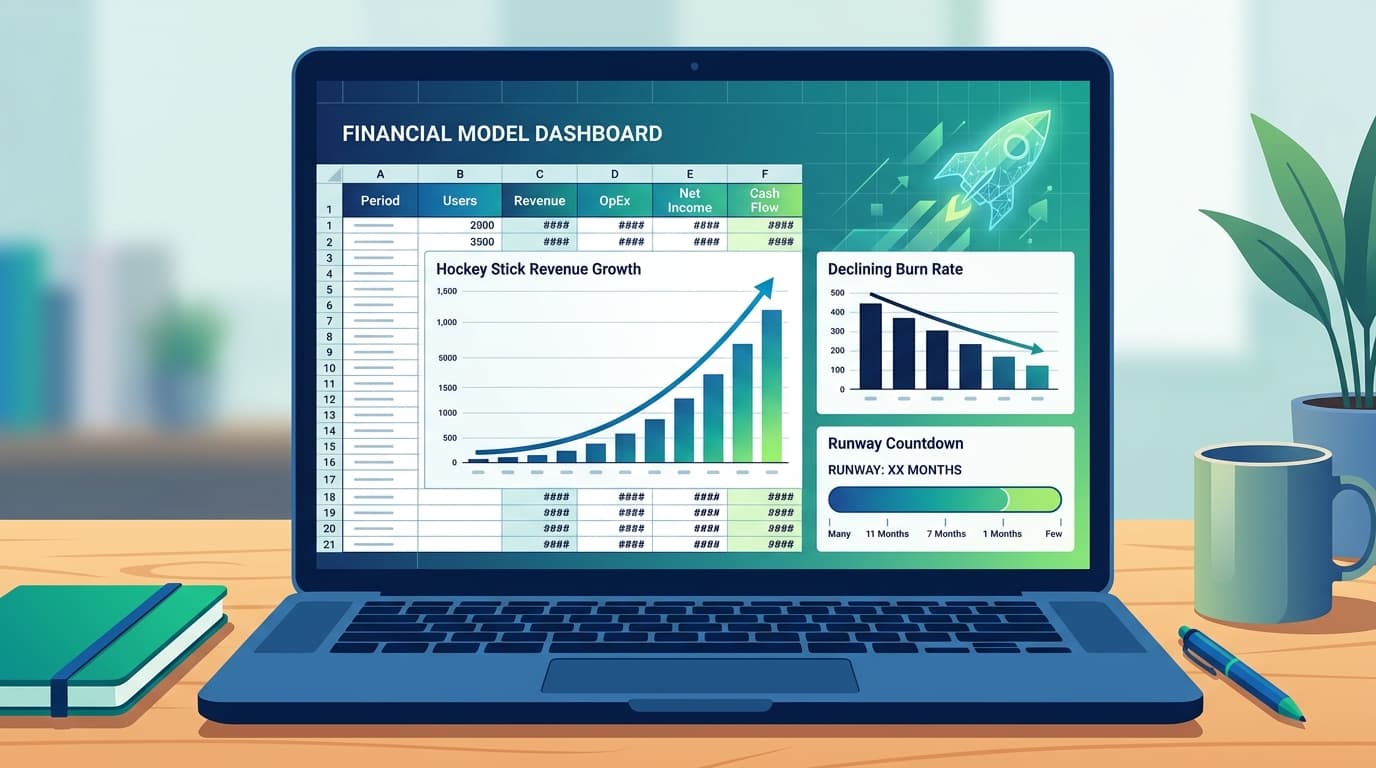
According to CB Insights' analysis of 1,100+ failed startups, 38% cited "running out of cash or failing to raise capital" as the primary reason for failure — making it the number-one startup killer (CB Insights, 2024). The irony is that most of these companies didn't lack a great product. They lacked a financial model that told them when the money would run out and what needed to happen before it did.
This guide covers how to build a startup financial model from scratch: revenue projections, expense forecasting, burn rate tracking, and the unit economics that determine whether your business can ever be profitable. For a spreadsheet that does most of the math for you, download our startup financial model template.
Key Takeaways
- A startup financial model has four core components: revenue projections, expense forecast, cash flow statement, and unit economics
- Bottom-up revenue forecasting (customers × price) is more credible than top-down (% of TAM)
- Burn rate = monthly cash outflow; runway = cash balance ÷ monthly burn rate
- Track CAC, LTV, and LTV:CAC ratio — investors expect LTV:CAC of 3:1 or better for SaaS
What a Startup Financial Model Includes
A startup financial model isn't a spreadsheet of wild guesses — it's a structured framework that translates your business strategy into numbers. Investors have seen thousands of models, and they can tell immediately whether yours is grounded in logic or built on wishful thinking.
Every startup financial model needs four interconnected components:
- Revenue model — how you make money, how much, and from whom
- Expense forecast — what it costs to build, sell, and support your product
- Cash flow statement — when money comes in and goes out (timing matters as much as amounts)
- Unit economics — the per-customer math that determines long-term viability
These components feed into two critical outputs: your burn rate (how fast you're spending cash) and your runway (how many months until the money's gone). Let's build each one.
How to Build Revenue Projections
Revenue projections are the heart of your financial model — and the part investors scrutinize most. There are two approaches, and smart founders use both.
Bottom-Up Forecasting (Preferred)
Bottom-up starts with your actual sales inputs and builds up to revenue. It's grounded in activities you can control and measure.
Formula:
Monthly Revenue = New Customers × Average Revenue per Customer
                + Existing Customers × Retention Rate × Average Revenue
                + Expansion Revenue (upsells, cross-sells)
Example: B2B SaaS company
| Month | New Customers | Churned | Total Customers | ARPU | MRR |
|---|---|---|---|---|---|
| 1 | 10 | 0 | 10 | $200 | $2,000 |
| 2 | 15 | 1 | 24 | $200 | $4,800 |
| 3 | 20 | 1 | 43 | $205 | $8,815 |
| 6 | 35 | 3 | 142 | $215 | $30,530 |
| 12 | 60 | 8 | 412 | $230 | $94,760 |
This approach is credible because every number is traceable to an assumption: "We'll acquire 10 customers in month 1 through our existing pipeline, growing 40% month-over-month as we add a sales rep in month 3." An investor can challenge each assumption independently.
Top-Down Forecasting (Sanity Check)
Top-down starts with market size and works backward. It's useful as a sanity check but isn't credible on its own.
Formula:
Revenue = Total Addressable Market × Obtainable Market Share %
Example:
TAM for project management SaaS: $12B
Serviceable Addressable Market (SAM): $2B (mid-market only)
Year 3 target market share: 0.1%
Projected revenue: $2M
If your bottom-up model shows $5M in year 3 but top-down suggests $2M is aggressive, something's off. The gap forces you to reexamine assumptions.
Which to use? Lead with bottom-up in your financial model. Include top-down as a slide in your pitch deck to show market opportunity. If the two diverge significantly, fix the bottom-up assumptions until they're defensible. For more on financial projection methods, see our financial modeling templates.
Expense Forecasting
Expense forecasting breaks down into two categories: what you've already committed to (fixed costs) and what scales with growth (variable costs).
Fixed Costs (Monthly Operating Expenses)
These don't change much month-to-month regardless of revenue:
| Category | Seed Stage | Series A | Series B |
|---|---|---|---|
| Salaries + benefits | $40K-$80K | $150K-$400K | $500K-$1.5M |
| Office/co-working | $0-$3K | $5K-$15K | $15K-$50K |
| Software tools | $1K-$3K | $5K-$15K | $15K-$40K |
| Insurance | $500-$1K | $2K-$5K | $5K-$15K |
| Legal + accounting | $1K-$3K | $3K-$8K | $8K-$20K |
| Total fixed | $43K-$90K | $165K-$443K | $543K-$1.6M |
Variable Costs (Scale with Revenue/Growth)
These grow as your business grows:
| Category | Typical Range |
|---|---|
| Cloud hosting (AWS/GCP/Azure) | 5-15% of revenue |
| Payment processing | 2.5-3.5% of revenue |
| Customer support | $500-$2,000 per 100 customers |
| Sales commissions | 8-15% of new ACV |
| Marketing spend | 20-40% of revenue (early stage) |
The most common mistake is underestimating how fast variable costs grow. If your hosting bill is $2K/month at 100 customers, it won't be $20K at 1,000 — it might be $15K if you optimize, or $30K if you don't. Model conservatively.
Burn Rate and Runway Calculations
These are the two numbers every founder, investor, and board member watches obsessively.
Burn Rate
Gross burn rate is your total monthly cash outflow — everything you spend.
Net burn rate is the difference between what you spend and what you earn:
Net Burn Rate = Monthly Revenue - Monthly Expenses

Example:
Monthly revenue: $30,000
Monthly expenses: $85,000
Net burn rate: -$55,000/month
Runway
Runway tells you how many months you can operate before running out of cash:
Runway = Cash Balance ÷ Net Burn Rate

Example:
Cash in bank: $1,200,000
Net burn rate: $55,000/month
Runway: 21.8 months
Critical thresholds:
- 18+ months: Comfortable. You have time to experiment and iterate.
- 12-18 months: Adequate, but start planning your next fundraise now (fundraising takes 3-6 months).
- 6-12 months: Concerning. Cut non-essential spending and accelerate revenue or fundraising.
- Under 6 months: Emergency mode. Make tough decisions immediately.
For a ready-made model with built-in runway calculations, download our cash flow forecast template.
Burn Rate Scenarios
Smart founders model three scenarios:
| Scenario | Description | Burn Rate | Runway |
|---|---|---|---|
| Base case | Current trajectory, realistic growth | $55K/month | 21.8 months |
| Upside | Faster growth, key deal closes | $45K/month | 26.7 months |
| Downside | Slower growth, key hire delayed | $70K/month | 17.1 months |
If your downside scenario puts you under 12 months of runway, you need a contingency plan before it becomes reality.
Unit Economics: The Math That Matters
Unit economics answer the fundamental question: does your business make money on each customer? A company can grow revenue 300% year-over-year and still be doomed if the unit economics don't work.
Customer Acquisition Cost (CAC)
CAC = Total Sales & Marketing Spend ÷ New Customers Acquired

Example:
Monthly S&M spend: $40,000
New customers: 25
CAC: $1,600
Include everything in the numerator: salaries of sales and marketing staff, ad spend, tools, events, content production. Don't cheat by excluding headcount — investors will add it back.
Customer Lifetime Value (LTV)
LTV = Average Revenue per Customer × Gross Margin % × Average Customer Lifetime

Example:
ARPU: $200/month
Gross margin: 80%
Average lifetime: 30 months
LTV: $200 × 0.80 × 30 = $4,800
LTV:CAC Ratio
LTV:CAC = $4,800 ÷ $1,600 = 3:1
Benchmarks:
- Below 1:1 — you're paying more to acquire customers than they'll ever return. Unsustainable.
- 1:1 to 3:1 — marginal. You might survive but won't generate enough profit to fuel growth.
- 3:1 to 5:1 — healthy. This is the target range for most VC-backed SaaS companies.
- Above 5:1 — you might be underinvesting in growth. Spend more on acquisition to capture market share.
CAC Payback Period
CAC Payback = CAC ÷ (ARPU × Gross Margin)

Example:
$1,600 ÷ ($200 × 0.80) = 10 months
This means you recover the cost of acquiring each customer in 10 months. Best-in-class SaaS companies target 12-18 months; below 12 is excellent.
Monthly Recurring Revenue (MRR) and Annual Recurring Revenue (ARR)
MRR = Total Paying Customers × Average Revenue per Customer
ARR = MRR × 12
Track MRR composition:
- New MRR — revenue from new customers this month
- Expansion MRR — increased revenue from existing customers (upgrades)
- Contraction MRR — decreased revenue from downgrades
- Churned MRR — lost revenue from cancelled customers
- Net New MRR = New + Expansion - Contraction - Churned
Net New MRR is the single most important growth metric for subscription businesses.
Churn Rate
Monthly Churn Rate = Customers Lost This Month ÷ Customers at Start of Month

Example:
3 cancellations ÷ 142 total customers = 2.1% monthly churn
Annual churn ≈ 22.7% (compounded)
A 2% monthly churn rate might seem small, but it means you're losing nearly a quarter of your customer base annually. For SaaS companies, best practice targets are under 5% annual churn for enterprise and under 7% for SMB. For in-depth financial modeling techniques, see our guide on financial modeling templates for business analysis.
Building Your Financial Model: Step by Step
Here's the practical process for assembling your model:
Step 1: Start with assumptions. Create a dedicated assumptions tab listing every input: customer growth rate, pricing, churn rate, headcount plan, marketing spend as % of revenue, hosting cost per customer. This is where investors will focus.
Step 2: Build the revenue model. Use bottom-up logic: customers × price, factoring in churn and expansion. Model monthly for years 1-2, quarterly for year 3.
Step 3: Build the expense model. Start with your current burn rate and add planned hires, tools, and scaling costs. Be honest about timing — that VP of Sales you plan to hire in Q3 won't generate revenue until Q4 at the earliest.
Step 4: Build the cash flow statement. Revenue recognition and cash collection aren't the same thing. If you invoice annually but recognize monthly, your cash position looks very different from your P&L. Model actual cash in and cash out.
Step 5: Calculate unit economics. Add a dashboard showing CAC, LTV, LTV:CAC, payback period, and churn — both current and projected. This is the page investors flip to first.
Step 6: Run scenarios. Build base, upside, and downside cases by varying your key assumptions (growth rate, churn, time to hire). Show what happens to runway under each scenario.
For a template that handles this structure automatically, our startup financial model template includes pre-built formulas for all these calculations across a 3-year projection.
What Investors Actually Look For
After reviewing hundreds of pitch decks and financial models, here's what experienced investors focus on:
Assumptions credibility. Are growth assumptions grounded in data (current pipeline, conversion rates, historical growth) or aspirational targets? "We'll grow 20% month-over-month because our competitor did" doesn't pass muster.
Unit economics trajectory. It's okay if CAC is high today — investors want to see a clear path to improvement. Show how CAC decreases as brand awareness grows and outbound becomes inbound.
Cash efficiency. How much revenue do you generate per dollar of capital invested? A company that raised $5M and generates $2M ARR is more capital-efficient than one that raised $15M for the same revenue.
Scenario awareness. Founders who present only the optimistic case signal inexperience. Showing that you've thought through what happens if growth is 50% slower demonstrates maturity.
Frequently Asked Questions
How far out should a startup financial model project?
Three years is standard for investor-facing models. Year 1 should be modeled monthly with granular detail. Year 2 can be quarterly. Year 3 can be annual. Don't model beyond 3 years — the assumptions become so speculative they're meaningless. Investors know year 3 projections are directional at best. What they're evaluating is the logic behind your assumptions, not whether you'll actually hit $10M ARR in month 36.
How do I build projections when I have no revenue yet?
Start with your sales pipeline and conversion assumptions. If you have 50 beta users and 10 have expressed willingness to pay $100/month, your starting point is $1,000 MRR with assumptions about conversion rate and growth. If you're truly pre-revenue, model from first principles: how many customers can one sales rep close per month, at what average deal size, with what close rate? Even rough assumptions are better than none because they force you to articulate the path to revenue.
What's a good burn rate for a seed-stage startup?
Seed-stage burn rates typically range from $30K-$100K per month depending on team size and location. A founding team of 3-5 in a high-cost city like SF or NYC will burn $60K-$100K/month. The same team in a lower-cost market might burn $30K-$50K. The more useful question is: what's your runway? If you raised $1.5M at $60K/month burn, that's 25 months — plenty of time to find product-market fit. If you raised $500K at the same burn rate, you have 8 months, which is dangerously tight.
Should I include fundraising in my financial model?
Include it as a scenario, not a certainty. Show your model with current cash (no future fundraise) to demonstrate how far your existing capital goes. Then show a separate scenario assuming a successful raise — this demonstrates how additional capital accelerates growth. Never build a model that requires future funding to survive past 6 months without clearly flagging the assumption. Investors want to know you can survive if the next round takes longer than expected.
How do I model pricing changes?
Create a pricing assumptions section with your current pricing and planned changes. If you're considering raising prices from $99/month to $149/month in Q3, model the impact: lower new customer conversion rate (estimate 10-20% drop) offset by higher ARPU. Show the sensitivity — at what conversion drop does the price increase become net negative? Many startups underprice initially and need to raise prices as they add features. Model this explicitly rather than assuming flat pricing forever.
What tools should I use to build a financial model?
Excel or Google Sheets remain the standard. Investors expect to receive a spreadsheet they can manipulate — not a PDF, not a Notion page, not a SaaS dashboard. Use our startup financial model template as a foundation. For more advanced scenarios, tools like Causal, Mosaic, or Runway offer collaborative financial planning with version control. But always maintain an exportable spreadsheet version for investor due diligence.