Sales Toolkit Templates: Essential Resources for Sales Teams & Managers

Building a high-performing sales organization requires more than talented salespeople. It demands a comprehensive toolkit of proven processes, scripts, templates, and tracking systems that enable consistent execution. Sales teams without proper enablement resources struggle with inconsistent messaging, poor pipeline visibility, and unpredictable results. A well-designed sales toolkit transforms individual effort into systematic success. For comprehensive resources, visit our Sales & Marketing Hub and explore our Sales Playbook templates. For ready-to-use templates, see our CRM Implementation Guide, Customer CRM Database Template, and Customer Health Scorecard.
Why Every Sales Team Needs a Comprehensive Toolkit
Sales toolkits are not just nice-to-have resources. They are essential infrastructure for any team serious about hitting revenue targets consistently. Organizations with documented sales processes and supporting materials significantly outperform those relying on ad-hoc approaches.
Key benefits of a structured sales toolkit:
- Faster rep ramp-up - New hires become productive 40% faster with documented processes
- Consistent messaging - Every customer interaction reflects your brand and value proposition
- Improved win rates - Proven approaches increase close rates by 15-25%
- Better forecasting - Standardized deal tracking enables accurate revenue predictions
- Scalable growth - Documented processes grow with your team without losing quality
The hidden cost of missing sales tools
Sales teams without proper toolkits face numerous challenges. Reps waste hours recreating materials from scratch. Inconsistent qualification leads to wasted time on bad-fit prospects. Proposals vary wildly in quality and messaging. Objections catch reps off guard without prepared responses. Pipeline data remains unreliable because tracking is inconsistent.
Research shows that sales reps spend only 34% of their time actually selling. A comprehensive toolkit reclaims hours each week by eliminating redundant work.
Essential Components of a Sales Toolkit
A complete sales toolkit addresses every stage of the sales process, from initial prospecting through deal closure and customer handoff. Here are the core components every sales organization needs.
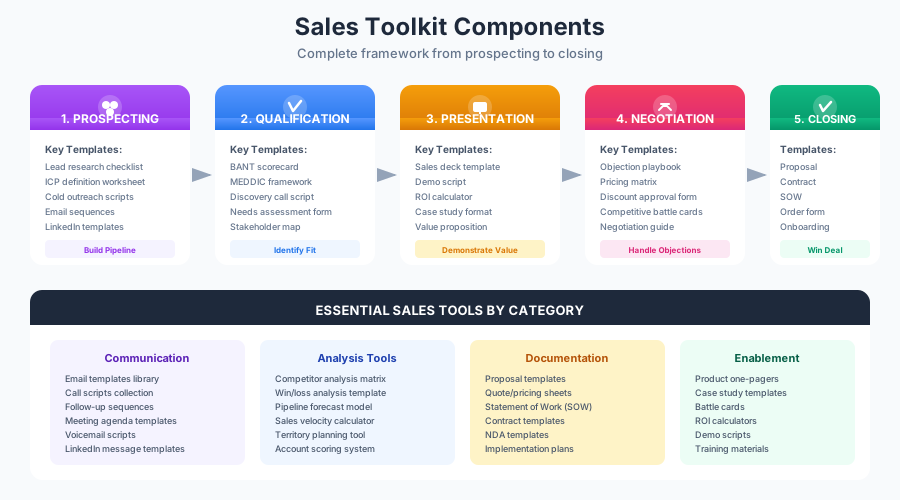
1. Prospecting Templates and Tools
Prospecting is where deals begin. Without systematic outreach, pipeline growth becomes unpredictable. Your prospecting toolkit should include templates for every channel and situation.
Cold Email Templates:
Create a library of proven email templates for different scenarios:
| Template Type | Use Case | Key Elements |
|---|---|---|
| Initial Outreach | First contact with cold prospect | Personalized hook, value proposition, soft CTA |
| Follow-up 1 | No response after 3-5 days | Add new insight, reference original email |
| Follow-up 2 | Still no response | Provide additional value, create urgency |
| Break-up Email | Final attempt | Acknowledge timing, leave door open |
| Referral Request | Asking for introductions | Specific ask, easy to forward |
| Inbound Response | Reply to website inquiry | Acknowledge interest, qualify, schedule call |
Example Cold Outreach Email:
Subject: Quick question about [Company] sales process

Hi [First Name],

I noticed [Company] recently [specific trigger: expanded team,
launched product, raised funding]. Congratulations!

Many [industry] companies at your stage find their sales process
becomes a bottleneck as they scale. Their reps spend more time on
admin work than selling, and pipeline visibility disappears.

We help teams like yours reclaim 8+ hours per week while improving
forecast accuracy by 40%.

Worth a 15-minute call to see if we might help?

[Signature]
LinkedIn Outreach Scripts:
LinkedIn requires a different approach than email. Connection requests have character limits, and messaging cadences differ.
Connection Request Template:
Hi [Name] - I've been following [Company]'s growth in [industry].
Would love to connect and exchange insights on scaling sales teams.
Looking forward to connecting!
Post-Connection Message:
Thanks for connecting, [Name]!

I noticed you lead sales at [Company]. I work with similar teams
to help them build scalable sales processes.

Would you be open to a brief call to exchange ideas? No pitch -
genuinely curious about how you're approaching [specific challenge].
2. Discovery Call Scripts and Frameworks
Discovery calls determine whether a prospect is a good fit and uncover the information needed to craft a compelling solution. Structured discovery prevents critical gaps in understanding.
BANT Qualification Framework:
| Criteria | Key Questions | Good Indicators |
|---|---|---|
| Budget | What resources are allocated for this? Have you made similar investments? | Specific budget range, allocated funds |
| Authority | Who else is involved in this decision? What is your approval process? | Direct decision-maker or clear path to them |
| Need | What challenges are you trying to solve? What happens if you do nothing? | Quantified pain, urgent priority |
| Timeline | When do you need this in place? What is driving that date? | Specific deadline, compelling event |
Discovery Call Script Template:
OPENING (2-3 minutes)
---------------------
"Thanks for taking the time today, [Name]. Before we dive in,
I want to make sure this conversation is valuable for you.

My goal is to understand your situation, share a bit about how
we've helped similar companies, and see if there might be a fit.
If there's not, I'll tell you honestly and point you in the
right direction.

Does that work for you? Great. To start, can you give me a
quick overview of your role and what prompted you to take this call?"

SITUATION QUESTIONS (5-7 minutes)
---------------------------------
- "Walk me through your current sales process from lead to close."
- "How many reps do you have, and how is the team structured?"
- "What tools are you currently using to manage your pipeline?"
- "How do you handle [specific function relevant to your solution]?"

PROBLEM QUESTIONS (5-7 minutes)
-------------------------------
- "What's the biggest challenge your sales team faces right now?"
- "How is that impacting your ability to hit targets?"
- "How long has this been an issue?"
- "What have you tried so far to address it?"

IMPLICATION QUESTIONS (3-5 minutes)
-----------------------------------
- "If this continues, what does that mean for the business?"
- "How is this affecting your reps' productivity and morale?"
- "What opportunities are you missing because of this?"

NEED-PAYOFF QUESTIONS (3-5 minutes)
-----------------------------------
- "If you could solve this, what would that mean for the team?"
- "How would your job change if this wasn't a problem?"
- "What would you be able to accomplish that you can't today?"

NEXT STEPS (2-3 minutes)
------------------------
"Based on what you've shared, I think we can help. Here's what
I'd suggest as a next step..."
3. Proposal and Quote Templates
Proposals convert conversations into commitments. Professional, consistent proposals build trust and accelerate decisions. Your proposal toolkit should include templates for different deal sizes and situations.
Standard Proposal Structure:
- Executive Summary - One-page overview of the opportunity and proposed solution
- Understanding Your Situation - Recap of challenges and goals from discovery
- Proposed Solution - Detailed description of what you are recommending
- Implementation Approach - How you will deliver and onboard
- Investment and Terms - Pricing, payment terms, and contract details
- Why Us - Differentiators, case studies, and credibility builders
- Next Steps - Clear action items and timeline
Executive Summary Template:
EXECUTIVE SUMMARY
-----------------

Company: [Prospect Company Name]
Prepared For: [Contact Name], [Title]
Prepared By: [Your Name], [Your Company]
Date: [Date]

THE OPPORTUNITY
[2-3 sentences summarizing the prospect's situation and challenges]

OUR RECOMMENDATION
[2-3 sentences describing the proposed solution at a high level]

EXPECTED OUTCOMES
- [Quantified benefit 1]
- [Quantified benefit 2]
- [Quantified benefit 3]

INVESTMENT
[Total investment with brief payment term summary]

IMPLEMENTATION TIMELINE
[High-level timeline from contract signing to full deployment]
Pricing Table Format:
| Component | Description | Investment |
|---|---|---|
| Platform License | Annual subscription for up to 25 users | $24,000/year |
| Implementation | Setup, configuration, and data migration | $5,000 one-time |
| Training | 4 sessions for end users and admins | $2,000 one-time |
| Total Year 1 | $31,000 | |
| Annual Renewal | $24,000/year |
4. Objection Handling Guides
Objections are a natural part of the sales process, but unprepared responses cost deals. A comprehensive objection handling guide ensures every rep can respond confidently and effectively.
Common Objections and Response Frameworks:
Price Objections:
Objection: "This is too expensive for our budget."
ACKNOWLEDGE
"I appreciate you being direct about that. Budget is always
a real consideration."

CLARIFY
"Help me understand - is it that the price exceeds what you
budgeted, or that you're not seeing the value relative to
the investment?"

REFRAME (if value issue)
"Let's step back. You mentioned [problem] is costing you
[quantified impact] each month. Our solution addresses that
directly. If we solve that problem, the investment pays for
itself in [timeframe]."

REFRAME (if budget issue)
"I understand budget constraints are real. Let's discuss
options - we have flexible payment terms, and some clients
start with a smaller scope to prove value before expanding."
Timing Objections:
Objection: "We're not ready to make a decision right now."
ACKNOWLEDGE
"That makes sense - timing is important to get right."

CLARIFY
"Help me understand what would need to change for the timing
to be right? Is there a specific milestone or event you're
waiting for?"

CREATE URGENCY
"I understand. One thing to consider - [relevant industry
trend, competitive dynamic, or deadline] suggests that waiting
could [specific consequence]. What would it cost to delay
another [timeframe]?"

OFFER ALTERNATIVE
"Even if you're not ready to commit today, would it make sense
to [smaller commitment: trial, pilot, proof of concept] so
you're prepared when the timing is right?"
Competitor Objections:
Objection: "We're also looking at [Competitor]."
ACKNOWLEDGE
"They're a solid company. It makes sense to evaluate options."

GATHER INTELLIGENCE
"What is it about their approach that appeals to you?"

DIFFERENTIATE
"That's helpful context. Where we differ is [specific
differentiator]. Clients typically choose us when [ideal
customer profile characteristics] are priorities. Does
that resonate with your situation?"

OFFER PROOF
"Would it help to speak with a customer who evaluated both
options and chose us? I can connect you with [reference]
who had a similar situation."
Authority Objections:
Objection: "I need to run this by my boss before deciding."
ACKNOWLEDGE
"Of course - important decisions require input from
leadership."

UNDERSTAND THE STAKEHOLDER
"Tell me about your boss's priorities. What will they
care most about in evaluating this?"

ENABLE THE CHAMPION
"I want to set you up for success in that conversation.
Would it help if I created a one-page summary that
addresses the key points they'll want to know?"

OFFER TO JOIN
"Sometimes it's helpful to have me join that conversation
to answer any technical questions directly. Would that
be useful, or do you prefer to handle it yourself?"
Deal Tracking and Pipeline Management Templates
Visibility into your pipeline is essential for accurate forecasting and effective coaching. Your toolkit needs templates for tracking deals through every stage.
Sales Pipeline Tracker Template
Required Fields for Every Opportunity:
| Field | Purpose | Update Frequency |
|---|---|---|
| Deal Name | Identify the opportunity | At creation |
| Company | Account association | At creation |
| Contact | Primary decision-maker | As identified |
| Deal Value | Expected revenue | When qualified, adjust as needed |
| Stage | Current pipeline position | As it changes |
| Probability | Weighted likelihood | Auto-calculated by stage |
| Close Date | Expected decision date | Weekly review |
| Next Action | Required follow-up | After every interaction |
| Next Action Date | When to follow up | After every interaction |
| Last Contact Date | Most recent touch | Automatic |
| Days in Stage | Stall indicator | Calculated |
Weighted Probability by Stage
Apply consistent probability weights to enable accurate forecasting:
| Stage | Definition | Probability |
|---|---|---|
| Lead | Initial contact made | 10% |
| Qualified | BANT confirmed | 25% |
| Discovery Complete | Full needs assessment done | 40% |
| Proposal Sent | Formal proposal delivered | 50% |
| Negotiation | Terms being discussed | 75% |
| Verbal Commit | Verbal agreement obtained | 90% |
| Closed Won | Contract signed | 100% |
Activity Tracking Template
Monitor sales activities to understand what drives results:
| Activity | Target/Week | Actual | Notes |
|---|---|---|---|
| Outbound Calls | 50 | ||
| Emails Sent | 100 | ||
| LinkedIn Touches | 25 | ||
| Discovery Calls | 5 | ||
| Demos Delivered | 3 | ||
| Proposals Sent | 2 |
For detailed pipeline management guidance, see our Sales Pipeline Template Guide.
Sales Process Frameworks and Best Practices
Beyond templates, your toolkit should codify your sales methodology and process standards.
Defining Your Sales Stages
Every organization needs clearly defined sales stages with specific entry and exit criteria:
Stage 1: Lead
- Entry Criteria: Contact information captured, initial interest indicated
- Exit Criteria: Qualification call scheduled or completed
- Required Activities: Research company, identify trigger event, personalize outreach
Stage 2: Qualified
- Entry Criteria: BANT confirmed, decision-maker engaged
- Exit Criteria: Discovery call completed, pain points documented
- Required Activities: Deep discovery, stakeholder mapping, need quantification
Stage 3: Discovery Complete
- Entry Criteria: Full needs assessment done, solution fit confirmed
- Exit Criteria: Proposal requested, budget confirmed
- Required Activities: Solution design, ROI calculation, proposal preparation
Stage 4: Proposal
- Entry Criteria: Proposal delivered, pricing reviewed
- Exit Criteria: Verbal agreement or negotiation initiated
- Required Activities: Follow-up call, address questions, refine terms
Stage 5: Negotiation
- Entry Criteria: Prospect committed to proceed, finalizing terms
- Exit Criteria: Contract signed, payment received
- Required Activities: Contract redlines, final approvals, close coordination
Sales Cadence Best Practices
Define standard cadences for different prospect types:
Cold Outbound Cadence (14 days):
- Day 1: Personalized email
- Day 3: LinkedIn connection request
- Day 5: Follow-up email with new angle
- Day 7: Phone call attempt
- Day 10: Third email with value add (content, insight)
- Day 14: Break-up email
Inbound Lead Cadence (7 days):
- Hour 1: Phone call attempt
- Hour 2: Email if no answer
- Day 1: Second call attempt
- Day 2: Email with additional resources
- Day 3: Third call attempt
- Day 5: Email with case study
- Day 7: Final email, offer alternative contact
Post-Demo Follow-up Cadence:
- Same day: Thank you email with demo recording and resources
- Day 2: Email addressing specific questions raised
- Day 5: Proposal delivery (if ready) or check-in
- Day 7: Follow-up call on proposal
- Day 10: Executive summary and next steps reminder
Email Templates for Every Stage
Equip your team with proven email templates that accelerate deals.
Meeting Confirmation Email
Subject: Confirmed: [Your Company] / [Their Company] - [Date/Time]

Hi [Name],

Looking forward to our call [day] at [time] [timezone].

Here's the meeting link: [URL]

To make our time productive, I'll be prepared to discuss:
- Your current approach to [relevant topic]
- Common challenges we see with [relevant issue]
- How companies like [similar customer] have addressed this

Is there anything specific you'd like to cover?

Talk soon,
[Signature]
Post-Meeting Summary Email
Subject: Summary: [Your Company] / [Their Company] Discussion

Hi [Name],

Thanks for the great conversation today. Here's my summary:

WHAT WE DISCUSSED
- [Key point 1 from the call]
- [Key point 2 from the call]
- [Key challenge they're facing]

WHAT YOU'RE LOOKING TO ACHIEVE
- [Goal 1 they mentioned]
- [Goal 2 they mentioned]

NEXT STEPS
- [ ] [Action item for you] - by [date]
- [ ] [Action item for them] - by [date]

Did I capture everything correctly? Let me know if I missed
anything.

[Signature]
Proposal Follow-Up Email
Subject: Re: Proposal for [Their Company]

Hi [Name],

I wanted to check in on the proposal I sent [day]. Have you
had a chance to review it with your team?

A few clients have mentioned that [specific section] raises
questions. Happy to schedule a quick call to walk through
anything that would be helpful.

What works for your schedule this week?

[Signature]
Closing Email
Subject: Ready to move forward?

Hi [Name],

Based on our conversations, it sounds like [Your Solution]
is a strong fit for [Their Company]'s goals around [specific
objective].

To get started, I just need:
1. Signed agreement (attached)
2. Purchase order or payment authorization
3. Primary contact for implementation

Once I have those, we can kick off onboarding as early as
[date].

Any questions before we proceed?

[Signature]
Building Your Custom Sales Toolkit
Every organization has unique elements that should be incorporated into their toolkit. Here is how to build a customized version.
Step 1: Audit Your Current Process
Document what exists today:
- What templates do reps currently use?
- Where are the gaps causing inconsistency?
- What questions come up repeatedly from new hires?
- What materials do top performers create on their own?
Step 2: Interview Top Performers
Learn from your best reps:
- What approaches consistently work for them?
- What scripts or frameworks have they developed?
- How do they handle common objections?
- What do they wish they had when they started?
Step 3: Standardize and Document
Create official versions of key materials:
- Consolidate multiple versions into single templates
- Add guidance on when and how to use each resource
- Include examples of successful implementations
- Build in flexibility for personalization
Step 4: Organize and Distribute
Make resources easily accessible:
- Central repository (shared drive, sales enablement platform)
- Logical organization by sales stage or function
- Search capability for quick access
- Mobile-friendly formats for field access
Step 5: Train and Reinforce
Ensure adoption through enablement:
- New hire onboarding that covers all toolkit components
- Regular training refreshers on key materials
- Coaching that references toolkit resources
- Recognition for effective toolkit utilization
Measuring Toolkit Effectiveness
A great toolkit is one that gets used and drives results. Track these metrics to assess your toolkit's impact:
Usage Metrics:
- Template download and access rates
- Most and least used resources
- Time spent in enablement platform
- Search queries (reveals gaps)
Performance Metrics:
- Time to first deal for new hires
- Win rate changes after toolkit launch
- Average deal size trends
- Sales cycle length improvements
Qualitative Feedback:
- Rep satisfaction surveys
- New hire feedback on onboarding
- Manager observations on consistency
- Customer feedback on proposal quality
Ready-to-Use Sales Toolkit Resources
Our comprehensive sales enablement library provides everything your team needs:
- Sales Playbook Template - Complete methodology documentation
- Sales Pipeline Template - Deal tracking and forecasting
- CRM Implementation Guide - System setup and configuration
- Lead Generation Templates - Prospecting and outreach resources
- Proposal Templates - Professional proposal and quote formats
Each resource is battle-tested across hundreds of sales organizations and fully customizable to your specific needs.
Equip Your Team for Success
A comprehensive sales toolkit is not a luxury. It is the foundation of consistent sales performance. Teams with proper enablement resources close more deals, ramp new reps faster, and forecast with greater accuracy.
Do not let your sales team reinvent the wheel with every prospect interaction. Build the toolkit they need to execute with confidence and consistency.
Ready to transform your sales operations? Explore our Sales & Marketing Hub for the complete collection of templates and resources to build a world-class sales organization.