IT Service Level Management: Complete SLA Template and Playbook

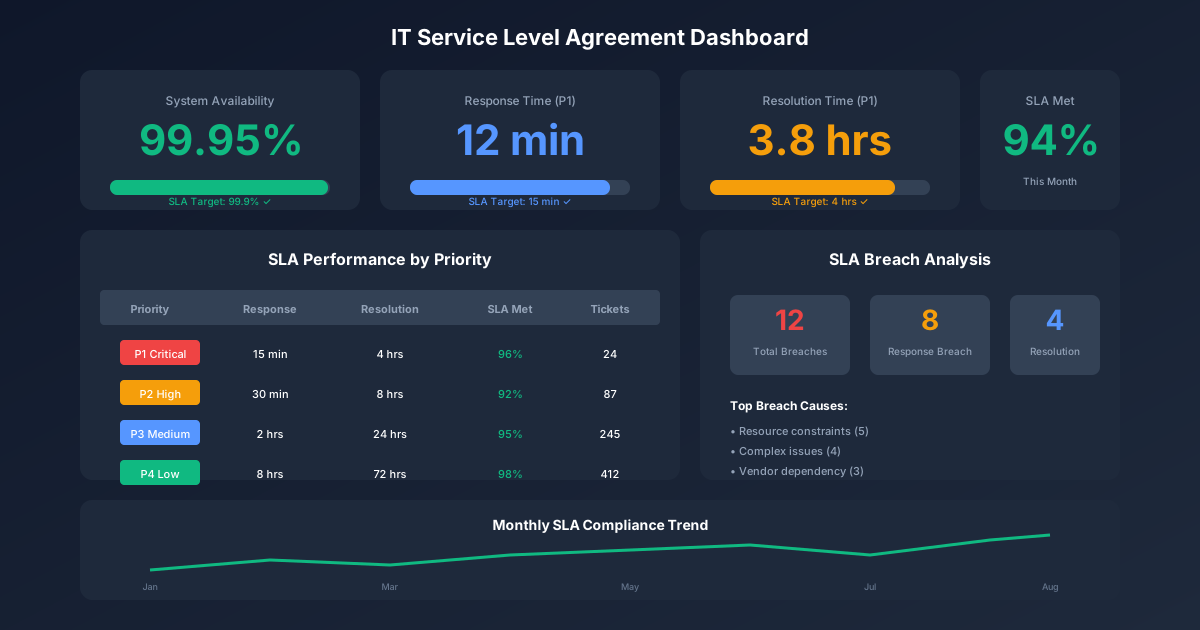
Service Level Agreements define the contract between IT and the business. Yet 70% of organizations struggle with SLA management—either setting unrealistic targets, failing to measure compliance, or letting agreements become shelfware. Effective SLA management improves IT credibility, aligns expectations, and provides a framework for continuous service improvement.
This guide provides a complete playbook for IT service level management, from designing SLA structures through monitoring, reporting, and improvement. You'll get practical templates and frameworks applicable to any organization. For ready-to-use templates, see our Change Management Log Template, Communication Plan Template, and IT Departmental Budget Template.
For foundational ITIL concepts, see our IT Management Hub and ITIL Foundation Templates. For service desk operations, explore our IT Service Desk Best Practices. For comprehensive IT operations guidance, visit our IT Operations Excellence Guide.
What is Service Level Management?
Service Level Management Defined
Service Level Management (SLM) is the ITIL practice responsible for setting clear business-based targets for service performance and ensuring these targets are met. It encompasses the entire lifecycle of service level agreements from design through retirement.
SLM Objectives:
- Define, document, and agree service level targets
- Monitor and report on service performance
- Conduct service reviews with customers
- Identify improvement opportunities
- Ensure IT services meet business needs
Key SLM Activities:
| Activity | Purpose | Frequency |
|---|---|---|
| SLA Design | Create service level structure | Per new service |
| SLA Negotiation | Agree targets with business | Annually + changes |
| Performance Monitoring | Track against targets | Continuous |
| Reporting | Communicate performance | Monthly/Quarterly |
| Service Reviews | Discuss performance with customers | Monthly/Quarterly |
| Improvement Planning | Address gaps and enhance services | Ongoing |
The SLA Hierarchy
Service levels are managed through a hierarchy of agreements:
Service Level Agreement (SLA)
- Agreement between IT and business customers
- Defines service targets from customer perspective
- Focuses on business outcomes and user experience
- Example: "Email service available 99.9% during business hours"
Operational Level Agreement (OLA)
- Agreement between internal IT teams
- Supports SLA delivery
- Defines internal responsibilities and handoffs
- Example: "Network team provides 99.95% network availability to support email SLA"
Underpinning Contract (UC)
- Agreement with external vendors
- Ensures vendor support for SLA achievement
- Includes penalties for non-performance
- Example: "Cloud provider guarantees 99.99% platform availability"
Relationship Between Agreements:
SLA (Customer-facing)
    ↓
OLA (Internal IT teams)
    ↓
UC (External vendors)
Each lower-level agreement must support the achievement of higher-level commitments.
Designing Effective SLAs
SLA Design Principles
1. Business-Aligned
- Targets reflect business needs, not IT capabilities
- Focus on outcomes users care about
- Language business stakeholders understand
2. Measurable
- Every target can be objectively measured
- Data collection is automated where possible
- Metrics are unambiguous
3. Achievable
- Targets are realistic given resources
- Based on baseline performance data
- Allow for some variability
4. Time-Bounded
- Clear measurement periods defined
- Exclusions documented (maintenance windows, etc.)
- Review and renewal dates specified
5. Documented
- Written, formal agreement
- Signed by both parties
- Accessible to all stakeholders
SLA Structure and Components
Standard SLA Document Structure:
1. Introduction and Purpose
- Agreement overview
- Parties involved
- Effective dates
- Review schedule
2. Service Description
- Services covered
- Service scope and boundaries
- Service hours
- User eligibility
3. Service Level Targets
- Availability targets
- Performance targets
- Support response/resolution times
- Capacity targets
4. Measurement and Reporting
- How metrics are calculated
- Data sources
- Reporting frequency
- Report distribution
5. Roles and Responsibilities
- IT responsibilities
- Customer responsibilities
- Escalation contacts
- Governance structure
6. Service Management
- Change management
- Incident management
- Problem management
- Service requests
7. Exclusions and Assumptions
- Planned maintenance windows
- Force majeure
- Customer-caused issues
- Assumptions about environment
8. Service Credits and Remedies
- Credit calculation (if applicable)
- Credit caps
- Claiming process
- Alternative remedies
9. Agreement Administration
- Amendment process
- Termination conditions
- Dispute resolution
- Signature page
Service Level Metrics and Targets
Availability Metrics
System Availability
Availability % = ((Total Time - Downtime) / Total Time) × 100
Availability Targets by Service Tier:
| Tier | Availability | Annual Downtime | Monthly Downtime |
|---|---|---|---|
| Platinum | 99.99% | 52.6 minutes | 4.4 minutes |
| Gold | 99.9% | 8.76 hours | 43.8 minutes |
| Silver | 99.5% | 43.8 hours | 3.65 hours |
| Bronze | 99.0% | 87.6 hours | 7.3 hours |
Availability Calculation Considerations:
Include in Downtime:
- Unplanned outages
- Extended maintenance beyond window
- Degraded performance below threshold
- Partial outages affecting users
Exclude from Downtime:
- Planned maintenance (within agreed windows)
- Customer-caused issues
- Force majeure events
- Third-party failures outside IT control
Availability Measurement Period:
- Monthly: Most common for operational SLAs
- Quarterly: Executive reporting
- Annual: Contract renewals, trending
Performance Metrics
Response Time
| Service Type | Target | Measurement |
|---|---|---|
| Web application | Under 2 seconds | Page load time (P95) |
| API response | Under 200ms | Server response time |
| Database query | Under 100ms | Query execution time |
| Email delivery | Under 5 minutes | Internal delivery |
| File access | Under 1 second | File open time |
Throughput
| Service | Metric | Target |
|---|---|---|
| Network | Bandwidth | 1 Gbps minimum |
| Message processing | 10,000/hour | |
| Print services | Pages per minute | 50 PPM |
| Batch processing | Records per hour | 100,000/hour |
Capacity
| Resource | Warning Threshold | Critical Threshold |
|---|---|---|
| CPU utilization | 70% | 85% |
| Memory utilization | 75% | 90% |
| Storage utilization | 80% | 90% |
| Network utilization | 60% | 80% |
Support Metrics
Incident Response and Resolution:
| Priority | Response Time | Resolution Time | Escalation |
|---|---|---|---|
| P1 - Critical | 15 minutes | 4 hours | Immediate |
| P2 - High | 1 hour | 8 hours | 2 hours |
| P3 - Medium | 4 hours | 24 hours | 8 hours |
| P4 - Low | 8 hours | 5 business days | 24 hours |
Priority Definitions:
| Priority | Impact | Urgency | Example |
|---|---|---|---|
| P1 | Multiple users, critical service | Business stopped | Email system down |
| P2 | Department, important service | Significant impact | CRM slow for sales team |
| P3 | Individual, standard service | Work impaired | Single printer offline |
| P4 | Individual, minor service | Minimal impact | Password reset request |
Service Request Fulfillment:
| Request Type | Target Fulfillment Time |
|---|---|
| Password reset | 15 minutes (self-service) / 1 hour (manual) |
| Software installation | 4 hours (standard) / 24 hours (custom) |
| Access provisioning | 4 hours (standard) / 8 hours (privileged) |
| New hardware | 3-5 business days |
| New user setup | 1 business day |
| User termination | Same day |
Quality Metrics
Customer Satisfaction:
- Target: ≥4.0/5.0 or ≥80% satisfied
- Measurement: Post-ticket survey, periodic surveys
First Contact Resolution:
- Target: ≥70%
- Measurement: Tickets resolved without escalation
SLA Compliance:
- Target: ≥95%
- Measurement: Targets met / Total measurements
Repeat Incidents:
- Target: under 5%
- Measurement: Recurring issues within 30 days
SLA Templates by Service Type
Infrastructure Services SLA
Template: Data Center / Server Infrastructure
Service Description: Provision and maintenance of server infrastructure supporting business applications.
Service Hours:
- Production systems: 24x7x365
- Development/Test: Business hours (8am-6pm local, Mon-Fri)
Service Level Targets:
| Metric | Target | Measurement |
|---|---|---|
| Server availability | 99.9% | Monthly uptime |
| Storage availability | 99.99% | Monthly uptime |
| Backup success rate | 99.9% | Daily backup completion |
| Recovery time (DR) | 4 hours | RTO for Tier 1 applications |
| Recovery point (DR) | 1 hour | RPO for Tier 1 applications |
| Patch compliance | 95% within SLA | Critical patches within 72 hours |
| Capacity headroom | 20% minimum | CPU, memory, storage |
Support Response:
| Severity | Response | Resolution |
|---|---|---|
| Critical (outage) | 15 minutes | 4 hours |
| High (degradation) | 30 minutes | 8 hours |
| Medium (impairment) | 2 hours | 24 hours |
| Low (request) | 8 hours | 5 days |
Network Services SLA
Template: Enterprise Network
Service Description: Corporate network infrastructure including LAN, WAN, wireless, and internet connectivity.
Service Hours:
- Core network: 24x7x365
- Office network: 24x7 (reduced support after hours)
Service Level Targets:
| Metric | Target | Measurement |
|---|---|---|
| Network availability | 99.95% | Core network uptime |
| WAN availability | 99.9% | Per circuit |
| Internet availability | 99.9% | Aggregate connectivity |
| Wireless availability | 99.5% | Per building/floor |
| Latency (internal) | Under 10ms | Site-to-site |
| Latency (internet) | Under 50ms | To major cloud providers |
| Packet loss | Under 0.1% | Monthly average |
| Bandwidth utilization | Under 70% peak | Warning threshold |
Exclusions:
- ISP outages beyond IT control
- User device issues (personal devices)
- Configuration changes requested by users
Application Services SLA
Template: Business Application
Service Description: [Application Name] - [Brief description of application purpose]
Service Hours:
- Production: [Define hours]
- Support: [Define support hours]
Service Level Targets:
| Metric | Target | Measurement |
|---|---|---|
| Application availability | 99.5% | Monthly during business hours |
| Page response time | Under 3 seconds | 95th percentile |
| Transaction success rate | 99.9% | Completed without error |
| Data accuracy | 100% | No data corruption |
| Report generation | Under 5 minutes | Standard reports |
| Batch processing | By 7am daily | Overnight batch completion |
Maintenance Windows:
- Standard: Sunday 2am-6am
- Emergency: As required with 4-hour notice
- Extended: Quarterly with 2-week notice
Support Contacts:
| Role | Contact | Hours |
|---|---|---|
| Application Support | app-support@company.com | Business hours |
| After-Hours | On-call pager | 24x7 |
| Escalation | IT Manager | As needed |
Service Desk SLA
Template: IT Service Desk
Service Description: Single point of contact for IT support requests and incident reporting.
Service Hours:
- Phone/Chat: 7am-7pm local time, Mon-Fri
- Self-Service Portal: 24x7
- After-Hours: On-call for P1/P2 only
Service Level Targets:
| Metric | Target | Measurement |
|---|---|---|
| Phone answer time | Under 30 seconds | Average speed to answer |
| Chat response time | Under 2 minutes | Initial response |
| Email response | Under 4 hours | Business hours |
| Portal acknowledgment | Under 1 hour | Automated + human |
| First contact resolution | 70% | Resolved without escalation |
| Customer satisfaction | ≥85% | Post-ticket survey |
| Abandonment rate | Under 5% | Calls abandoned before answer |
Incident Resolution Targets:
| Priority | Response | Resolution | Update Frequency |
|---|---|---|---|
| P1 | 15 min | 4 hours | Every 30 minutes |
| P2 | 1 hour | 8 hours | Every 2 hours |
| P3 | 4 hours | 24 hours | Daily |
| P4 | 8 hours | 5 days | Upon resolution |
Cloud Services SLA
Template: Cloud Platform (IaaS/PaaS)
Service Description: Cloud infrastructure and platform services supporting business applications.
Service Level Targets:
| Metric | Target | Source |
|---|---|---|
| Compute availability | 99.95% | Provider SLA |
| Storage availability | 99.99% | Provider SLA |
| Database availability | 99.95% | Provider SLA |
| Network availability | 99.99% | Provider SLA |
| Data durability | 99.999999999% | 11 nines |
IT Value-Add Targets:
| Metric | Target | Measurement |
|---|---|---|
| Provisioning time | Under 4 hours | Standard request |
| Cost optimization | Under 10% waste | Monthly cloud spend review |
| Security compliance | 100% | CIS benchmark compliance |
| Backup verification | 100% monthly | Restore test success |
Exclusions:
- Provider-side outages covered by provider SLA
- User misconfiguration
- Intentional service termination
SLA Negotiation Process
Preparing for Negotiation
Step 1: Gather Baseline Data
Before negotiating, understand current performance:
- Current availability metrics
- Historical incident data
- Performance measurements
- User satisfaction scores
- Cost of service delivery
Step 2: Understand Business Requirements
| Question | Purpose |
|---|---|
| What business processes depend on this service? | Understand criticality |
| What is the cost of downtime? | Justify investment |
| What hours must the service be available? | Define service windows |
| What response time is acceptable? | Set performance targets |
| Who are the key stakeholders? | Identify decision-makers |
Step 3: Assess Capability and Cost
| Service Level | Availability | Estimated Cost | Notes |
|---|---|---|---|
| Basic | 99.0% | $X | Minimal redundancy |
| Standard | 99.5% | $X + 20% | Some redundancy |
| Enhanced | 99.9% | $X + 50% | Full redundancy |
| Premium | 99.99% | $X + 100% | Active-active, DR |
Each "nine" of availability typically requires significant additional investment.
The Negotiation Meeting
Agenda:
-
Current State Review (15 min)
- Present baseline performance data
- Review any current SLA performance
- Acknowledge known issues
-
Business Requirements (20 min)
- Customer explains business needs
- Discuss criticality and dependencies
- Quantify cost of service disruption
-
Target Discussion (30 min)
- Present proposed targets
- Discuss trade-offs (cost vs. availability)
- Negotiate specific metrics
- Agree on measurement methodology
-
Exclusions and Assumptions (15 min)
- Agree on maintenance windows
- Define exclusions
- Document assumptions
-
Agreement and Next Steps (10 min)
- Summarize agreed targets
- Set timeline for formal documentation
- Schedule review cadence
Negotiation Best Practices
Do:
- Come prepared with data
- Present options with cost implications
- Listen to business priorities
- Be willing to compromise
- Document everything discussed
- Set realistic, achievable targets
Don't:
- Promise what you can't deliver
- Use technical jargon
- Ignore cost implications
- Set targets without measurement capability
- Agree to everything without analysis
- Let perfect be the enemy of good
Handling Unrealistic Expectations
When business demands exceed capability:
- Quantify the Gap: Show current performance vs. requested
- Explain the Investment: Detail what's needed to meet target
- Present Alternatives: Offer tiered options at different costs
- Propose a Path: Roadmap to improved service levels over time
- Agree on Interim Targets: Set achievable milestones
Example Conversation:
"You've requested 99.99% availability, which is 52 minutes of downtime annually. Our current architecture achieves 99.5% (44 hours). To reach 99.99%, we'd need to invest $500K in redundant infrastructure. As an alternative, we can achieve 99.9% (8.7 hours) with a $150K investment this year, then plan for 99.99% in Year 2."
SLA Monitoring and Reporting
Monitoring Framework
Real-Time Monitoring:
| Tool Type | Purpose | Examples |
|---|---|---|
| Availability monitoring | Track uptime/downtime | Pingdom, Uptime Robot, PRTG |
| APM (Application Performance) | Response times, errors | New Relic, Datadog, AppDynamics |
| Infrastructure monitoring | Server/network health | Nagios, Zabbix, SolarWinds |
| Synthetic monitoring | User experience simulation | Catchpoint, ThousandEyes |
| Real User Monitoring | Actual user experience | Google Analytics, Dynatrace |
Monitoring Requirements by SLA Type:
| SLA Metric | Monitoring Method | Frequency |
|---|---|---|
| Availability | Uptime checks | Every 1-5 minutes |
| Response time | Synthetic transactions | Every 5-15 minutes |
| Throughput | Metrics collection | Every 1 minute |
| Support SLAs | ITSM system tracking | Continuous |
SLA Reporting
Monthly SLA Report Template:
Executive Summary
- Overall SLA compliance: X%
- Services meeting targets: X of Y
- Key achievements
- Areas of concern
- Actions underway
Service Performance Summary
| Service | Target | Actual | Status | Trend |
|---|---|---|---|---|
| 99.9% | 99.95% | 🟢 Met | → | |
| ERP | 99.5% | 99.2% | 🔴 Missed | ↓ |
| Network | 99.95% | 99.97% | 🟢 Met | ↑ |
| Service Desk | 95% | 94% | 🟡 At Risk | → |
Detailed Performance by Service
For each service:
- Availability chart (daily/weekly)
- Incident summary
- Downtime log
- Performance metrics
- Compliance calculation
- Improvement actions
Support Performance
| Metric | Target | Actual | Compliance |
|---|---|---|---|
| P1 Response | 15 min | 12 min avg | 98% |
| P1 Resolution | 4 hrs | 3.2 hrs avg | 95% |
| P2 Response | 1 hr | 48 min avg | 97% |
| P2 Resolution | 8 hrs | 6.5 hrs avg | 92% |
| Overall SLA | 95% | 94.5% | 🟡 |
Incidents Impacting SLA
| Date | Service | Duration | Impact | Root Cause | Prevention |
|---|---|---|---|---|---|
| 01/15 | ERP | 45 min | 500 users | Database lock | Query optimization |
| 01/22 | 20 min | All users | Certificate expiry | Auto-renewal |
Actions and Improvement Plan
| Issue | Action | Owner | Due | Status |
|---|---|---|---|---|
| ERP performance | Database tuning | DBA | 02/15 | In Progress |
| Certificate management | Implement monitoring | Security | 02/28 | Planned |
Reporting Cadence
| Report | Audience | Frequency | Content |
|---|---|---|---|
| SLA Dashboard | IT Operations | Daily | Real-time status |
| SLA Summary | IT Management | Weekly | Performance trends |
| SLA Report | Business Stakeholders | Monthly | Full compliance report |
| Executive Summary | Leadership | Quarterly | High-level overview |
| Annual Review | All Stakeholders | Annually | Year performance + planning |
SLA Review Meetings
Monthly Service Review Agenda:
| Item | Time | Purpose |
|---|---|---|
| Previous action items | 10 min | Review completion status |
| SLA performance review | 20 min | Walk through monthly report |
| Incidents and issues | 15 min | Discuss significant events |
| Upcoming changes | 10 min | Planned maintenance, projects |
| Improvement initiatives | 10 min | Progress on enhancements |
| Open discussion | 10 min | Customer feedback, concerns |
| Action items | 5 min | Assign new actions |
Quarterly Business Review:
- Comprehensive SLA performance analysis
- Trend analysis (improving/declining)
- Business impact assessment
- Investment recommendations
- SLA target adjustments if needed
- Strategic planning discussion
SLA Breach Management
Breach Detection and Response
SLA Breach Severity Levels:
| Level | Definition | Response |
|---|---|---|
| Warning | Within 10% of missing target | Monitor closely |
| Minor Breach | Target missed, minimal impact | Document, improve |
| Major Breach | Target missed, significant impact | Formal review, action plan |
| Critical Breach | Repeated/severe misses | Executive escalation |
Breach Response Process:
- Detection: Automated alert or manual identification
- Classification: Determine severity and impact
- Notification: Alert appropriate stakeholders
- Investigation: Root cause analysis
- Remediation: Implement fix or workaround
- Documentation: Record in SLA breach log
- Prevention: Identify improvements to prevent recurrence
Root Cause Analysis
5 Whys Example:
Problem: SLA breached - P1 incident took 6 hours to resolve (target: 4 hours)
- Why did resolution take 6 hours? → Waited 2 hours for database team
- Why did we wait for database team? → On-call DBA not reachable
- Why wasn't DBA reachable? → Outdated contact information
- Why was contact info outdated? → No regular verification process
- Why no verification process? → Never established after last DBA change
Root Cause: No process to verify on-call contact information Action: Implement monthly on-call roster verification
Service Credits
Credit Calculation Methods:
Method 1: Percentage-Based
Credit = Monthly Fee × (Target - Actual) / Target

Example:
- Monthly fee: $10,000
- Target availability: 99.9%
- Actual availability: 99.5%
- Credit: $10,000 × (99.9 - 99.5) / 99.9 = $40
Method 2: Tiered Credits
| Availability Achieved | Credit |
|---|---|
| 99.9% or above | No credit |
| 99.5% - 99.89% | 5% of monthly fee |
| 99.0% - 99.49% | 10% of monthly fee |
| 98.0% - 98.99% | 25% of monthly fee |
| Below 98.0% | 50% of monthly fee |
Method 3: Downtime-Based
| Downtime | Credit |
|---|---|
| 0-30 minutes | No credit |
| 31-60 minutes | 5% of monthly fee |
| 1-4 hours | 10% of monthly fee |
| 4-8 hours | 25% of monthly fee |
| >8 hours | 50% of monthly fee |
Credit Caps:
- Monthly cap: Typically 50-100% of monthly fee
- Annual cap: May be specified
- Exclusions: Scheduled maintenance, customer-caused issues
Credit Claiming Process:
- Customer submits claim within 30 days
- IT validates against monitoring data
- Approve or dispute with evidence
- Apply credit to next invoice
- Document in SLA records
Operational Level Agreements (OLAs)
OLA Purpose and Structure
OLAs define internal commitments that support customer-facing SLAs.
OLA Template:
Agreement Between: [IT Team A] and [IT Team B] Effective Date: [Date] Supporting SLA: [Customer SLA Reference]
Service Commitment: [Description of service one team provides to another]
Service Level Targets:
| Metric | Target | Measurement |
|---|---|---|
| [Metric 1] | [Target] | [How measured] |
| [Metric 2] | [Target] | [How measured] |
Responsibilities:
| Providing Team | Receiving Team |
|---|---|
| [Responsibility] | [Responsibility] |
Escalation Path:
| Level | Contact | Response |
|---|---|---|
| L1 | Team Lead | 1 hour |
| L2 | Manager | 2 hours |
| L3 | Director | 4 hours |
OLA Examples
Network Team OLA (Supporting Email SLA):
| SLA Target | OLA Commitment |
|---|---|
| Email 99.9% availability | Network provides 99.95% connectivity |
| Email under 5 second response | Network latency under 50ms |
Database Team OLA (Supporting ERP SLA):
| SLA Target | OLA Commitment |
|---|---|
| ERP 99.5% availability | Database provides 99.9% availability |
| ERP under 3 second response | Query response under 100ms |
| ERP data integrity | Zero data corruption |
Security Team OLA (Supporting All Services):
| Commitment | Target |
|---|---|
| Firewall availability | 99.99% |
| Security incident response | 15 minutes |
| Vulnerability patching | Per policy SLA |
| Access provisioning | 4 hours |
Continuous Improvement
Service Improvement Process
Identify Improvement Opportunities:
| Source | Method |
|---|---|
| SLA performance data | Trend analysis, breach review |
| Customer feedback | Surveys, service reviews |
| Incident analysis | Recurring issues, major incidents |
| Industry benchmarks | Comparison to peers |
| Technology advances | New capabilities available |
Improvement Planning:
| Improvement | Current | Target | Investment | Timeline |
|---|---|---|---|---|
| Availability | 99.5% | 99.9% | $100K | 6 months |
| Response time | 3 sec | 2 sec | $50K | 3 months |
| FCR rate | 65% | 75% | $25K | 6 months |
Continual Service Improvement (CSI) Register:
| ID | Improvement | Priority | Status | Owner | Due |
|---|---|---|---|---|---|
| CSI-001 | Implement redundant database | High | In Progress | DBA | Q2 |
| CSI-002 | Enhance monitoring | Medium | Planned | Ops | Q3 |
| CSI-003 | Knowledge base expansion | Medium | Ongoing | SD | Ongoing |
SLA Maturity Model
Level 1: Ad Hoc
- No formal SLAs
- Reactive support
- No performance measurement
- Next Step: Document basic service commitments
Level 2: Basic
- Some SLAs documented
- Manual measurement
- Inconsistent reporting
- Next Step: Implement monitoring tools
Level 3: Defined
- Comprehensive SLAs
- Automated monitoring
- Regular reporting
- Next Step: Establish OLAs and UCs
Level 4: Managed
- Full SLA hierarchy (SLA/OLA/UC)
- Proactive management
- Service credits implemented
- Next Step: Predictive analytics
Level 5: Optimized
- Continuous improvement culture
- Predictive SLA management
- Industry-leading performance
- Next Step: Innovation and transformation
Annual SLA Review
Annual Review Agenda:
-
Year in Review
- Overall SLA performance summary
- Achievements and challenges
- Major incidents and lessons learned
-
Performance Analysis
- Service-by-service review
- Trend analysis
- Benchmark comparison
-
Customer Feedback
- Satisfaction survey results
- Service review feedback
- Complaint analysis
-
Cost Analysis
- Cost of service delivery
- Investment vs. performance
- Cost optimization opportunities
-
Target Adjustment
- Proposed target changes
- New services to add
- Services to retire
-
Improvement Plan
- Next year initiatives
- Investment requirements
- Timeline and milestones
-
Agreement Renewal
- Updated SLA document
- Signature collection
- Communication plan
Implementation Roadmap
Phase 1: Foundation (Weeks 1-4)
Week 1-2: Assessment
- Inventory existing service commitments
- Assess current monitoring capabilities
- Gather baseline performance data
- Identify key stakeholders
Week 3-4: Design
- Define SLA structure and hierarchy
- Select metrics for each service
- Draft SLA templates
- Design reporting framework
Phase 2: Development (Weeks 5-8)
Week 5-6: Documentation
- Complete SLA documents
- Create OLA documents
- Review underpinning contracts
- Develop reporting templates
Week 7-8: Tools and Processes
- Configure monitoring tools
- Set up automated reporting
- Create dashboards
- Document processes
Phase 3: Negotiation (Weeks 9-12)
Week 9-10: Internal Alignment
- Review SLAs with IT teams
- Negotiate OLAs internally
- Validate monitoring accuracy
- Test reporting
Week 11-12: Business Engagement
- Present SLAs to business stakeholders
- Negotiate and finalize targets
- Obtain signatures
- Communicate to organization
Phase 4: Operations (Ongoing)
Monthly:
- Generate SLA reports
- Conduct service reviews
- Track improvement actions
- Update breach log
Quarterly:
- Business review meetings
- Trend analysis
- Improvement planning
- OLA/UC review
Annually:
- Comprehensive SLA review
- Target renegotiation
- Document updates
- Maturity assessment
Common Pitfalls and Solutions
Pitfall 1: Unmeasurable SLAs
Problem: Targets set without ability to measure. Solution: Only commit to metrics you can track; invest in monitoring before finalizing SLAs.
Pitfall 2: IT-Centric Language
Problem: SLAs written in technical jargon business doesn't understand. Solution: Use business language; focus on outcomes users experience, not technical details.
Pitfall 3: Set and Forget
Problem: SLAs signed but never reviewed or measured. Solution: Mandatory monthly reporting, quarterly reviews, annual renegotiation.
Pitfall 4: Unrealistic Targets
Problem: Agreeing to targets IT cannot achieve. Solution: Base targets on baseline data; present cost/benefit trade-offs; negotiate achievable commitments.
Pitfall 5: Missing OLAs
Problem: SLAs exist but internal agreements don't support them. Solution: Create OLAs for every internal dependency; ensure vendor contracts (UCs) align.
Pitfall 6: No Consequences
Problem: SLA breaches have no impact. Solution: Implement service credits, escalation procedures, and tie performance to IT metrics.
Pitfall 7: Too Many Metrics
Problem: Tracking 50 metrics, overwhelming stakeholders. Solution: Focus on 5-10 meaningful metrics per service; use supporting metrics for IT internal management only.
Conclusion
Effective service level management transforms IT from a reactive cost center to a proactive business partner. When you define clear commitments, measure performance consistently, and drive continuous improvement, you build trust with business stakeholders and deliver reliable services.
Your SLA Management Checklist:
- Define service level structure (SLA, OLA, UC)
- Select meaningful, measurable metrics
- Establish realistic, achievable targets
- Implement automated monitoring
- Create standardized reporting
- Establish regular review cadence
- Define breach management process
- Document service credits (if applicable)
- Create improvement register
- Schedule annual SLA review
Related Resources:
- ITIL Foundation Templates - ITIL service management framework
- IT Service Desk Best Practices - Service desk operations
- IT Operations Excellence Guide - ITIL implementation
- IT Governance KPIs Dashboard - IT performance metrics
Build a service level management practice that delivers consistent, reliable IT services aligned with business needs.