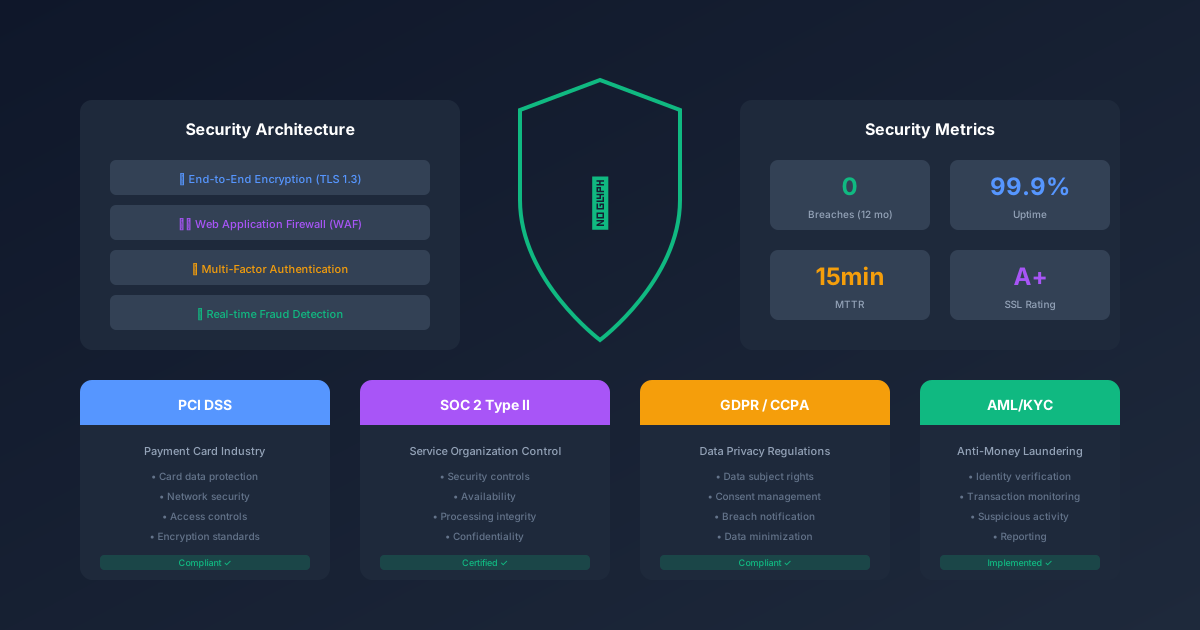
Fintech companies face a unique challenge: innovating quickly while meeting stringent financial security requirements. Regulators, partners, and customers demand robust security programs, but many startups lack the compliance expertise that traditional banks have built over decades.
This guide provides a practical framework for building security policies that satisfy regulators, pass audits, and protect your customers—without slowing down your business.
For related compliance resources, explore our IT Management Hub, Security & Compliance Center, and IT Governance Framework Guide. For policy templates, see our IT Policy Templates.
Fintech Regulatory Landscape
Key Regulations by Business Type
| Business Type | Primary Regulations | Key Requirements |
|---|
| Payment Processor | PCI DSS, State MTL | Card data protection, licensing |
| Lending Platform | GLBA, TILA, ECOA, State | Privacy, fair lending, licensing |
| Banking as a Service | OCC, FDIC, State | Bank partnership requirements |
| Investment Platform | SEC, FINRA | Registration, AML, fiduciary |
| Cryptocurrency | FinCEN, State MTL, SEC | AML, state licensing |
| Insurance Tech | State DOI | Licensing, data protection |
Regulatory Framework Summary
| Regulation | Scope | Key Requirements | Penalties |
|---|
| PCI DSS | Card data handlers | 12 requirements, SAQ/ROC | Brand fines, termination |
| SOC 2 | Service organizations | Trust principles, controls | Partner requirements |
| GLBA | Financial institutions | Privacy notices, safeguards | Up to $100K per violation |
| SOX | Public companies | Financial controls, reporting | Criminal penalties |
| BSA/AML | All financial services | AML program, SAR filing | Criminal + civil |
| CCPA/CPRA | CA consumer data | Privacy rights, opt-out | $7,500 per violation |
| State MTL | Money transmitters | Licensing, bonding, exams | License revocation |
PCI DSS Compliance
PCI DSS 4.0 Requirements
| Requirement | Description | Key Controls |
|---|
| 1 | Install and maintain network security controls | Firewalls, segmentation |
| 2 | Apply secure configurations | Hardening standards, no defaults |
| 3 | Protect stored account data | Encryption, key management |
| 4 | Protect cardholder data during transmission | TLS, strong cryptography |
| 5 | Protect against malware | AV, anti-malware |
| 6 | Develop secure systems | SDLC, vulnerability management |
| 7 | Restrict access | Need to know, least privilege |
| 8 | Identify users and authenticate | MFA, password policies |
| 9 | Restrict physical access | Facility controls, media |
| 10 | Log and monitor | Logging, monitoring, alerting |
| 11 | Test security regularly | Scanning, penetration testing |
| 12 | Support security with policies | Policies, risk assessment |
PCI Validation Levels
| Level | Transaction Volume | Validation Requirement |
|---|
| 1 | > 6 million | Annual ROC by QSA |
| 2 | 1-6 million | Annual SAQ, quarterly scans |
| 3 | 20K-1 million (e-commerce) | Annual SAQ, quarterly scans |
| 4 | < 1 million | Annual SAQ recommended |
SAQ Types
| SAQ | Applicable To | Scope |
|---|
| A | Card-not-present, fully outsourced | ~24 questions |
| A-EP | E-commerce with redirect | ~200 questions |
| B | Imprint or standalone dial-out | ~40 questions |
| C | Payment application systems | ~160 questions |
| D | All other merchants | Full DSS (~300 questions) |
| P2PE | Validated P2PE terminals | ~35 questions |
Cardholder Data Environment (CDE) Scoping
| In Scope | Potentially In Scope | Out of Scope |
|---|
| Systems storing/processing/transmitting CHD | Systems connecting to CDE | Fully segmented systems |
| Security systems for CDE | Shared services | No CHD access |
| Network segments with CHD | Supporting infrastructure | Different network |
Scope Reduction Strategies:
- Network segmentation
- Tokenization
- Point-to-point encryption (P2PE)
- Outsource to PCI-compliant providers
SOC 2 Compliance
Trust Services Criteria
| Category | Description | Common Controls |
|---|
| Security | Protection against unauthorized access | Access control, encryption, monitoring |
| Availability | System availability per SLA | Redundancy, disaster recovery |
| Processing Integrity | Accurate and complete processing | Validation, reconciliation |
| Confidentiality | Protection of confidential information | Classification, encryption |
| Privacy | Personal information handling | Privacy notices, consent |
SOC 2 Control Examples
Security (CC1-CC9):
| Control ID | Control | Evidence |
|---|
| CC1.1 | Demonstrate commitment to integrity and ethics | Code of conduct, background checks |
| CC2.1 | Establish oversight board | Board charter, meeting minutes |
| CC3.1 | Define security objectives | Security policy, risk assessment |
| CC4.1 | Demonstrate accountability | Role descriptions, performance reviews |
| CC5.1 | Enforce logical access controls | Access review, termination procedures |
| CC6.1 | Implement logical and physical access | Identity management, facility security |
| CC7.1 | Detect and respond to security events | SIEM, incident response procedures |
| CC8.1 | Manage changes | Change management process |
| CC9.1 | Mitigate risks from vendors | Vendor management program |
SOC 2 Report Types
| Type | Coverage | Appropriate When |
|---|
| Type I | Design of controls at a point in time | New systems, initial assessment |
| Type II | Operating effectiveness over 6-12 months | Mature systems, customer requirement |
SOC 2 Readiness Checklist
| Area | Item | Status |
|---|
| Governance | | |
| Security policy documented | |
| Risk assessment completed | |
| Management oversight in place | |
| Access Control | | |
| User access management process | |
| Role-based access implemented | |
| Quarterly access reviews | |
| Terminated access removal | |
| Change Management | | |
| Change management policy | |
| Change approval process | |
| Testing before production | |
| Rollback procedures | |
| Monitoring | | |
| Security logging enabled | |
| Log retention (1+ year) | |
| Alert monitoring | |
| Incident response plan | |
| Vendor Management | | |
| Vendor inventory | |
| Vendor risk assessment | |
| Contract review | |
| Ongoing monitoring | |
Security Policy Framework
1. Purpose and Scope
This policy establishes the information security requirements for [Company Name] to protect customer data, financial information, and company assets while maintaining regulatory compliance.
2. Security Principles
| Principle | Application |
|---|
| Defense in depth | Multiple layers of security controls |
| Least privilege | Minimum access necessary |
| Separation of duties | Critical functions require multiple approvers |
| Need to know | Data access based on job requirements |
| Assume breach | Design controls for when (not if) compromised |
3. Data Classification
| Classification | Description | Examples | Controls |
|---|
| Restricted | Most sensitive, regulated | PII, cardholder data, credentials | Encryption, strict access, audit |
| Confidential | Sensitive business data | Financial data, strategies | Encryption, role-based access |
| Internal | Internal use only | Policies, internal comms | Access controls |
| Public | No restrictions | Marketing materials | Integrity protection |
4. Access Control Requirements
| Control | Requirement |
|---|
| Authentication | MFA for all systems with sensitive data |
| Password | 12+ characters, complexity, 90-day rotation |
| Session | 15-minute idle timeout |
| Privileged | Separate accounts, additional approval |
| Service accounts | Documented purpose, limited scope |
| Remote access | VPN with MFA |
5. Encryption Standards
| Data State | Minimum Standard |
|---|
| Data at rest | AES-256 |
| Data in transit | TLS 1.2+ |
| Key management | HSM or KMS |
| Cardholder data | PCI DSS compliant |
Acceptable Use Policy
1. Permitted Use
- Company systems are for business purposes
- Limited personal use permitted if not interfering with work
- All use subject to monitoring
2. Prohibited Activities
- Accessing systems without authorization
- Sharing credentials with others
- Installing unauthorized software
- Transmitting sensitive data insecurely
- Bypassing security controls
- Using company resources for illegal activities
3. Personal Devices (BYOD)
- Enrollment in MDM required
- Device encryption mandatory
- Remote wipe capability
- Separation of personal/work data
- Approved apps only for work
Incident Response Policy
1. Incident Classification
| Severity | Description | Response Time | Escalation |
|---|
| Critical | Active breach, major outage | Immediate | CISO, CEO |
| High | Likely breach, significant risk | 1 hour | CISO, Department head |
| Medium | Potential security event | 4 hours | Security team |
| Low | Minor security issue | 24 hours | IT team |
2. Response Phases
| Phase | Activities | Documentation |
|---|
| Identification | Detect, classify, assign | Incident ticket |
| Containment | Isolate, preserve evidence | Containment log |
| Eradication | Remove threat, patch | Remediation record |
| Recovery | Restore services, verify | Recovery checklist |
| Lessons Learned | Post-incident review | PIR report |
3. Regulatory Notifications
| Regulation | Notification Trigger | Timeline |
|---|
| PCI DSS | Card data compromise | Immediate to brands |
| GLBA | Consumer data breach | As soon as reasonably possible |
| State breach laws | PII breach (varies) | 30-90 days typically |
| SEC | Material cybersecurity incident | 4 business days (8-K) |
Vendor Security Requirements
Third-Party Risk Assessment
| Risk Level | Criteria | Due Diligence Required |
|---|
| Critical | Access to restricted data, core operations | Full security assessment, SOC 2, annual review |
| High | Access to confidential data, important systems | Security questionnaire, SOC 2, annual review |
| Medium | Internal data access, standard services | Security questionnaire, annual review |
| Low | No data access, commodity services | Basic verification |
Security Questionnaire Topics
| Category | Sample Questions |
|---|
| Governance | Do you have a documented security policy? CISO or equivalent? |
| Access Control | How do you manage user access? MFA implementation? |
| Encryption | Encryption at rest and in transit? Key management? |
| Incident Response | Do you have an IR plan? Breach notification procedures? |
| Compliance | SOC 2, PCI, ISO certifications? Audit frequency? |
| Subprocessors | Do you use subcontractors? How are they managed? |
| Business Continuity | DR/BCP plans? RTO/RPO? Testing frequency? |
Contract Security Requirements
| Requirement | Language |
|---|
| Data protection | Vendor shall implement and maintain administrative, technical, and physical safeguards |
| Incident notification | Vendor shall notify Company within 24 hours of any security incident |
| Audit rights | Company may audit Vendor's security controls with reasonable notice |
| Subcontractor | No subcontracting without prior written approval |
| Data return/destruction | Upon termination, Vendor shall return or securely destroy all data |
| Insurance | Vendor shall maintain cyber liability insurance of $X million |
| Compliance | Vendor shall comply with applicable regulations including [list] |
Compliance Program Management
Compliance Calendar
| Frequency | Activity | Owner |
|---|
| Daily | Security monitoring and alert review | Security Operations |
| Weekly | Vulnerability scan review | Security |
| Monthly | Access review (sampling) | IT Security |
| Monthly | Patch compliance review | IT |
| Quarterly | ASV scans (PCI) | Security |
| Quarterly | Policy review | Compliance |
| Semi-Annual | Penetration testing | Security/Vendor |
| Annual | Risk assessment | CISO |
| Annual | SOC 2 audit | External auditor |
| Annual | PCI assessment | QSA/ISA |
| Annual | Security awareness training | HR/Security |
| Metric | Target | Measurement |
|---|
| Patch compliance (critical) | 100% in 7 days | Scan results |
| MFA coverage | 100% | Access audit |
| Training completion | 100% | LMS records |
| Vulnerability remediation (high) | < 30 days | Scan tracking |
| Incident response time | < 1 hour | Ticket metrics |
| Third-party assessments current | 100% | Vendor tracker |
| Control exceptions | 0 | Exception register |
Audit Preparation Checklist
| Category | Items |
|---|
| Documentation | |
| Current policies and procedures |
| Risk assessment documentation |
| Network and data flow diagrams |
| Asset inventory |
| User access lists |
| Vendor inventory |
| Evidence | |
| Access review records |
| Training completion records |
| Change management tickets |
| Incident response records |
| Penetration test reports |
| Vulnerability scan reports |
| Personnel | |
| SME availability scheduled |
| Evidence collection assignments |
| Interview prep completed |
Implementation Roadmap
Phase 1: Foundation (Months 1-3)
| Activity | Deliverable |
|---|
| Gap assessment | Current state vs. requirements |
| Risk assessment | Documented risk register |
| Policy drafting | Core security policies |
| Control inventory | Control matrix |
| Tooling assessment | Security tool gaps |
Phase 2: Implementation (Months 4-8)
| Activity | Deliverable |
|---|
| Access control improvements | MFA, RBAC implementation |
| Logging and monitoring | SIEM deployment |
| Vulnerability management | Scanning program |
| Vendor management | Third-party program |
| Training program | Security awareness |
Phase 3: Validation (Months 9-12)
| Activity | Deliverable |
|---|
| Penetration testing | Test results and remediation |
| SOC 2 readiness | Gap remediation |
| PCI assessment prep | SAQ or ROC preparation |
| Internal audit | Audit findings |
| External audit | SOC 2 Type I or II |
Phase 4: Maturity (Ongoing)
| Activity | Frequency |
|---|
| Continuous monitoring | Ongoing |
| Control testing | Quarterly |
| Policy updates | Annual |
| Risk assessment | Annual |
| External audit | Annual |
Key Takeaways
-
Start with risk assessment: Understand your data, systems, and threats before selecting controls
-
Prioritize by regulation: Focus on requirements that apply to your specific business model
-
Leverage frameworks: SOC 2 and PCI provide structured approaches—don't reinvent the wheel
-
Document everything: Auditors need evidence; good documentation is half the compliance battle
-
Build security into operations: Compliance is easier when security is embedded in daily processes
-
Partner strategically: Choose vendors who are already compliant to reduce your scope
For related resources, explore our IT Governance Framework Guide, Vendor Management Policy Guide, and Healthcare IT Compliance Guide.