Acceptable Encryption Policy Template [2026] — PCI-DSS, HIPAA & SOC 2 Ready

![Acceptable Encryption Policy Template [2026] — PCI-DSS, HIPAA & SOC 2 Ready](/images/encryption-policy-hero.svg?dpl=dpl_At1SKoA9zh8NKaLECzqhv4yEjB9o)
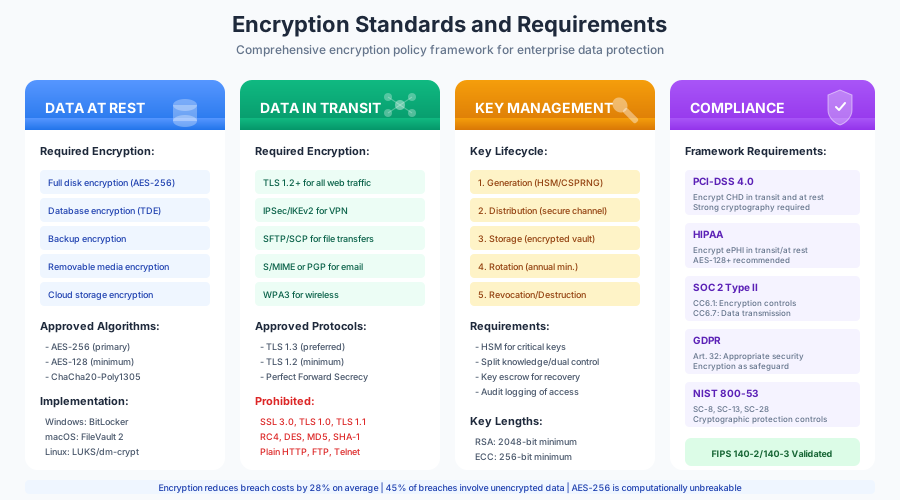
Data breaches cost organizations an average of $4.45 million per incident, but organizations that extensively use encryption reduce that cost by 28%. An acceptable encryption policy is your organization's blueprint for protecting sensitive data through cryptographic controls. This comprehensive guide shows you how to create, implement, and maintain an effective encryption policy that safeguards your most valuable assets. For comprehensive resources, visit our IT Management Hub, IT Security section, and Security & Compliance Hub.
Why Encryption Policies Are Essential
The Current Threat Landscape
Data Breach Statistics:
- Average breach cost: $4.45 million
- 45% of breaches involve unencrypted data
- 277 days average time to identify a breach
- 83% of organizations experienced multiple breaches
- Ransomware attacks occur every 11 seconds
- 60% of small businesses close within 6 months of a breach
What Encryption Protects:
- Customer personal information (PII)
- Financial records and payment data
- Protected health information (PHI)
- Intellectual property and trade secrets
- Employee records and HR data
- Business communications
- Authentication credentials
- Backup data and archives
Consequences of Inadequate Encryption:
- Regulatory fines (GDPR: up to 4% of global revenue)
- PCI-DSS non-compliance penalties ($5,000-$100,000/month)
- HIPAA violations ($100-$50,000 per record)
- Reputation damage and customer churn
- Legal liabilities and class action lawsuits
- Business disruption and recovery costs
- Loss of competitive advantage
What Is an Acceptable Encryption Policy?
An acceptable encryption policy defines the standards, requirements, and procedures for implementing cryptographic controls across your organization. It specifies which encryption algorithms are approved, where encryption must be applied, and how encryption keys are managed throughout their lifecycle.
Policy Objectives
Primary Goals:
- Protect data confidentiality through encryption
- Ensure data integrity with cryptographic controls
- Support authentication and non-repudiation
- Meet regulatory and compliance requirements
- Standardize encryption across the organization
- Enable secure data sharing with partners
- Reduce risk of data breaches
Scope and Applicability
Covered Systems:
- All company-owned devices (laptops, desktops, servers)
- Mobile devices (smartphones, tablets)
- Cloud services and applications
- Network infrastructure
- Backup systems and media
- Development and test environments
- Third-party integrations
Applicable Personnel:
- All employees (full-time and part-time)
- Contractors and consultants
- Vendors and business partners
- IT administrators and developers
- Executive leadership
- Remote workers
Encryption Requirements by Data State
Data at Rest Encryption
Data at rest refers to information stored on hard drives, databases, backup media, and cloud storage. Encrypting data at rest protects against physical theft, unauthorized access, and improper disposal.
Mandatory Encryption Requirements:
Full Disk Encryption (FDE):
- All laptops and workstations
- Mobile devices (smartphones, tablets)
- Removable media (USB drives, external drives)
- Server hard drives containing sensitive data
Database Encryption:
- Transparent Data Encryption (TDE) for databases
- Column-level encryption for sensitive fields
- Backup encryption for database exports
- Encryption of database logs containing sensitive data
Cloud Storage:
- Server-side encryption (SSE) minimum
- Customer-managed keys (CMK) for sensitive data
- Client-side encryption for highly sensitive data
- Key management through cloud HSM or external KMS
Backup Media:
- All backup tapes and media encrypted
- Encryption keys stored separately from backups
- Offsite backup encryption verification
- Secure key escrow for disaster recovery
Approved Algorithms for Data at Rest:
| Algorithm | Key Length | Use Case | Status |
|---|---|---|---|
| AES-256 | 256-bit | Primary standard | Approved |
| AES-128 | 128-bit | Minimum acceptable | Approved |
| ChaCha20-Poly1305 | 256-bit | Alternative to AES | Approved |
| 3DES | 168-bit | Legacy only | Deprecated |
| DES | 56-bit | Prohibited | Prohibited |
| RC4 | Variable | Prohibited | Prohibited |
Implementation by Platform:
Windows Systems:
- BitLocker with TPM + PIN
- Group Policy enforcement
- Recovery key escrow to Active Directory
- Compliance reporting via Intune/SCCM
macOS Systems:
- FileVault 2 with institutional recovery key
- MDM enforcement
- Key escrow to enterprise system
- Compliance verification
Linux Systems:
- LUKS (Linux Unified Key Setup)
- dm-crypt with AES-256
- Automated encryption during provisioning
- Key management via enterprise tools
Mobile Devices:
- iOS: Hardware encryption with strong passcode
- Android: Full device encryption with secure startup
- MDM enrollment required for corporate data
- Remote wipe capability enabled
Data in Transit Encryption
Data in transit moves across networks, between systems, and through the internet. Encryption during transmission prevents eavesdropping, man-in-the-middle attacks, and data interception.
Web Traffic Encryption
TLS Requirements:
- TLS 1.3 preferred for all new implementations
- TLS 1.2 minimum for existing systems
- Perfect Forward Secrecy (PFS) required
- Strong cipher suites only
- Certificate pinning for mobile apps
- HSTS enabled on all web servers
Approved Cipher Suites:
TLS_AES_256_GCM_SHA384
TLS_CHACHA20_POLY1305_SHA256
TLS_AES_128_GCM_SHA256
ECDHE-RSA-AES256-GCM-SHA384
ECDHE-ECDSA-AES256-GCM-SHA384
Prohibited Protocols and Ciphers:
- SSL 2.0, SSL 3.0
- TLS 1.0, TLS 1.1
- RC4, DES, 3DES
- MD5, SHA-1 for signatures
- Export-grade ciphers
- NULL ciphers
- Anonymous Diffie-Hellman
VPN and Remote Access
VPN Requirements:
- IPSec with IKEv2 or WireGuard
- AES-256-GCM encryption
- Perfect Forward Secrecy
- Certificate-based authentication
- Split tunneling disabled for sensitive access
- Always-on VPN for corporate devices
Remote Desktop:
- RDP with Network Level Authentication (NLA)
- TLS encryption required
- Certificate-based authentication preferred
- Multi-factor authentication mandatory
- Session recording for privileged access
Email Encryption
Transport Encryption:
- TLS for all email transmission (opportunistic minimum)
- Mandatory TLS for partners with MTA-STS
- SPF, DKIM, and DMARC configured
- Certificate verification for critical partners
Message-Level Encryption:
- S/MIME for business communications
- PGP/GPG for technical teams
- Microsoft 365 Message Encryption for Office users
- Automatic encryption based on content classification
- User training on encryption usage
File Transfer
Approved Methods:
- SFTP (SSH File Transfer Protocol)
- SCP (Secure Copy Protocol)
- FTPS (FTP over TLS) - explicit mode only
- HTTPS for web-based transfers
- Managed file transfer (MFT) solutions
Prohibited Methods:
- Plain FTP
- Telnet
- Unencrypted HTTP
- SMB without encryption
- Consumer file sharing services
API and Application Communications
Requirements:
- TLS 1.2+ for all API endpoints
- Certificate validation (no self-signed in production)
- API gateway encryption termination
- Service mesh with mTLS for microservices
- Secrets management for API keys
- Rate limiting and authentication
Key Management
Proper key management is as critical as the encryption itself. Weak key management can render even the strongest encryption useless.
Key Lifecycle Management
1. Key Generation
Requirements:
- Use cryptographically secure random number generators (CSPRNG)
- Generate keys in secure environments (HSM preferred)
- Document key generation procedures
- Dual control for master keys
- Entropy verification
Key Length Minimums:
| Algorithm | Minimum | Recommended |
|---|---|---|
| RSA | 2048-bit | 4096-bit |
| ECC | 256-bit | 384-bit |
| AES | 128-bit | 256-bit |
| HMAC | 256-bit | 512-bit |
2. Key Distribution
Secure distribution methods:
- Direct HSM-to-HSM transfer
- Key wrapping with transport keys
- Diffie-Hellman key exchange
- Hardware security modules
- Never transmit keys via email or unencrypted channels
3. Key Storage
Storage requirements:
- Hardware Security Modules (HSM) for critical keys
- Encrypted key vaults (HashiCorp Vault, AWS KMS)
- Separation from encrypted data
- Access controls and logging
- Physical security for hardware keys
4. Key Usage
Controls:
- Purpose limitation (one key per purpose)
- Access logging and monitoring
- Automatic key rotation where supported
- Usage limits and expiration
- Separation of encryption and signing keys
5. Key Rotation
Rotation schedules:
- Symmetric keys: Annual minimum, quarterly recommended
- Asymmetric keys: Every 2-3 years
- TLS certificates: Annual maximum
- After suspected compromise: Immediate
- When personnel with access depart: Evaluate rotation
6. Key Revocation and Destruction
Procedures:
- Certificate Revocation Lists (CRL)
- Online Certificate Status Protocol (OCSP)
- Key destruction verification
- Secure deletion (multiple overwrites)
- Documentation and audit trail
Key Escrow and Recovery
Business Continuity Requirements:
- Escrow critical encryption keys
- Split knowledge procedures
- Geographic distribution of key components
- Regular recovery testing
- Documented emergency access procedures
- Authorized personnel list maintenance
Recovery Procedures:
- Verify identity of requestor
- Confirm business justification
- Multi-person authorization
- Document recovery event
- Audit trail maintenance
- Key rotation after recovery
Approved Cryptographic Standards
Symmetric Encryption
Approved:
- AES (128, 192, 256-bit) - Block cipher standard
- ChaCha20-Poly1305 - Stream cipher alternative
- XChaCha20 - Extended nonce variant
Deprecated (phase out by date):
- 3DES - By end of 2023
Prohibited:
- DES
- RC4
- Blowfish (for new implementations)
- RC2
Asymmetric Encryption
Approved:
- RSA (2048-bit minimum, 4096 recommended)
- ECDSA (P-256, P-384, P-521 curves)
- Ed25519 for signatures
- X25519 for key exchange
Deprecated:
- RSA 1024-bit (immediate phase-out)
Prohibited:
- DSA
- ElGamal
- Weak elliptic curves
Hash Functions
Approved:
- SHA-256, SHA-384, SHA-512
- SHA-3 family
- BLAKE2, BLAKE3
Deprecated:
- SHA-1 (for signatures - prohibited)
Prohibited:
- MD5
- MD4
- SHA-1 for security purposes
Key Derivation Functions
Approved:
- PBKDF2 (minimum 100,000 iterations)
- Argon2id (preferred for passwords)
- scrypt
- bcrypt
Prohibited:
- Simple hash of password
- MD5-based derivation
- Single-iteration hashing
Compliance Mapping
PCI-DSS 4.0 Requirements
Encryption Requirements:
| Requirement | Description | Implementation |
|---|---|---|
| 3.5 | Protect stored cardholder data | AES-256 encryption |
| 4.1 | Encrypt transmission of CHD | TLS 1.2+ |
| 3.6 | Key management procedures | HSM, key rotation |
| 3.7 | Document key management | Policy and procedures |
| 8.3 | Strong authentication | Encrypted credentials |
Key Management (PCI-DSS 3.6):
- Documented key generation procedures
- Secure key distribution
- Secure key storage
- Key changes for suspected compromise
- Key retirement/replacement
- Split knowledge and dual control
- Unauthorized key substitution prevention
HIPAA Security Rule
Technical Safeguards:
| Standard | Implementation Specification | Encryption Requirement |
|---|---|---|
| 164.312(a)(1) | Access Control | Encrypt ePHI at rest |
| 164.312(e)(1) | Transmission Security | Encrypt ePHI in transit |
| 164.312(e)(2) | Encryption | Addressable but strongly recommended |
Best Practices:
- AES-128 minimum for ePHI
- TLS 1.2+ for transmission
- Encrypted backup media
- Key management procedures documented
- Risk assessment for encryption decisions
SOC 2 Type II
Trust Services Criteria:
| Criteria | Control | Encryption Mapping |
|---|---|---|
| CC6.1 | Logical access security | Encrypted authentication |
| CC6.6 | System boundaries | Encrypted transmission |
| CC6.7 | Data transmission | TLS, VPN encryption |
| CC6.8 | Data at rest | Storage encryption |
Evidence Requirements:
- Documented encryption policy
- Configuration standards
- Key management procedures
- Encryption testing results
- Exception documentation
GDPR Article 32
Appropriate Technical Measures:
- Encryption as a security measure (explicitly mentioned)
- Pseudonymization of personal data
- Confidentiality assurance
- Regular testing of controls
Benefits of Encryption for GDPR:
- Breach notification exemption (encrypted data)
- Demonstrates security by design
- Supports data minimization
- Enables secure processing
NIST 800-53 Controls
Relevant Controls:
| Control | Description | Implementation |
|---|---|---|
| SC-8 | Transmission Confidentiality | TLS, VPN |
| SC-12 | Cryptographic Key Establishment | Key management |
| SC-13 | Cryptographic Protection | Approved algorithms |
| SC-28 | Protection of Information at Rest | Storage encryption |
Implementation Guide
Phase 1: Assessment (Weeks 1-2)
Current State Analysis:
- Inventory all data repositories
- Identify sensitive data locations
- Assess current encryption capabilities
- Review existing key management
- Document compliance gaps
Data Classification:
- Public - No encryption required
- Internal - Encryption recommended
- Confidential - Encryption required
- Restricted - Strong encryption mandatory
Gap Analysis Checklist:
- All laptops encrypted?
- Database encryption enabled?
- TLS 1.2+ on all web services?
- Email encryption available?
- VPN encryption current?
- Key management documented?
- Backup encryption verified?
Phase 2: Policy Development (Weeks 3-4)
Policy Components:
1. Purpose and Scope
- Policy objectives
- Covered systems and data
- Applicable personnel
- Related policies
2. Encryption Requirements
- Data at rest requirements
- Data in transit requirements
- By data classification
- By system type
3. Approved Standards
- Algorithms and key lengths
- Protocols and configurations
- Prohibited technologies
- Exception process
4. Key Management
- Lifecycle procedures
- Roles and responsibilities
- Storage and protection
- Recovery procedures
5. Compliance
- Regulatory mapping
- Audit requirements
- Reporting procedures
- Violation consequences
6. Exceptions
- Request process
- Approval authority
- Documentation requirements
- Expiration and review
Phase 3: Technical Implementation (Weeks 5-12)
Week 5-6: Endpoint Encryption
- Deploy full disk encryption
- Configure BitLocker/FileVault policies
- Implement recovery key escrow
- Verify compliance reporting
Week 7-8: Network Encryption
- Audit TLS configurations
- Upgrade to TLS 1.2/1.3
- Disable deprecated protocols
- Implement certificate management
Week 9-10: Database and Storage
- Enable TDE on databases
- Configure cloud encryption
- Encrypt backup systems
- Implement file-level encryption
Week 11-12: Key Management
- Deploy key management solution
- Migrate existing keys
- Implement rotation schedules
- Document procedures
Phase 4: Training and Rollout (Weeks 13-14)
Training Program:
- Policy overview for all employees
- Technical training for IT staff
- Administrator procedures
- User encryption tools
Communication:
- Executive announcement
- Policy publication
- FAQ documentation
- Support resources
Phase 5: Ongoing Management
Monitoring:
- Encryption compliance dashboards
- Key usage monitoring
- Certificate expiration alerts
- Exception tracking
Maintenance:
- Quarterly key rotation review
- Annual policy review
- Technology updates
- Compliance validation
Common Implementation Challenges
Challenge 1: Legacy System Compatibility
Problem: Older systems may not support modern encryption standards.
Solutions:
- Network segmentation for legacy systems
- Gateway encryption (TLS termination)
- Planned system upgrades
- Documented exceptions with compensating controls
- Risk acceptance for business-critical legacy systems
Challenge 2: Performance Impact
Problem: Encryption can impact system performance.
Solutions:
- Hardware acceleration (AES-NI)
- Efficient algorithms (AES-GCM, ChaCha20)
- Proper sizing and architecture
- Performance testing before deployment
- Modern hardware with native encryption support
Challenge 3: Key Management Complexity
Problem: Managing keys across diverse systems is complex.
Solutions:
- Centralized key management system
- Automation of key lifecycle
- Clear roles and responsibilities
- Regular training and documentation
- Enterprise KMS solutions (HashiCorp Vault, AWS KMS)
Challenge 4: User Resistance
Problem: Users may resist encryption due to perceived inconvenience.
Solutions:
- Seamless encryption (transparent to users)
- Clear communication of benefits
- Executive sponsorship
- Training and support
- Balance security with usability
Challenge 5: Cloud Encryption Decisions
Problem: Choosing between provider-managed and customer-managed keys.
Recommendations:
- Provider-managed keys for standard data
- Customer-managed keys (CMK) for sensitive data
- Client-side encryption for highly sensitive data
- Key management in cloud HSM for compliance
- Document decision rationale
Policy Enforcement
Technical Controls
Endpoint Enforcement:
- GPO/MDM policy enforcement
- Compliance checking before network access
- Automatic encryption remediation
- Blocking non-compliant devices
Network Enforcement:
- Firewall rules blocking unencrypted traffic
- Certificate-based authentication
- Network access control (NAC)
- Traffic inspection and alerting
Application Enforcement:
- Code review for encryption implementation
- Automated security testing
- API gateway enforcement
- Configuration management
Administrative Controls
Monitoring:
- Regular compliance scanning
- Exception report review
- Key management audits
- Penetration testing
Reporting:
- Monthly compliance metrics
- Quarterly key management review
- Annual policy effectiveness assessment
- Incident reporting
Violations and Consequences
Minor Violations:
- First offense: Training requirement
- Second offense: Written warning
- Third offense: Access restrictions
Major Violations:
- Intentional bypass: Disciplinary action
- Data exposure due to non-compliance: Investigation
- Repeated violations: Termination consideration
- Regulatory impact: Legal review
Free Encryption Policy Resources
Comprehensive Policy Package
Our encryption policy toolkit includes:
- Complete acceptable encryption policy template
- Data classification guide
- Algorithm approval matrix
- Key management procedures
- Compliance crosswalk (PCI-DSS, HIPAA, SOC 2)
- Implementation checklist
- Training materials
Download Free Encryption Policy Template
Related Security Resources
Security Templates:
- Data Security Policy
- Network Security Policy
- Password Management Policy
- Access Control Policy
- Incident Response Plan
Related Blog Posts:
Conclusion
An acceptable encryption policy is essential for protecting your organization's sensitive data and meeting compliance requirements. By implementing strong encryption standards for data at rest and in transit, combined with proper key management, you significantly reduce your risk of data breaches and their associated costs.
Implementation Checklist:
- Download encryption policy template
- Assess current encryption state
- Classify data by sensitivity
- Define approved algorithms and protocols
- Deploy endpoint encryption
- Configure TLS 1.2+ everywhere
- Implement key management system
- Enable database encryption
- Secure backup encryption
- Train all employees
- Monitor compliance continuously
- Review policy annually
Key Success Factors:
- Executive sponsorship for encryption initiatives
- Clear policy with specific requirements
- Centralized key management
- Automation of encryption deployment
- Regular compliance monitoring
- User training and awareness
- Integration with compliance programs
- Continuous improvement based on threats
Next Steps:
- Download encryption policy template
- Review data security policy
- Explore IT security policies
- Visit Security & Compliance Hub
Protect your organization's data with strong encryption. Download our comprehensive encryption policy template and implementation guide today.