SOC 2 Compliance Guide: Trust Services Criteria, Audit Preparation & Implementation

SOC 2 (System and Organization Controls 2) has become the gold standard for demonstrating security practices to customers and partners. For SaaS companies, cloud service providers, and any organization handling customer data, SOC 2 compliance is often a prerequisite for enterprise sales. This comprehensive guide walks you through the Trust Services Criteria, audit types, implementation process, and preparation strategies. For additional compliance frameworks, visit our Enterprise Security Policy Library.
Understanding SOC 2 Fundamentals
SOC 2 is a voluntary compliance standard developed by the American Institute of Certified Public Accountants (AICPA) for service organizations. Unlike prescriptive frameworks, SOC 2 focuses on outcomes rather than specific controls, giving organizations flexibility in how they achieve compliance.
What SOC 2 Covers
- Service organizations that store, process, or transmit customer data
- Trust Services Criteria across five categories (Security, Availability, Processing Integrity, Confidentiality, Privacy)
- Control environment including policies, procedures, and technical safeguards
- Third-party attestation by licensed CPA firms
Who Needs SOC 2
SOC 2 is essential for:
| Organization Type | Why SOC 2 Matters |
|---|---|
| SaaS providers | Enterprise customer requirement |
| Cloud service providers | Trust and transparency |
| Data centers | Infrastructure assurance |
| Managed service providers | Service quality demonstration |
| Payment processors | Financial data protection |
| Healthcare IT vendors | Complementary to HIPAA |
| Any B2B service handling data | Competitive differentiation |
Key Insight: SOC 2 is not legally required, but increasingly expected. 90% of enterprise procurement processes now include security questionnaires that SOC 2 reports directly address.
The Five Trust Services Criteria
SOC 2 is built around five Trust Services Criteria (TSC). Security is mandatory; the others are selected based on your services and customer needs.
1. Security (Common Criteria) - Required
Security is the foundation of every SOC 2 audit. The Common Criteria cover nine categories:
CC1: Control Environment
- Commitment to integrity and ethical values
- Board oversight responsibilities
- Organizational structure and authority
- Commitment to competence
- Accountability enforcement
CC2: Communication and Information
- Internal communication of objectives
- External communication to stakeholders
- Quality information for controls
CC3: Risk Assessment
- Risk identification and analysis
- Fraud risk assessment
- Change management
CC4: Monitoring Activities
- Ongoing and separate evaluations
- Deficiency communication and remediation
CC5: Control Activities
- Technology general controls
- Logical access security
- Physical access controls
CC6: Logical and Physical Access
- Access provisioning and authentication
- Access removal procedures
- Physical facility protection
CC7: System Operations
- Change management
- System monitoring
- Incident management
CC8: Change Management
- Infrastructure changes
- Software changes
- Configuration management
CC9: Risk Mitigation
- Vendor management
- Business continuity
- Recovery procedures
2. Availability (Optional)
For organizations where uptime is critical to customer operations:
- System monitoring - Performance and availability tracking
- Incident response - Procedures for addressing outages
- Disaster recovery - Business continuity planning
- Capacity planning - Ensuring adequate resources
- SLA management - Commitment to availability targets
Include Availability if: You provide mission-critical services, have contractual uptime SLAs, or customers depend on your system being accessible.
3. Processing Integrity (Optional)
For organizations where data accuracy and completeness matter:
- Input validation - Data accuracy at entry
- Processing controls - Accurate transformation of data
- Output verification - Completeness and accuracy of results
- Error handling - Detection and correction procedures
- Audit trails - Transaction logging and traceability
Include Processing Integrity if: You perform calculations, transactions, or data transformations that customers rely upon.
4. Confidentiality (Optional)
For organizations handling sensitive business information:
- Data classification - Identifying confidential information
- Access restrictions - Limiting access to authorized personnel
- Encryption - Protecting data in transit and at rest
- Secure disposal - Proper destruction of confidential data
- Non-disclosure - Contractual protections
Include Confidentiality if: You handle trade secrets, intellectual property, financial data, or other sensitive business information.
5. Privacy (Optional)
For organizations handling personal information:
- Notice - Privacy policy communication
- Choice and consent - Data collection permissions
- Collection - Limiting data collection to stated purposes
- Use, retention, and disposal - Data lifecycle management
- Access - Individual access to their data
- Disclosure - Third-party sharing controls
- Quality - Data accuracy maintenance
- Monitoring and enforcement - Privacy compliance oversight
Include Privacy if: You collect personal information directly from individuals. Note: Privacy criteria overlap significantly with GDPR and CCPA requirements.
SOC 2 Type I vs Type II
Understanding the difference between Type I and Type II reports is crucial for planning your compliance journey.
Type I Report
What It Is: Point-in-time assessment of control design
Scope:
- Controls are designed appropriately
- Controls are in place at a specific date
- No testing of operating effectiveness
Duration: 4-8 weeks for audit
Best For:
- First-time SOC 2 attestation
- Quick market requirement
- Foundation for Type II
- Startup or early-stage companies
Limitations:
- Does not prove controls work over time
- Less valuable to sophisticated customers
- Often viewed as stepping stone
Type II Report
What It Is: Assessment of control design AND operating effectiveness over time
Scope:
- Controls are designed appropriately
- Controls operated effectively over the review period (typically 6-12 months)
- Detailed testing of control performance
Duration: 6-12 month observation period + 6-8 weeks for audit
Best For:
- Mature security programs
- Enterprise customer requirements
- Ongoing compliance demonstration
- Competitive differentiation
Advantages:
- Stronger assurance to customers
- Demonstrates sustained compliance
- Often required for enterprise deals
- Can be renewed annually
Progression Path
| Stage | Report Type | Timeline |
|---|---|---|
| Initial compliance | Type I | Month 3-4 |
| Observation period | (Building history) | Months 4-12 |
| Full attestation | Type II | Month 12-14 |
| Ongoing | Annual Type II renewal | Every 12 months |
Most organizations start with Type I to demonstrate commitment, then progress to Type II within 12-18 months.
SOC 2 Implementation Roadmap
Phase 1: Readiness Assessment (Weeks 1-4)
1.1 Scope Definition
- Identify systems in scope
- Determine applicable Trust Services Criteria
- Define organizational boundaries
- Document service descriptions
1.2 Gap Analysis
- Assess current controls against TSC
- Identify missing or weak controls
- Prioritize remediation efforts
- Estimate resource requirements
1.3 Stakeholder Alignment
- Secure executive sponsorship
- Assign compliance ownership
- Define roles and responsibilities
- Establish budget and timeline
Phase 2: Control Implementation (Weeks 5-16)
2.1 Policies and Procedures
Create or update documentation for:
| Policy Area | Key Documents |
|---|---|
| Security | Information security policy, acceptable use policy |
| Access | Access control policy, authentication standards |
| Operations | Change management, incident response |
| HR | Background checks, security training |
| Vendor | Third-party risk management |
| Business Continuity | DR plan, backup procedures |
2.2 Technical Controls
Implement required technical safeguards:
- Identity and access management - SSO, MFA, role-based access
- Encryption - Data at rest and in transit
- Logging and monitoring - SIEM, audit trails
- Vulnerability management - Scanning, patching
- Endpoint protection - EDR, device management
- Network security - Firewalls, segmentation
2.3 Process Controls
Establish operational procedures:
- Employee onboarding and offboarding
- Security awareness training
- Incident response procedures
- Change management workflows
- Vendor assessment processes
- Risk assessment procedures
Phase 3: Evidence Collection (Weeks 12-24)
3.1 Documentation Requirements
Gather evidence demonstrating control operation:
- Policy documents with version control
- Access review records
- Change management tickets
- Training completion records
- Vulnerability scan results
- Incident response logs
- Vendor assessments
- Meeting minutes (security reviews)
3.2 Control Testing
Conduct internal testing before the audit:
- Verify controls operate as designed
- Sample transactions for evidence
- Test access controls
- Review audit logs
- Validate encryption configurations
- Test backup and recovery
Phase 4: Audit Execution (Weeks 20-28)
4.1 Auditor Selection
Choose a licensed CPA firm with:
- SOC 2 expertise and experience
- Industry knowledge
- Reasonable pricing
- Clear communication
- Good reputation
4.2 Audit Process
| Phase | Activities | Duration |
|---|---|---|
| Planning | Scope confirmation, document requests | 1-2 weeks |
| Fieldwork | Control testing, interviews, evidence review | 3-4 weeks |
| Reporting | Draft report, management response | 2-3 weeks |
| Finalization | Final report delivery | 1 week |
4.3 Audit Deliverables
- SOC 2 report (Type I or Type II)
- Management assertion letter
- Auditor's opinion
- System description
- Control matrix
- Test results summary
- Exceptions and management responses
Common SOC 2 Controls
Access Control
| Control | Description | Evidence |
|---|---|---|
| Unique user IDs | Each user has individual account | User list report |
| MFA enforcement | Multi-factor for critical systems | MFA configuration |
| Access reviews | Quarterly access certification | Review records |
| Least privilege | Minimum necessary access | Role definitions |
| Termination procedures | Timely access removal | Termination tickets |
Change Management
| Control | Description | Evidence |
|---|---|---|
| Change requests | Documented change tickets | Ticketing system |
| Testing requirements | Changes tested before production | Test records |
| Approval workflows | Authorized change approval | Approval logs |
| Rollback procedures | Ability to reverse changes | Rollback documentation |
| Segregation of duties | Developers cannot deploy to production | Role separation |
Security Operations
| Control | Description | Evidence |
|---|---|---|
| Vulnerability scanning | Regular vulnerability assessments | Scan reports |
| Patch management | Timely security updates | Patch records |
| Penetration testing | Annual third-party testing | Pentest report |
| Security monitoring | Continuous log monitoring | SIEM dashboards |
| Incident response | Defined response procedures | IR plan, incident logs |
Data Protection
| Control | Description | Evidence |
|---|---|---|
| Encryption at rest | Data encrypted in storage | Encryption configurations |
| Encryption in transit | TLS for data transmission | Certificate records |
| Backup procedures | Regular data backups | Backup logs |
| Data retention | Defined retention periods | Retention policy |
| Secure disposal | Proper data destruction | Disposal records |
Audit Preparation Checklist
60 Days Before Audit
- Confirm audit scope and criteria with auditor
- Assign internal audit coordinator
- Review all policies for currency and accuracy
- Conduct internal control testing
- Identify and remediate any gaps
- Prepare system description document
30 Days Before Audit
- Complete evidence collection for all controls
- Organize documentation in shared repository
- Schedule key personnel for auditor interviews
- Review access lists for accuracy
- Verify all training records are current
- Test backup and recovery procedures
2 Weeks Before Audit
- Conduct final policy review
- Verify all evidence is accessible
- Brief interview participants on process
- Confirm auditor logistics and access
- Prepare responses to common questions
- Review prior year exceptions (if applicable)
During the Audit
- Designate single point of contact for auditor
- Respond promptly to evidence requests
- Document any issues or concerns
- Track open items daily
- Escalate blockers immediately
- Review draft findings promptly
Common SOC 2 Pitfalls
1. Insufficient Documentation
Problem: Policies exist but are not documented or maintained.
Solution: Implement policy management with version control, regular reviews, and acknowledgment tracking.
2. Incomplete Access Reviews
Problem: Access reviews are missed or not properly documented.
Solution: Automate quarterly access reviews with documented approvals and remediation tracking.
3. Weak Change Management
Problem: Changes bypass formal approval processes.
Solution: Enforce ticketing requirements with approval workflows and segregation of duties.
4. Missing Evidence
Problem: Controls exist but cannot be proven with evidence.
Solution: Build evidence collection into daily operations; don't wait until audit time.
5. Vendor Management Gaps
Problem: Critical vendors not assessed or monitored.
Solution: Maintain vendor inventory with risk ratings, SOC 2 reports, and periodic reviews.
6. Training Documentation
Problem: Security training occurs but completion is not tracked.
Solution: Use LMS with completion tracking and annual recertification requirements.
SOC 2 Costs
Audit Costs
| Organization Size | Type I | Type II |
|---|---|---|
| Small (< 50 employees) | $15,000-$30,000 | $25,000-$50,000 |
| Medium (50-200 employees) | $25,000-$50,000 | $40,000-$80,000 |
| Large (200+ employees) | $40,000-$80,000 | $60,000-$150,000 |
Implementation Costs
| Category | Typical Range |
|---|---|
| Readiness assessment | $5,000-$20,000 |
| Policy development | $5,000-$15,000 |
| Technical controls | $10,000-$50,000 |
| Compliance platform | $10,000-$30,000/year |
| Consulting support | $15,000-$50,000 |
| Training programs | $2,000-$10,000 |
Total First-Year Investment
| Scenario | Estimated Total |
|---|---|
| Type I (minimal consulting) | $30,000-$60,000 |
| Type I (with consulting) | $50,000-$100,000 |
| Type II (minimal consulting) | $50,000-$100,000 |
| Type II (with consulting) | $80,000-$200,000 |
Costs vary significantly based on current security maturity, scope complexity, and chosen auditor.
SOC 2 Maintenance
Annual Requirements
- Annual Type II audit - Continuous attestation
- Policy reviews - At least annual updates
- Control testing - Ongoing internal assessments
- Training refresh - Annual security awareness
- Access recertification - Quarterly reviews
- Vendor reassessments - Annual vendor reviews
Continuous Compliance
Build compliance into operations rather than treating it as a point-in-time activity:
- Integrate evidence collection into daily workflows
- Automate control monitoring where possible
- Track compliance metrics dashboards
- Address findings immediately
- Maintain audit-ready documentation
SOC 2 and Other Frameworks
SOC 2 often complements other compliance requirements:
| Framework | Relationship | Overlap |
|---|---|---|
| ISO 27001 | Complementary | 60-70% control overlap |
| HIPAA | SOC 2 + HIPAA attestation available | Healthcare customers |
| GDPR | Privacy criteria alignment | EU data handling |
| PCI DSS | Separate but related | Payment processing |
| NIST CSF | Maps to SOC 2 controls | Risk management alignment |
| FedRAMP | SOC 2 can support | Government customers |
Efficiency Tip: Implement controls that satisfy multiple frameworks simultaneously to reduce compliance burden.
SOC 2 Templates and Tools
Implementing SOC 2 compliance requires comprehensive documentation and ongoing management. Our toolkit includes:
- SOC 2 Compliance Templates - Complete audit preparation toolkit
- Security Policy Templates - Policy documentation library
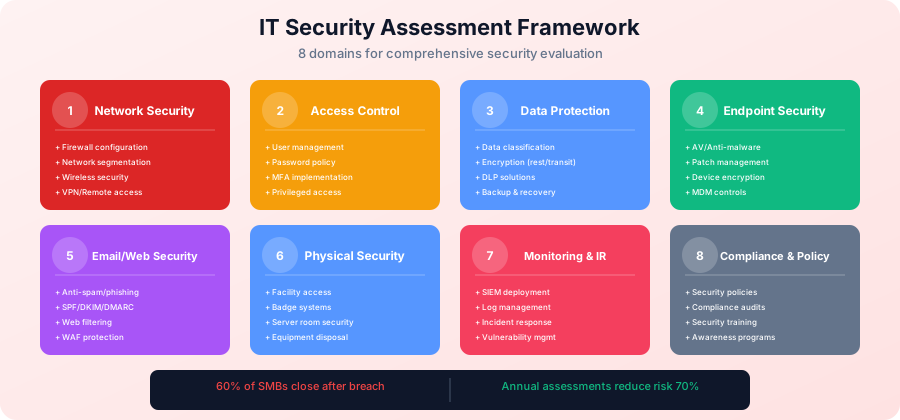
- IT Security Assessment - Assessment frameworks
- Vendor Risk Assessment - Third-party management
Additional Resources:
- Enterprise Security Policy Library - Comprehensive security documentation hub
- Cybersecurity Framework Comparison: NIST vs ISO 27001 - Framework selection guide
- HIPAA Compliance Checklist - Healthcare compliance guide
- GDPR Compliance Guide - Data protection compliance
Start Your SOC 2 Journey
SOC 2 compliance demonstrates your commitment to security and builds trust with customers. While the journey requires investment, the payoff in enterprise credibility and competitive advantage is substantial.
Begin with a readiness assessment to understand your current state, prioritize gaps, and build a realistic timeline. Most organizations can achieve Type I within 3-4 months and Type II within 12-18 months.
Ready to start? Explore our SOC 2 Compliance Templates and Security & Compliance Hub for the tools you need to achieve and maintain SOC 2 compliance.