From Cost Center to Revenue Driver: The Marketing Manager's Guide to Proving Impact

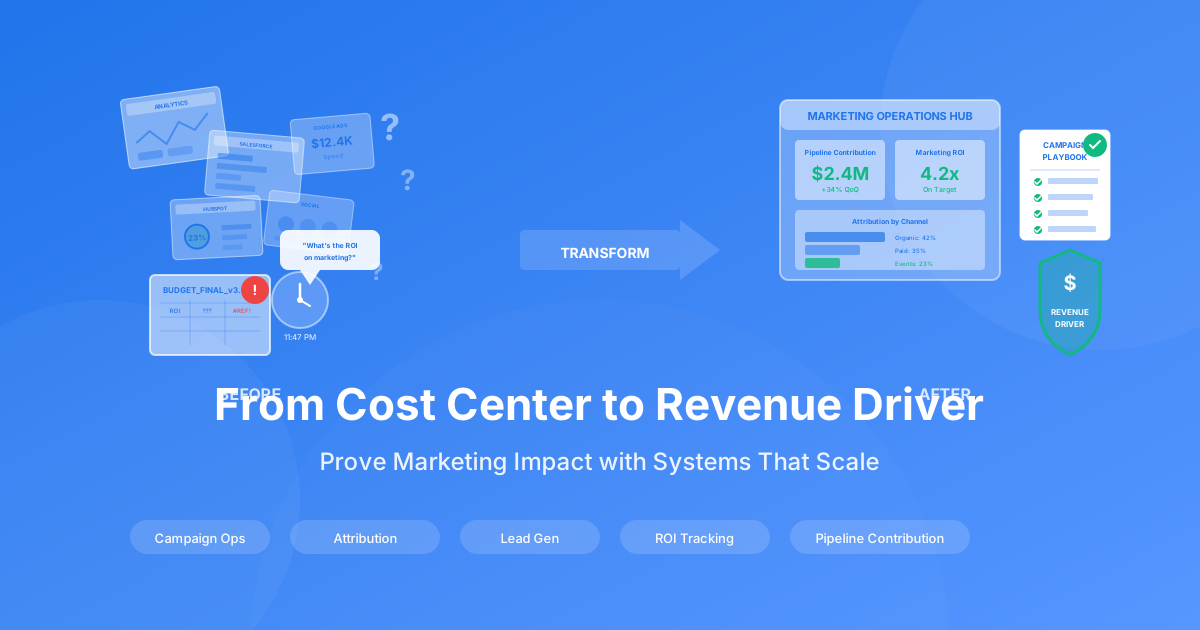
Budget meeting is tomorrow. You've been preparing for weeks, but somehow it still feels like you're going in unarmed.
The CFO will ask the question. The same question every quarter: "What's the ROI on marketing?"
You know the answer is good. You can feel it. The campaigns are working. Leads are flowing. Sales is busy. But proving it? That's where things get complicated.
Your data lives in five different tools. Google Analytics tells one story. HubSpot tells another. Salesforce has its own version of the truth. Your social media dashboards show engagement metrics that don't map to anything finance cares about. And somewhere in a folder on your desktop is a spreadsheet you cobbled together at midnight, trying to connect all these dots into something that looks like attribution.
The CFO doesn't want to hear about impressions. They want pipeline. They want revenue contribution. They want to know that every dollar invested in marketing comes back multiplied.
You're about to defend your budget with a spreadsheet that makes you nervous.
Sound familiar?
This guide incorporates insights from marketing operations leaders and demand generation directors across B2B technology, SaaS, and professional services who have built data-driven marketing organizations.
The Reality of Marketing Operations
If you're a marketing manager, you know the paradox. Marketing has never been more measurable, yet proving impact has never felt harder. Every platform promises analytics. Every tool generates reports. But none of them talk to each other, and none of them speak the language of the C-suite.
The Attribution Nightmare
A lead comes in. They clicked a paid ad three months ago, downloaded a whitepaper, attended a webinar, received four nurture emails, and finally requested a demo after seeing a LinkedIn post. Which channel gets credit? If you ask your ad platform, it's the ad. If you ask your email tool, it's the nurture sequence. If you ask sales, they'll say it was their cold call.
Meanwhile, the CFO just wants to know: did that $50,000 marketing spend generate pipeline?
The Content Black Hole
Your team creates constantly. Blog posts. Ebooks. Infographics. Videos. Social content. Email campaigns. But where does it all go? According to research, 60-70% of marketing content is never used. It gets created, published, and forgotten. No tracking. No optimization. No understanding of what works.
The Campaign Chaos
Every campaign feels like starting from scratch. What was the launch checklist for that webinar last quarter? Where's the email template that performed so well? What naming convention did we use in Salesforce? Tribal knowledge lives in people's heads, not in documented processes.
The Sales Blame Game
"Marketing leads are garbage." You've heard it. Maybe not directly, but the sentiment hangs in the air. Sales has their own definition of a qualified lead. Marketing has another. The handoff is messy. And when deals don't close, marketing is an easy target.
The Budget Defense
Every budget cycle feels like a trial. You present your plans. Finance asks for proof of past performance. You pull reports from six different systems, massage the data, hope the numbers add up, and pray nobody asks a follow-up question that requires you to dig deeper.
This isn't a failure of effort. Marketing teams work incredibly hard. This is a failure of systems.
The Hidden Costs of Marketing Chaos
Let's quantify what this chaos actually costs, because until you see the numbers, it's easy to accept the status quo.
Time Drain: Reporting vs. Strategy
Marketing teams spend 40% or more of their time on reporting and data reconciliation. That's not analysis. That's not strategy. That's pulling numbers from different dashboards and trying to make them tell a coherent story.
If your marketing team costs $500,000 annually in fully loaded compensation, you're spending $200,000 worth of talent on data wrangling instead of marketing.
The math is brutal: That's a full-time senior hire you could add to your team if reporting was systematized.
Content Waste: The 60% Problem
Studies consistently show that 60-70% of marketing content goes unused. Not "underperforming." Unused. Never deployed. Never seen by prospects.
If you produce $100,000 worth of content annually (agency fees, team time, design resources), you're throwing away $60,000 or more. Every year.
That's not a content problem. That's a process problem. Content gets created without a distribution plan. It sits in folders without a content calendar to activate it. It becomes obsolete before it's ever deployed.
Attribution Blindness: Budget Misallocation
When you can't accurately attribute results, you can't optimize spend. Marketing budgets get allocated based on gut feel, executive preference, or whoever argues loudest, not data.
Companies with poor attribution typically misallocate 20-30% of their marketing budget. On a $1M annual budget, that's $200,000-$300,000 going to underperforming channels while high-performing channels are starved.
The opportunity cost: What could you achieve if every marketing dollar went to proven channels?
The Growth Gap
Here's the number that should keep you up at night: companies with documented marketing processes grow 30% faster than those without.
Not 30% more efficient. 30% faster growth.
Documentation isn't bureaucracy. It's a competitive advantage. When your processes are systematized, campaigns launch faster. Optimization happens continuously. Knowledge doesn't walk out the door when someone leaves. Scaling doesn't mean chaos.
The Career Cost
Marketing managers who can't prove ROI don't get promoted. They don't get budget increases. They don't get a seat at the strategic table.
The path to CMO runs through demonstrated business impact, not activity metrics. But it's hard to demonstrate impact when your attribution is a mess and your data doesn't connect.
The Personal Toll
The Sunday night anxiety before Monday reporting. The stress before every budget meeting. The feeling of working incredibly hard but never being able to prove it.
This isn't sustainable. And it's not necessary.
The Framework: Building a Marketing Operations System
There's a better way. Marketing managers who've escaped the attribution chaos didn't buy expensive platforms or hire armies of analysts. They built systems. Interconnected, documented, repeatable systems that transform marketing from cost center to revenue driver.
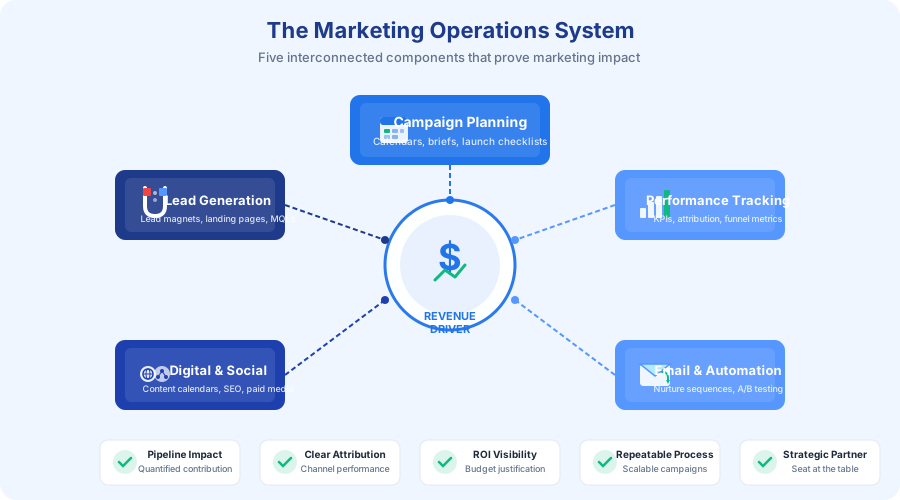
Let me walk you through the five components of a Marketing Operations System.
Component 1: Campaign Planning
Every campaign that feels chaotic started without a plan. Every campaign that runs smoothly follows a documented playbook.
Editorial Calendars:
Not just a list of publish dates. A strategic document that maps content to buyer journey stages, ties content to campaigns, and ensures consistent publishing cadence.
- 90-day rolling calendar minimum
- Content mapped to funnel stages (awareness, consideration, decision)
- Distribution channels specified for each piece
- Owner and deadline clarity
- Integration with campaign launches
Campaign Briefs:
Before any campaign launches, document:
- Objective and success metrics
- Target audience and segmentation
- Key messages and value propositions
- Channels and budget allocation
- Timeline and milestones
- Team responsibilities
When the campaign ends, you have a record. When someone asks "what did we do?" you have an answer.
Launch Checklists:
What happens the day before a webinar? The hour before? The day after? Document it. Your best campaign manager's knowledge should be captured in checklists that anyone can follow.
Checklist categories:
- Pre-launch preparation (assets, copy, tracking)
- Launch day execution (emails, social, ads)
- Post-launch optimization (analysis, follow-up, repurposing)
Naming Conventions:
This sounds mundane until you try to pull a campaign report from Salesforce and discover fifteen different naming formats. Establish conventions for:
- Campaign names in CRM
- UTM parameters
- Asset file names
- Email subject line testing
Consistency enables reporting. Inconsistency creates data chaos.
Explore our Campaign Management Resources for planning templates and checklists.
Component 2: Performance Tracking
If you can't measure it, you can't improve it. If you can't communicate it, you can't defend it.
KPI Dashboards:
Build dashboards that answer the questions executives actually ask:
- What's marketing's contribution to pipeline?
- What's the cost per qualified lead by channel?
- How is marketing influencing deal velocity?
- What's the ROI on specific campaigns?
Not vanity metrics. Business metrics. Metrics that finance understands.
Attribution Models:
Pick a model and stick with it. The worst attribution model is the one that changes every quarter.
Common models:
- First touch (what brought them in?)
- Last touch (what converted them?)
- Linear (equal credit across all touchpoints)
- Time decay (recent touches weighted higher)
- Position-based (first and last touch weighted)
No model is perfect. The goal is consistency and credibility, not precision.
Funnel Metrics:
Track the entire funnel, not just the top:
- Visitors to leads (conversion rate)
- Leads to MQLs (qualification rate)
- MQLs to SQLs (acceptance rate)
- SQLs to opportunities (conversion rate)
- Opportunities to closed-won (win rate)
Where is the funnel leaking? That's where you optimize.
Conversion Tracking:
Every conversion point should be tracked:
- Form submissions
- Content downloads
- Demo requests
- Trial signups
- Event registrations
And every conversion should be attributed. If you can't trace a conversion back to its source, you have a tracking gap.
Visit our Marketing ROI Calculator to start quantifying your impact.
Component 3: Email & Automation
Email remains the highest-ROI marketing channel, but only if it's systematized.
Nurture Sequences:
Document your nurture tracks:
- Entry criteria (what triggers enrollment?)
- Exit criteria (what removes someone?)
- Email cadence and content
- Branching logic (if they do X, then Y)
- Performance benchmarks
When someone asks "what happens when a lead downloads our ebook?" you should have a documented answer, not a guess.
Segmentation Strategies:
Define your segments clearly:
- How are segments created?
- What criteria define each segment?
- How are segments maintained and cleaned?
- What content is appropriate for each segment?
Segmentation without strategy is just complexity.
A/B Testing Frameworks:
Test systematically, not randomly:
- What are you testing? (subject line, CTA, send time)
- What's your hypothesis?
- What's the success metric?
- What's the minimum sample size?
- How long will you run the test?
- What will you do with the results?
Document tests and results. Build a learning library over time.
Deliverability Management:
The best email in the world doesn't matter if it lands in spam:
- List hygiene practices
- Bounce handling procedures
- Engagement-based suppression
- Domain reputation monitoring
- Authentication setup (SPF, DKIM, DMARC)
Explore our Email Marketing Resources for sequence templates and automation playbooks.
Component 4: Digital & Social
Digital presence requires consistent execution, not sporadic activity.
Content Calendars:
Separate from campaign calendars, content calendars track ongoing content production:
- Blog publishing schedule
- Social posting cadence by platform
- Content themes and pillars
- Seasonal and trending opportunities
- Content repurposing plan
Social Playbooks:
Document how you show up on each platform:
- Brand voice and tone guidelines
- Posting frequency and timing
- Engagement response protocols
- Hashtag strategy
- Visual guidelines
Consistency builds brand. Documentation enables consistency.
SEO Checklists:
Every piece of content should follow SEO best practices:
- Keyword research completed
- Title and meta optimized
- Headers structured properly
- Internal linking included
- Image alt text added
- Mobile optimization verified
Checklists prevent optimization being forgotten in the rush to publish.
Paid Media Frameworks:
For paid campaigns, document:
- Campaign structure standards
- Audience targeting approach
- Budget allocation methodology
- Bid strategy guidelines
- Creative testing process
- Reporting cadence
When campaigns underperform, frameworks help you diagnose why.
Component 5: Lead Generation
Leads are marketing's primary output. Make the machine run smoothly.
Lead Magnets:
Document your lead magnet inventory:
- What assets exist?
- What stage of funnel do they serve?
- What landing page hosts them?
- What follow-up sequence triggers?
- When were they last updated?
Outdated lead magnets are worse than no lead magnets.
Landing Page Templates:
Standardize what works:
- Page structure and layout
- Form field requirements by offer type
- Social proof elements
- CTA best practices
- Mobile optimization standards
Templates accelerate creation and enforce consistency.
Conversion Optimization:
Document your optimization process:
- How often do you review page performance?
- What metrics trigger optimization?
- How do you prioritize pages to optimize?
- What's your testing methodology?
- How do you implement winners?
MQL Definitions:
This is where marketing and sales alignment lives or dies:
- What actions qualify a lead as MQL?
- What demographic criteria matter?
- What firmographic criteria matter?
- What's the scoring model?
- What triggers handoff to sales?
Write it down. Get sales to agree. Review quarterly.
Explore our Lead Generation Resources for landing page templates and conversion frameworks.
The Toolkit: Templates That Transform
Understanding the framework is step one. Implementation requires tools. Here's how specific templates solve specific pain points:
| Your Problem | Template Solution | The Outcome |
|---|---|---|
| "What's marketing's ROI?" | Marketing ROI Dashboard Template | Instant answer with supporting data |
| "Campaign performance is inconsistent" | Campaign Brief Template | Repeatable success, documented learnings |
| "Content gets created but never used" | Content Calendar Template | Strategic deployment, no wasted assets |
| "Sales says leads are bad" | MQL Definition Framework | Aligned definitions, accepted leads |
| "Attribution is impossible" | Attribution Model Documentation | Consistent measurement, credible reporting |
| "Every campaign starts from scratch" | Campaign Launch Checklist | Faster execution, nothing forgotten |
| "I can't prove pipeline contribution" | Pipeline Contribution Dashboard | Marketing's impact quantified |
| "Email performance is declining" | Email Audit Checklist | Diagnosis and optimization roadmap |
The Integration Advantage
These templates work better together than alone. Your campaign brief feeds your editorial calendar. Your calendar drives your content tracking. Your tracking populates your dashboards. Your dashboards answer the CFO's questions.
One connected system. No more data islands.
Visit the Sales and Marketing Hub to explore the complete toolkit.
Quick Wins: Start Today
You don't need to transform everything at once. Here are immediate actions that create real impact:
This Week: Establish a Naming Convention
Time required: 2 hours
Pick one area (campaign names, UTM parameters, or email subject lines) and document a naming convention. Get stakeholder buy-in. Implement immediately.
Example campaign naming convention:
[Year]-[Quarter]-[Type]-[Campaign Name]-[Segment]
2025-Q1-Webinar-MarketingROI-Enterprise
This single action will improve your reporting accuracy within 30 days.
This Month: Build a Pipeline Contribution Dashboard
Time required: 8 hours
Create one dashboard that answers: "What's marketing's contribution to pipeline this month?"
Required components:
- Total pipeline value
- Marketing-sourced pipeline (first touch)
- Marketing-influenced pipeline (any touch)
- Pipeline by campaign
- Pipeline by channel
This becomes your answer to the CFO question. One dashboard. Five minutes. Complete confidence.
This Quarter: Document Your Top 3 Campaigns
Time required: 12 hours
Pick your three best-performing campaign types (webinars, content offers, email nurtures, whatever works for you). Document everything:
- Campaign brief template
- Launch checklist
- Email templates
- Landing page templates
- Reporting framework
Turn tribal knowledge into repeatable playbooks. The next time you run this campaign type, you'll launch in half the time with predictable results.
Ongoing: Weekly Pipeline Review
Time required: 1 hour per week
Block Friday afternoon. Review:
- What pipeline did marketing generate this week?
- What's converting? What isn't?
- What campaigns are launching next week?
- What optimizations are needed?
Make this a habit. Consistent attention prevents drift.
Marketing Operations Assessment
Take an honest look at your current state. Check each item you can confidently answer "yes" to:
- Can you show marketing's contribution to pipeline within 5 minutes?
- Do you have a documented content calendar for the next 90 days?
- Is your campaign naming convention consistent across all channels?
- Do you know your cost per lead by channel?
- Are your email sequences documented and optimized?
- Do you have templates for recurring campaign types?
- Can you identify which content drives the most conversions?
- Is there a clear handoff process from MQL to sales?
Score yourself:
- 0-2 checked: Crisis mode. Start with the naming convention this week.
- 3-4 checked: Foundation exists. Focus on dashboards and documentation.
- 5-6 checked: Making progress. Time for optimization and scale.
- 7-8 checked: Marketing operations maturity. Shift to automation and innovation.
Be honest. Every unchecked box is an opportunity.
The Transformation: What Success Looks Like
Imagine walking into the budget meeting with confidence instead of anxiety.
The CFO asks the question: "What's the ROI on marketing?"
You pull up your dashboard. One click. The numbers are there:
- Marketing-sourced pipeline: $2.4M (34% of total pipeline)
- Marketing-influenced pipeline: $5.1M (68% of total pipeline)
- Marketing ROI: 4.2x (every $1 invested returned $4.20 in pipeline value)
- Cost per qualified lead by channel: Organic content $42, Paid search $78, Events $156
You don't defend. You present. The data speaks.
The CFO's follow-up question: "How do we increase marketing's contribution to 40% of pipeline?"
That's a strategic conversation. That's a seat at the table. That's marketing as a revenue driver, not a cost center.
For your team: Campaigns launch smoothly because playbooks exist. New hires ramp quickly because processes are documented. Content gets used because it's mapped to campaigns. Attribution is clear because tracking is consistent.
For sales: Leads are accepted because MQL definitions are aligned. Handoffs are smooth because processes are documented. Marketing isn't blamed because results are visible.
For your career: You're not the person who creates pretty campaigns. You're the person who drives pipeline. You're the person with data. You're the person the CEO wants in strategy meetings.
For you: The anxiety fades. You're not guessing anymore. You're measuring. You're optimizing. You're proving impact.
This isn't fantasy. This is what systematic marketing operations looks like. It's achievable with the right frameworks, templates, and discipline.
Your Next Steps
The path from cost center to revenue driver isn't about working harder. It's about building systems that prove what you already know: marketing works.
Here's how to move forward:
1. Assess your current state. Use the checklist above. Be honest about where you are.
2. Pick your starting point. If attribution is your biggest pain, start with the naming convention and dashboard. If content waste is killing you, start with the content calendar.
3. Download the tools. Visit our Sales and Marketing Hub for templates and frameworks organized by function:
4. Block the time. Schedule your first "marketing ops" block this week. Even four hours is a start.
5. Document one thing. Campaign brief template. Naming convention. Dashboard framework. Pick one and finish it.
6. Measure your progress. Revisit the assessment in 90 days. Watch your checkmarks grow.
The CFO will ask the question again next quarter. Will you have a better answer?
Build the systems. Prove the impact. Earn your seat at the table.
Related Resources
Ready to dive deeper into specific areas? Explore these comprehensive guides:
- Sales and Marketing Hub - All Resources
- Campaign Management Templates
- Lead Generation Frameworks
- Marketing ROI Calculator
- For Marketing Managers - Role-Based Resources
Your transformation starts with one documented process. Which one will you tackle first?