From Firefighting to Framework: How IT Managers Build Sustainable Operations

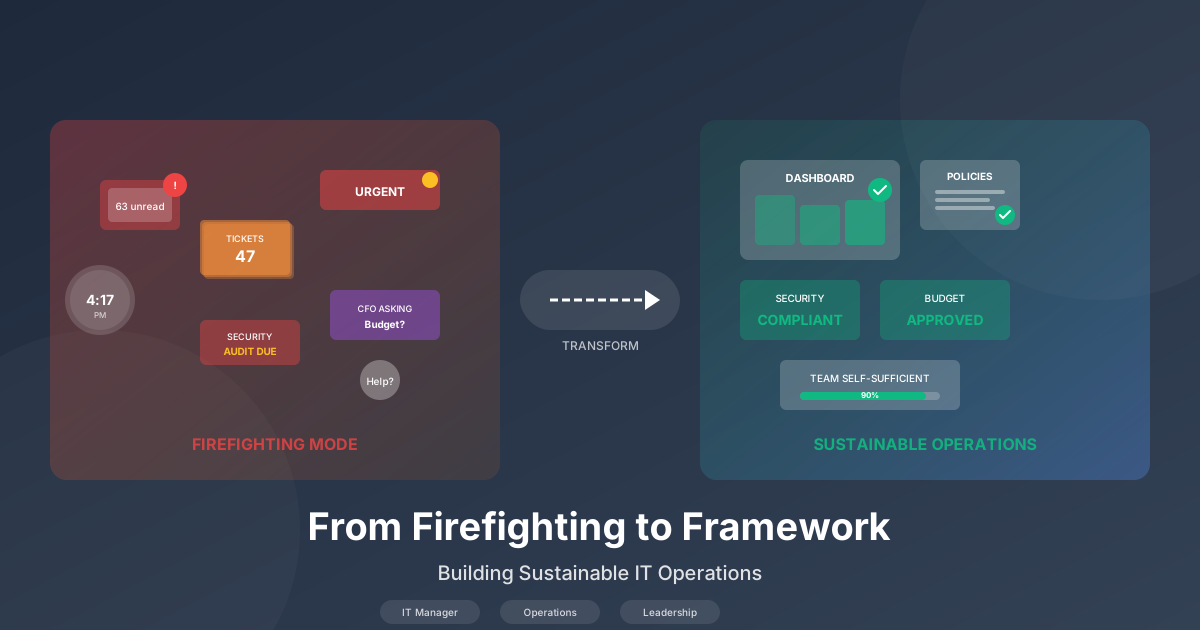
It's 4:17pm on a Tuesday. You have 63 unread emails, a half-finished security audit response due Friday, your CFO just pinged asking for "quick thoughts" on next year's IT budget, and someone from accounting is standing at your desk because "the internet is slow."
Sound familiar?
You finally escape the accounting conversation (it was their VPN—again), only to get pulled into an emergency meeting about a vendor contract that's auto-renewing in 72 hours. By the time you get back to your desk, it's 6:30pm. The security audit sits untouched. The budget request remains unanswered. And your inbox has grown to 78 unread.
This isn't a bad day. This is every day.
This guide incorporates insights from IT directors and managers across healthcare, finance, and technology sectors who have successfully transformed their operations from reactive firefighting to proactive leadership.
The Reality of IT Management
If you're an IT manager, you know the drill. Your job description says "strategic technology leadership," but your actual day looks more like:
The Ticket Avalanche Help desk escalations that "only you can solve." Password resets that somehow require manager approval. That one application that crashes every Thursday afternoon for reasons no one understands.
The Security Tightrope Compliance audits. Penetration test findings. The CEO's son who wants admin access to "test something." Balancing security with usability while everyone complains about both.
The Budget Squeeze Justifying every dollar while the business expects enterprise capabilities on a startup budget. Explaining why "the cloud" isn't actually free. Defending headcount against AI replacement theories.
The Vendor Circus Contract renewals at maximum inconvenience. Sales reps who become your best friends during renewal season. License true-ups that reveal shadow IT you didn't know existed.
The Expectation Gap Leadership wants innovation. Users want stability. Finance wants cost savings. Security wants lockdown. And somehow, you're supposed to deliver all four simultaneously.
You didn't sign up for this chaos. You signed up to build things, solve problems, and make technology work for people. But instead, you're stuck in perpetual firefighting mode—so busy putting out flames that you never get to prevent the next fire.
The Hidden Costs of Reactive IT
Let's quantify what this chaos actually costs you—and your organization.
Time Cost
The average IT manager spends 60% of their time on reactive tasks. That's three days a week responding to emergencies instead of preventing them. Over a year, that's over 1,200 hours—the equivalent of 30 work weeks—spent in firefighting mode.
The math is brutal: If you make $120,000/year, you're spending roughly $72,000 worth of your time on tasks that proper systems would eliminate or delegate.
Financial Cost
Poorly documented processes cost 20-30% more during transitions. When your senior engineer leaves, does their knowledge walk out the door? When you onboard a new team member, how many weeks until they're productive?
Organizations with documented IT processes see:
- 40% faster onboarding
- 25% reduction in repeated incidents
- 50% less time spent on knowledge transfer
Risk Cost
Ad-hoc security practices don't just create audit findings—they create breach exposure. The average cost of a data breach is $4.45 million. But even a minor compliance violation can cost your organization hundreds of thousands in fines and remediation.
When auditors ask "show me your policy," do you have an answer? Or do you have a panicked scramble?
Career Cost
Here's the uncomfortable truth: staying in "firefighter" mode caps your career.
Strategic initiatives—cloud migrations, automation projects, digital transformation—these are what get IT managers promoted to IT directors. But you can't lead a cloud migration when you're troubleshooting printer drivers.
The IT managers who advance are the ones who build systems that run without them. The ones who get stuck are the ones who make themselves indispensable for the wrong reasons.
Team Cost
Your burnout is contagious. When you're constantly stressed, your team feels it. When you're the bottleneck for every decision, your team can't grow. When tribal knowledge lives only in your head, your team lives in fear of your vacation.
The result? Higher turnover, harder recruiting, and a cycle of knowledge loss that makes everything worse.
The Framework: 5 Pillars of Sustainable IT Operations
There's a better way. Not a magic solution—sustainable IT operations require real work. But there's a systematic approach that transforms chaos into control.
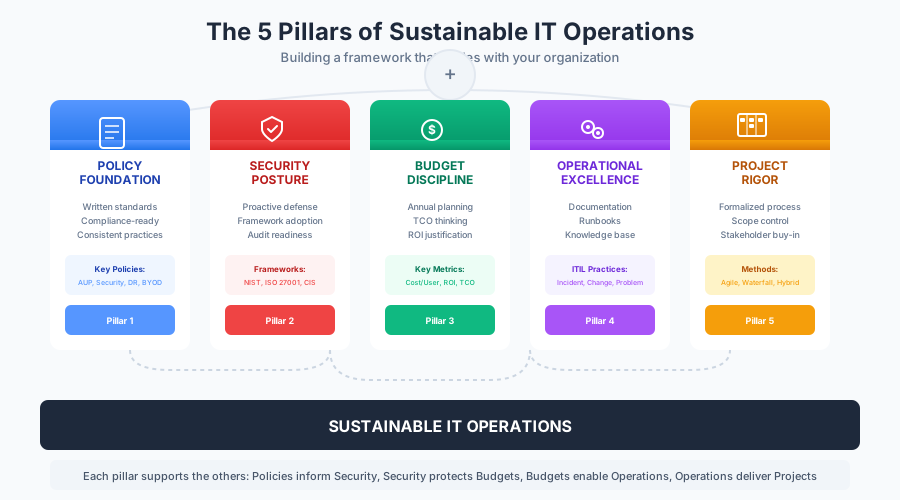
Pillar 1: Policy Foundation
Why it matters: Without written policies, you're making the same decisions over and over. Every "can I install this software?" becomes a judgment call. Every security question requires your personal attention. Every new hire learns through osmosis instead of documentation.
Written policies create:
- Consistency: The same answer every time, regardless of who's asking
- Scalability: Your team can enforce policies without escalating to you
- Compliance: Auditors see documentation, not excuses
- Onboarding: New hires understand expectations from day one
Core policies every IT department needs:
- Acceptable Use Policy (AUP)
- Information Security Policy
- Password and Authentication Policy
- BYOD/Mobile Device Policy
- Incident Response Policy
- Disaster Recovery Policy
- Change Management Policy
- Data Classification Policy
You don't need to write these from scratch. Start with proven templates and customize them for your organization. The goal isn't perfection—it's having something documented that you can improve over time.
Resource: Explore our IT Policy Templates for audit-ready, customizable policies.
Pillar 2: Security Posture
Why it matters: Reactive security is expensive security. You're either investing in prevention or paying for remediation—and remediation costs 10x more.
Proactive vs. Reactive Security:
| Reactive Approach | Proactive Approach |
|---|---|
| Respond to breaches | Prevent breaches |
| Fix vulnerabilities when found | Scheduled vulnerability scanning |
| Ad-hoc security training | Regular security awareness program |
| Audit scrambles | Continuous compliance monitoring |
| Incident chaos | Documented response procedures |
Framework adoption matters. Whether you choose NIST CSF, ISO 27001, or CIS Controls, having a recognized framework provides:
- A roadmap for improvement
- Common language with auditors
- Prioritization guidance
- Industry credibility
You don't need full certification to benefit. Even a "NIST-aligned" approach signals maturity and provides structure.
Resource: Visit our Security and Compliance Hub for assessment tools and security templates.
Pillar 3: Budget Discipline
Why it matters: IT managers who can't speak the language of finance don't get budget increases. They get budget cuts.
The annual planning cycle:
- Q3: Start gathering requirements and usage data
- Q4: Build budget with TCO analysis and ROI justification
- Q1: Present and defend budget
- Ongoing: Track actual vs. planned, adjust forecasts
TCO thinking transforms budget conversations:
Don't just request "$50,000 for new servers." Instead:
"The current servers cost us $75,000/year in maintenance, plus $30,000 in downtime impact. New infrastructure at $50,000 upfront reduces ongoing costs to $20,000/year, delivering $35,000 annual savings and 99.9% uptime. Three-year ROI: 210%."
That's a budget request that gets approved.
Hidden costs to capture:
- Staff time on maintenance
- Downtime impact (revenue, productivity)
- Security risk exposure
- Compliance costs
- Opportunity cost of delayed projects
Resource: Use our IT Budget Calculator to build data-driven budget requests.
Pillar 4: Operational Excellence
Why it matters: The goal isn't to be the person who can fix anything. The goal is to build systems where most things don't break—and when they do, anyone can fix them.
Documentation is your multiplier:
- Runbooks: Step-by-step guides for common procedures
- Knowledge base: Searchable answers to frequent questions
- Architecture diagrams: Visual documentation of systems
- Decision logs: Why we made the choices we made
ITIL principles, simplified:
You don't need to implement full ITIL. But these core concepts transform operations:
Incident Management: How do we handle outages?
- Clear escalation paths
- Defined severity levels
- Response time targets
- Post-incident reviews
Change Management: How do we make changes safely?
- Standard change catalog (pre-approved changes)
- Change advisory board for complex changes
- Rollback procedures
- Communication templates
Problem Management: How do we prevent repeat incidents?
- Root cause analysis process
- Known error database
- Trend analysis
- Proactive problem identification
The test: Can your team solve problems without you? If not, your documentation needs work.
Resource: Browse our IT Operations templates for runbooks, checklists, and procedure guides.
Pillar 5: Project Rigor
Why it matters: Not everything is a "quick fix." When you treat projects like tasks, you get scope creep, missed deadlines, and stakeholder frustration.
When to formalize:
- Effort exceeds 40 hours
- Multiple stakeholders involved
- Budget allocation required
- Business process changes
- Integration with other systems
Project rigor includes:
- Written scope and requirements
- Stakeholder sign-off
- Timeline with milestones
- Risk identification
- Communication plan
- Success criteria
This isn't bureaucracy—it's protection. When the CEO asks why the project is "late," you have documentation showing the scope tripled after kickoff.
Resource: Find project templates in our IT Project Management section.
The Toolkit: Templates That Transform
Understanding the framework is step one. Implementation is where the real change happens. Here's how specific templates solve specific problems:
| Your Problem | Template Solution | The Outcome |
|---|---|---|
| "We don't have a policy for that" | IT Policy Bundle | Audit-ready documentation in hours, not weeks |
| "What's our security posture?" | Security Assessment Checklist | Clear gap analysis and prioritized roadmap |
| "Budget got rejected again" | IT Budget Template | Data-driven requests with TCO and ROI |
| "New hire can't do anything" | IT Onboarding Checklist | Consistent setup, faster productivity |
| "Vendor contract is expiring" | Vendor Management Template | Negotiation leverage and renewal tracking |
| "Same incident keeps happening" | Incident Response Runbook | Root cause resolution, not just band-aids |
| "I'm the only one who knows this" | Knowledge Base Template | Documented tribal knowledge that survives turnover |
| "Projects always run late" | Project Charter Template | Scope control and stakeholder alignment |
The system effect: These templates work better together than alone. Your policies inform your security posture. Your security posture justifies your budget. Your budget enables operations. Your operations deliver projects. Each pillar supports the others.
Start here: Download our IT Management Toolkit for a comprehensive starter pack of templates and frameworks.
Quick Wins: Start Today
You don't need to transform overnight. Sustainable change happens incrementally. Here's your action plan:
This Week (2 hours)
Pick one policy and document it.
Choose the policy that would save you the most time if it existed. For most IT managers, that's either:
- Password/Authentication Policy (stops the "can I share my password?" questions)
- Acceptable Use Policy (stops the "can I install this software?" questions)
- BYOD Policy (stops the "can I use my personal phone for work?" questions)
Download a template, customize it for your organization, get stakeholder approval, and publish it. You just eliminated an entire category of ad-hoc decisions.
This Month (8 hours)
Document your top 5 recurring issues as runbooks.
What incidents hit your desk every week? That application that crashes? That VPN issue? That printer that jams? Document the diagnosis and resolution steps so anyone on your team can handle them.
Format each runbook with:
- Symptoms (how to recognize this issue)
- Diagnosis steps (how to confirm the cause)
- Resolution steps (how to fix it)
- Escalation criteria (when to escalate)
You just multiplied your team's capability without hiring anyone.
This Quarter (20 hours)
Build your first real IT budget with TCO analysis.
Don't wait until budget season. Start now:
- Inventory all IT costs (hardware, software, cloud, contracts, staff)
- Calculate cost per user or per function
- Identify optimization opportunities
- Model a proposed investment with ROI analysis
- Practice presenting it
You'll walk into the next budget cycle prepared instead of scrambling.
Ongoing (2 hours/week)
Block "strategic work" time and protect it ruthlessly.
Put it on your calendar. Make it recurring. Treat it like a meeting with your CEO—because in a sense, it is. This is when you work ON your department instead of IN it.
Use this time for:
- Documentation and process improvement
- Strategic planning and roadmapping
- Professional development
- Proactive security and compliance work
- Automation and efficiency projects
The urgent will always try to consume this time. Don't let it.
5-Minute Assessment: Where Do You Stand?
Take an honest look at your current state. Check each item you can confidently answer "yes" to:
- Do you have written IT policies? (Not in your head—written, approved, published)
- Can a new hire find answers without asking you? (Documentation exists and is findable)
- Do you know your total IT spend? (Including shadow IT and hidden costs)
- When did you last review your security posture? (Formal assessment, not just gut feeling)
- Do you have a documented disaster recovery plan? (Tested within the last year)
- Can your team handle common incidents without you? (Runbooks exist and are used)
- Do you have a written IT roadmap? (Aligned with business strategy)
- Are your vendor contracts tracked and managed? (Not just discovered at renewal)
Score yourself:
- 0-2 checked: Crisis mode—start with Pillar 1 (Policy Foundation)
- 3-4 checked: Building blocks exist—focus on documentation and process
- 5-6 checked: Foundation is solid—time for optimization and strategy
- 7-8 checked: Mature operations—shift to innovation and continuous improvement
Be honest. Awareness is the first step to improvement.
The Transformation: What Sustainable Operations Looks Like
Imagine walking into Monday morning with a plan instead of panic.
Your inbox has 20 emails instead of 60 because your team handles routine issues using documented runbooks. The security audit response is already drafted because you maintain compliance documentation year-round. The CFO's budget question takes five minutes because you have a current TCO model with ROI projections ready.
And that person from accounting? They checked the knowledge base, found the VPN troubleshooting guide, and fixed it themselves.
This is what sustainable IT operations looks like:
For your CFO: You're not just requesting budget—you're presenting strategic investments with quantified returns. You speak finance fluently. Budget conversations become collaborative instead of adversarial.
For your team: They're growing instead of drowning. They can solve problems independently. They're not afraid of your vacation because knowledge isn't locked in your head.
For auditors: They find organized evidence instead of scrambling. Compliance is continuous, not a crisis. Security posture is documented and defensible.
For the business: IT is a partner, not a cost center. Technology enables strategy instead of blocking it. Requests get structured responses with timelines instead of "we'll try to fit it in."
For you: You finally have time for that cloud migration. That automation project. That certification you've been meaning to pursue. You're building your career instead of just surviving your job.
The path from firefighting to framework isn't easy. It requires discipline, investment, and patience. But every IT manager who's made the transition will tell you the same thing: the hardest part is starting.
Your Next Steps
You've read this far because something resonated. The chaos, the frustration, the feeling of being stuck—you recognized yourself.
Here's how to move forward:
1. Choose your starting point. Based on your assessment, identify which pillar needs the most attention. Don't try to fix everything at once.
2. Download the tools. Visit our IT Management Hub for templates, frameworks, and guides organized by function:
3. Block the time. Schedule your first "strategic work" block this week. Even two hours is a start.
4. Document one thing. Policy, runbook, procedure—pick one and finish it. Momentum builds from completion.
5. Measure your progress. Revisit the 5-minute assessment in 90 days. Watch your checkmarks grow.
The transition from firefighting to framework won't happen overnight. But every policy you document, every runbook you create, every system you build—you're constructing the foundation for sustainable operations.
Stop surviving. Start leading.
Related Resources
Ready to dive deeper into specific areas? Explore these comprehensive guides:
- Complete IT Management Guide for New Managers
- IT Policy Templates: Complete Guide
- IT Budget Template and Planning Guide
- IT Security Assessment Checklist
- Cloud Migration Guide for IT Managers
- IT Management Hub - All Resources
Your transformation starts with a single documented policy. Which one will you tackle first?