HR Document Retention Policy: Complete Guide to Personnel Records Management

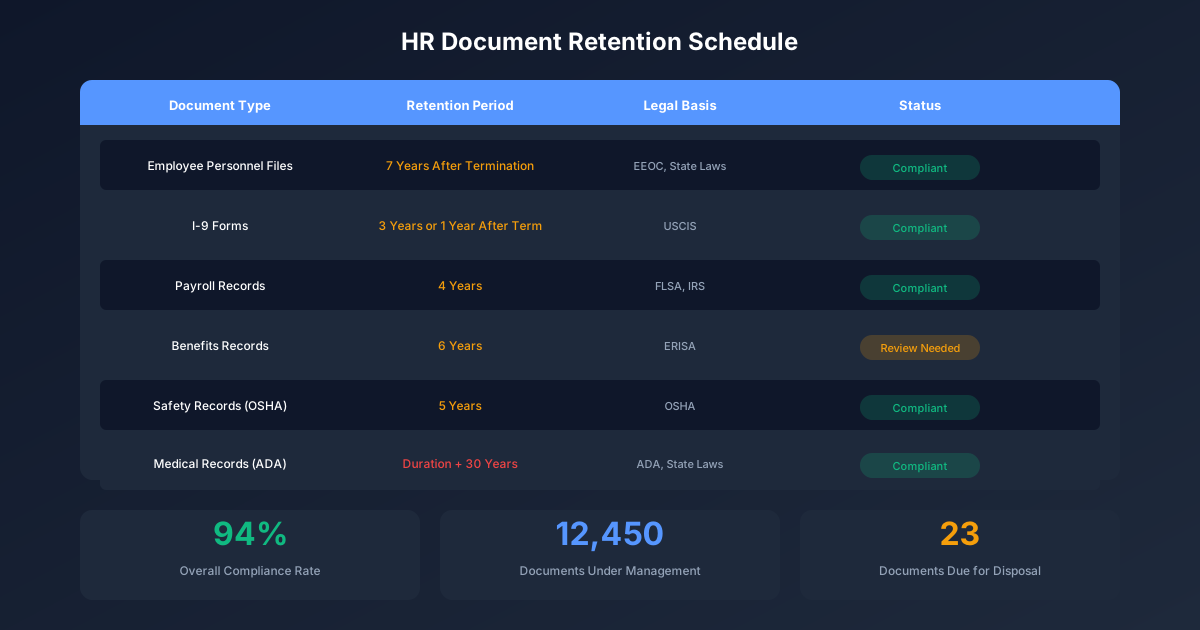
HR document retention is one of the most complex compliance obligations facing organizations. Unlike general data retention, HR records are governed by a patchwork of federal laws, state statutes, and agency regulations—each with different retention periods, access requirements, and penalties for non-compliance. Getting it wrong exposes your organization to audit findings, litigation discovery problems, and substantial fines.
This guide provides a comprehensive framework for HR document retention, covering every record type from hiring through termination and beyond. You'll learn the specific requirements, build compliant retention schedules, and implement secure storage and destruction practices.
For related compliance resources, explore our HR Management Hub, HR Policy & Compliance Center, HR Compliance Templates, and Data Retention Policy Guide for broader organizational data governance.
Why HR Document Retention is Different
HR records face unique retention challenges compared to other business documents:
Multiple Overlapping Requirements:
- Federal laws (FLSA, FMLA, ADA, ADEA, Title VII, ERISA, OSHA)
- State employment laws (often longer than federal)
- Agency regulations (EEOC, DOL, IRS, ICE)
- Industry-specific rules (government contractors, healthcare)
Varied Trigger Events:
- Some periods run from document creation
- Others from employee termination
- Still others from plan year end or benefit eligibility
Segregation Requirements:
- Medical records must be separate from personnel files
- I-9s must be separate from both
- Different access controls for different record types
Litigation Holds:
- Employment lawsuits can require extended retention
- Discovery obligations override normal destruction schedules
- Class action exposure multiplies risk
Penalties for Non-Compliance:
| Violation Area | Potential Penalty |
|---|---|
| I-9 violations | $252-$25,076 per form |
| FLSA record violations | $1,000+ per violation plus back wages |
| OSHA record violations | $15,625 per violation |
| ERISA violations | $250/day per participant |
| EEOC audit failures | Adverse inference in litigation |
HR Document Retention Requirements by Category
Personnel Files
The core employee personnel file contains employment history, performance, and administrative records. Requirements come primarily from Title VII, ADEA, and ADA.
Personnel File Contents:
| Document Type | Retention Period | Legal Basis |
|---|---|---|
| Employment application | 1 year from action OR duration + 1 year | Title VII, ADEA, ADA |
| Resume and cover letter | 1 year from action OR duration + 1 year | Title VII, ADEA, ADA |
| Offer letter | Duration + 3 years minimum | Contract, state law |
| Employment contract | Duration + 6 years | Statute of limitations |
| Job description | Duration + 3 years | ADA, FLSA |
| Performance reviews | Duration + 3 years minimum | Best practice; litigation |
| Disciplinary records | Duration + 7 years | Litigation protection |
| Promotion/demotion records | Duration + 3 years | Title VII, ADEA |
| Transfer records | Duration + 3 years | Title VII, ADEA |
| Training records | Duration + 3 years | Various regulations |
| Termination documentation | Termination + 7 years | Litigation protection |
| Separation agreement | Permanent | Contract enforcement |
| Exit interview | Termination + 3 years | Best practice |
Best Practice Retention: Retain complete personnel files for 7 years after termination to cover most statute of limitations periods for employment claims.
What NOT to Include in Personnel Files:
- Medical records (separate file required)
- I-9 forms (separate file required)
- Background check reports (limited access)
- Investigation files (confidential)
- Garnishment orders (payroll file)
- Immigration documents (separate)
I-9 Employment Eligibility Verification
I-9 retention has specific requirements under the Immigration Reform and Control Act (IRCA) and is actively enforced by Immigration and Customs Enforcement (ICE).
I-9 Retention Rule:
Retain I-9 for the LONGER of:
- 3 years from date of hire, OR
- 1 year after termination date

Formula: MAX(Hire Date + 3 years, Termination Date + 1 year)
I-9 Retention Examples:
| Hire Date | Termination Date | 3 Years from Hire | 1 Year from Term | Destroy After |
|---|---|---|---|---|
| 01/15/2020 | 06/30/2024 | 01/15/2023 | 06/30/2025 | 06/30/2025 |
| 01/15/2020 | 03/01/2021 | 01/15/2023 | 03/01/2022 | 01/15/2023 |
| 01/15/2022 | 12/31/2024 | 01/15/2025 | 12/31/2025 | 12/31/2025 |
Critical I-9 Requirements:
- Store I-9s separately from personnel files (allows efficient audit response)
- Organize by status: active employees, terminated employees, reverification needed
- Never store copies of identity documents (creates over-documentation risk)
- E-Verify records retained separately with same timeline
- Document any corrections with date and initials
Audit Preparation: When ICE issues a Notice of Inspection, you have 3 business days to produce I-9s. Separate storage enables rapid response without exposing entire personnel files.
Payroll and Tax Records
Multiple agencies require payroll record retention: IRS, DOL, and state tax authorities.
Federal Payroll Requirements:
| Record Type | Retention Period | Authority |
|---|---|---|
| Basic payroll records | 3 years | FLSA |
| Wage computation records | 2 years | FLSA |
| Time cards/sheets | 2 years | FLSA |
| W-4 forms | 4 years after tax due | IRS |
| W-2 copies | 4 years after tax due | IRS |
| Payroll tax returns (941, 940) | 4 years after tax due | IRS |
| 1099 forms | 4 years after tax due | IRS |
| State tax withholding | Per state (typically 4 years) | State tax authority |
| Garnishment records | 3 years after final payment | Various |
| Direct deposit authorizations | Duration + 2 years | Best practice |
Payroll Record Details Required by FLSA:
For non-exempt employees, maintain:
- Employee name, address, date of birth (if under 19), sex, occupation
- Time and day workweek begins
- Regular hourly rate
- Hours worked each day and each workweek
- Total daily or weekly straight-time earnings
- Total overtime compensation for the workweek
- Additions to or deductions from wages each pay period
- Total wages paid each pay period
- Date of payment and pay period covered
Exempt Employee Records:
For exempt employees, maintain:
- Basis of pay (weekly, monthly salary amount)
- Total compensation per pay period
- Date of payment and pay period covered
State Variations: California, New York, and other states require longer retention periods (6-7 years) or additional records. Always apply the longer period when federal and state requirements differ.
Benefits and ERISA Records
Employee benefits create extensive retention obligations under ERISA, COBRA, HIPAA, and the Affordable Care Act.
ERISA Plan Records:
| Record Type | Retention Period | Notes |
|---|---|---|
| Plan documents | Permanent | Keep all versions |
| Summary Plan Descriptions (SPD) | 6 years after filing | Required distribution |
| Summary of Material Modifications | 6 years after filing | Timing-specific |
| Form 5500 filings | 6 years from filing | All schedules |
| Participant enrollment | Duration + 6 years | Plan eligibility |
| Beneficiary designations | 6 years after plan distribution | Estate planning |
| Contribution records | 6 years after plan year | 401(k), pension |
| Distribution records | 6 years after distribution | Tax implications |
| Trust agreements | Permanent | Plan governance |
| Investment policy statements | 6 years | Fiduciary documentation |
| Meeting minutes (plan committee) | 6 years | Decision documentation |
COBRA Records:
| Record Type | Retention Period | Notes |
|---|---|---|
| Qualifying event notices | 6 years | Termination, reduction, divorce |
| Election forms | 6 years from coverage end | Coverage decisions |
| Premium payment records | 6 years from coverage end | Payment history |
| Coverage termination notices | 6 years from termination | End of COBRA |
| Eligibility determinations | 6 years | Qualification documentation |
HIPAA Records (Health Plan):
| Record Type | Retention Period | Notes |
|---|---|---|
| Privacy notices | 6 years from creation or last effective date | Distribution required |
| Authorization forms | 6 years from date signed | PHI disclosures |
| Business associate agreements | 6 years after termination | Vendor management |
| Breach notifications | 6 years | Documentation of incidents |
| Privacy policies | 6 years from last effective date | Policy versions |
ACA Records:
| Record Type | Retention Period | Notes |
|---|---|---|
| Forms 1094-C, 1095-C | 3 years from filing | Employer reporting |
| Offer of coverage records | 7 years | ALE compliance |
| Employee status determinations | 7 years | Full-time/part-time |
| Affordability calculations | 7 years | Safe harbor documentation |
Medical and ADA Records
Medical records require special handling under ADA, GINA, and HIPAA. These must be stored separately from personnel files with restricted access.
Medical File Contents:
| Document Type | Retention Period | Access Restrictions |
|---|---|---|
| Pre-employment physicals | Duration + 1 year | Limited to medical staff |
| Drug test results | Duration + 1 year minimum | Limited access |
| ADA accommodation requests | Duration + 3 years | HR and manager only |
| Interactive process documentation | Duration + 3 years | HR only |
| FMLA certifications | 3 years from leave end | HR only |
| Return-to-work certifications | Duration + 3 years | HR and manager |
| Workers' comp records | Duration + statute of limitations | State-specific |
| Fitness-for-duty evaluations | Duration + 3 years | HR and safety |
| Genetic information (GINA) | Duration + 1 year | Strictly confidential |
ADA Confidentiality Requirements:
Medical information must be:
- Stored in separate, locked files
- Accessible only to those with legitimate need
- Not used for discriminatory purposes
- Disclosed only when legally required
Who May Access Medical Files:
| Role | Access Level |
|---|---|
| HR (benefits, accommodations) | Full access to relevant records |
| Direct supervisor | Restrictions/accommodations only (not diagnosis) |
| Safety personnel | Work restrictions only |
| First aid/safety | Emergency medical conditions only |
| Government agencies | As required by law |
| Insurance carriers | Claim-specific only |
Recruitment and Applicant Records
Recruitment records create liability under Title VII, ADEA, ADA, and state anti-discrimination laws. The EEOC requires retention for audit and charge investigation purposes.
Applicant Record Requirements:
| Record Type | Retention Period | Legal Basis |
|---|---|---|
| Applications (hired) | Duration + 1 year | Title VII, ADEA, ADA |
| Applications (not hired) | 1 year from decision | Title VII, ADEA, ADA |
| Resumes (solicited) | 1 year from decision | Title VII, ADEA, ADA |
| Interview notes | 1 year from decision | Best practice |
| Reference check records | 1 year from decision | Documentation |
| Background checks | 1-7 years (varies by state) | FCRA, state law |
| Job postings | 1 year from posting | Best practice |
| Applicant flow data | 2 years (federal contractors) | OFCCP |
| Selection criteria | 1 year from decision | ADA, Title VII |
Federal Contractor Additional Requirements (OFCCP):
| Record Type | Retention Period |
|---|---|
| Applicant flow logs | 2 years |
| Affirmative action plans | 2 years (keep current + prior year) |
| EEO-1 reports | 2 years minimum (recommend permanent) |
| VETS-4212 reports | 2 years |
| Internet applicant records | 2 years |
| Compensation analysis | 2 years |
Background Check Records (FCRA):
- Consumer reports: Destroy after hiring decision (do not retain in personnel file)
- Adverse action documentation: 2 years minimum
- Authorization forms: Duration + 5 years
- Pre-adverse action notices: 2 years
State Ban-the-Box Considerations: Many states restrict when background checks can be conducted and how records are used. Document compliance with timing requirements.
Training and Development Records
Training records support compliance demonstrations and performance documentation.
Required Training Records:
| Training Type | Retention Period | Requirement Source |
|---|---|---|
| Sexual harassment prevention | 3 years from completion | State laws (CA, NY, etc.) |
| Safety training (OSHA) | Duration of employment | OSHA regulations |
| HIPAA training | 6 years from completion | HIPAA Privacy Rule |
| Ethics/compliance training | 3 years | Best practice |
| Job-specific certifications | Duration + 3 years | Regulatory varies |
| New hire orientation | Duration + 1 year | Best practice |
| Management training | Duration + 3 years | Best practice |
| Anti-discrimination training | 3 years | Best practice |
Training Record Components:
For each training session, document:
- Employee name and ID
- Training topic and content summary
- Training date and duration
- Training delivery method (in-person, online, etc.)
- Trainer/provider name
- Assessment/quiz results if applicable
- Employee acknowledgment/signature
- Certificate of completion if issued
Workplace Safety Records (OSHA)
OSHA requires specific record retention for workplace injuries, illnesses, and safety programs.
OSHA Recordkeeping Requirements:
| Record Type | Retention Period | Notes |
|---|---|---|
| OSHA 300 Log | 5 years following year covered | Annual summary |
| OSHA 301 Incident Reports | 5 years following year covered | Individual incidents |
| OSHA 300A Summary | 5 years following year covered | Posted annually |
| Exposure records | 30 years | Toxic substances, blood pathogens |
| Medical surveillance records | Duration + 30 years | Hazardous exposure |
| Safety training records | Duration | While employed |
| Personal protective equipment | Duration | Fit testing, training |
| Hazard communication records | Duration | SDS, training |
Post-Termination Exposure Records: For employees exposed to toxic substances or hazardous agents, medical and exposure records must be retained for 30 years after termination—one of the longest HR retention requirements.
Disciplinary and Termination Records
Disciplinary and termination records are crucial for defending wrongful termination, discrimination, and retaliation claims.
Disciplinary Record Retention:
| Record Type | Retention Period | Purpose |
|---|---|---|
| Verbal warning documentation | Duration + 3 years | Performance history |
| Written warnings | Duration + 7 years | Progressive discipline |
| Performance improvement plans | Duration + 7 years | Documentation of support |
| Suspension records | Duration + 7 years | Disciplinary history |
| Investigation files | Duration + 7 years | Complaint resolution |
| Termination checklist | Termination + 7 years | Process compliance |
| Termination letter | Termination + 7 years | Communication record |
| Separation agreement | Permanent | Contract enforcement |
| WARN Act notices | 3 years from notice | Mass layoff compliance |
| Severance calculations | Termination + 7 years | Payment documentation |
Why 7 Years Post-Termination:
- Covers most state statute of limitations for employment claims
- Addresses delayed-filing scenarios for discrimination charges
- Provides documentation if former employee files suit
- Supports unemployment claim responses
Investigation File Retention:
Investigation files (harassment, discrimination, theft, policy violations) should be:
- Stored separately from personnel files
- Retained for duration + 7 years minimum
- Subject to litigation holds when claims filed
- Accessible only to HR, legal, and investigators
Building Your HR Retention Schedule
Step 1: Inventory All HR Record Types
Create a comprehensive inventory of every HR document type in your organization:
Inventory Template:
| Record Type | Description | Physical/Electronic | Storage Location | Current Retention | Owner |
|---|---|---|---|---|---|
| Personnel files | Employee records | Both | HR file room / HRIS | Varies | HR Manager |
| I-9 forms | Employment verification | Physical | Locked cabinet | 3 yrs/1 yr | HR Coordinator |
| Medical files | ADA, FMLA, WC | Physical | Locked separate cabinet | Varies | HR Manager |
| Payroll records | Compensation data | Electronic | Payroll system | 4 years | Payroll Manager |
| ... | ... | ... | ... | ... | ... |
Step 2: Determine Applicable Requirements
For each record type, identify all applicable regulations:
Requirement Matrix:
| Record Type | Federal Requirement | State Requirement | Industry Requirement | Litigation Risk | Applied Retention |
|---|---|---|---|---|---|
| Personnel files | 1 year (EEOC) | 3 years (CA) | None | High (7 years) | 7 years post-term |
| Payroll records | 3 years (FLSA) | 6 years (CA) | None | Medium | 6 years |
| I-9 forms | 3 yrs OR 1 yr post | Same as federal | None | High | Federal formula |
| Medical files | 1 year (ADA) | 3 years (CA) | HIPAA 6 years | High | 7 years post-term |
Rule of Thumb: When requirements conflict, apply the longest retention period.
Step 3: Create Retention Schedule
Sample HR Retention Schedule:
| Category | Record Type | Retention Period | Trigger Event | Destruction Method |
|---|---|---|---|---|
| Personnel | Employment application | 7 years | Termination | Shred |
| Job description | 7 years | Termination | Shred | |
| Performance reviews | 7 years | Termination | Shred | |
| Disciplinary records | 7 years | Termination | Shred | |
| Termination documentation | 7 years | Termination | Shred | |
| Payroll | Time records | 6 years | Calendar year end | Secure delete |
| W-4 forms | 4 years | Tax filing date | Secure delete | |
| Payroll registers | 6 years | Calendar year end | Secure delete | |
| Benefits | Plan documents | Permanent | N/A | N/A |
| Enrollment forms | 6 years | Coverage end | Shred | |
| COBRA records | 6 years | Coverage end | Shred | |
| Medical | ADA accommodations | 7 years | Termination | Shred |
| FMLA certifications | 3 years | Leave end | Shred | |
| Drug test results | 7 years | Termination | Shred | |
| I-9 | Form I-9 | Greater of 3 yrs from hire or 1 yr from term | Hire/Term | Shred |
| Recruitment | Applications (not hired) | 1 year | Decision date | Shred |
| Interview notes | 1 year | Decision date | Shred | |
| Safety | OSHA logs | 5 years | Calendar year end | Shred |
| Exposure records | 30 years | Termination | Archive | |
| Training | Compliance training | 3 years | Completion | Secure delete |
| Safety training | Duration | Termination | Shred |
Step 4: Establish Destruction Procedures
Destruction Methods by Record Type:
Physical Records:
- Cross-cut shredding (minimum DIN P-4 security level)
- Incineration for highly sensitive records
- Certificate of destruction from vendor
- Witnessed destruction for confidential materials
Electronic Records:
- Secure deletion with overwrite
- Cryptographic erasure for encrypted data
- Physical destruction of storage media if required
- Audit trail of deletion activities
Destruction Documentation:
For each destruction event, record:
- Date of destruction
- Record types destroyed
- Retention period satisfied
- Destruction method used
- Witness name (if applicable)
- Authorization signature
Destruction Log Template:
| Date | Record Description | Quantity | Retention Met | Method | Authorized By | Witness |
|---|---|---|---|---|---|---|
| 01/15/2025 | 2017 term files (23 employees) | 2 boxes | 7 years | Shred | J. Smith | M. Chen |
| 01/15/2025 | 2023 non-hire applications | 156 files | 1 year | Shred | J. Smith | M. Chen |
File Organization and Storage
Physical File Structure
Recommended Physical File Organization:
File Type 1: Personnel Files (Main)
- Organized alphabetically by last name
- Active and terminated employees separated
- Terminated files moved to archive storage after 1 year
- File folder with standard sections
Personnel File Sections:
- Employment (application, offer, contract)
- Compensation (salary history, increases)
- Performance (reviews, goals, feedback)
- Training (completions, certifications)
- Disciplinary (warnings, PIPs)
- Administrative (acknowledgments, changes)
File Type 2: Medical Files (Separate)
- Locked storage, separate from personnel
- Access log maintained
- Organized alphabetically
- Includes ADA, FMLA, WC, drug tests
File Type 3: I-9 Files (Separate)
- Section 1: Active employees (by hire date for audit)
- Section 2: Terminated employees (by destruction date)
- Section 3: Reverification pending
File Type 4: Investigation Files (Confidential)
- Locked, restricted access
- Organized by case number
- Separate from personnel and medical
Electronic Records Management
HRIS Record Organization:
Most modern HRIS systems support document management:
- Configure retention rules by document type
- Set up automated destruction reminders
- Implement access controls by role
- Enable audit logging for document access
Electronic Storage Requirements:
| Requirement | Implementation |
|---|---|
| Integrity | Version control, change logging |
| Accessibility | Search capability, indexing |
| Security | Encryption, access controls |
| Authenticity | Digital signatures where required |
| Backup | Regular backups with tested recovery |
| Audit trail | Access logging, modification tracking |
Cloud Storage Considerations:
- Ensure vendor retention policy alignment
- Verify data residency compliance
- Confirm deletion is truly permanent
- Document business associate agreements (for medical)
Access Controls
Access Matrix by Role:
| File Type | HR Generalist | HR Manager | HRBP | Payroll | Manager | Employee |
|---|---|---|---|---|---|---|
| Personnel - own | Read | Full | Read | No | Limited | Read (per policy) |
| Personnel - other | Read | Full | Read | No | Own reports | No |
| Medical | No | Full | No | No | No | Own only |
| I-9 | Full | Full | No | No | No | No |
| Payroll | No | Read | No | Full | No | Own only |
| Investigation | No | Full | Case-specific | No | No | No |
Access Logging Requirements:
For medical and investigation files, log:
- Who accessed the record
- Date and time of access
- Purpose of access
- Any documents viewed or copied
Litigation Holds and Legal Considerations
Understanding Litigation Holds
A litigation hold suspends normal document retention when litigation is reasonably anticipated. Failure to preserve relevant documents creates spoliation liability.
Litigation Hold Triggers:
| Event | Preservation Duty Begins |
|---|---|
| Lawsuit filed | Immediately |
| Demand letter received | Immediately |
| EEOC charge filed | Upon receipt of notice |
| Government investigation notice | Upon receipt |
| Grievance filed (union) | When filed |
| Internal complaint (potential litigation) | Upon assessment |
| Termination of protected employee | Consider immediate hold |
Litigation Hold Process:
- Identify Trigger: Legal or HR recognizes preservation duty
- Assess Scope: Determine affected employees, date ranges, record types
- Issue Hold Notice: Written notice to all custodians
- Suspend Destruction: Stop scheduled deletions for affected records
- Confirm Compliance: Document acknowledgments from custodians
- Monitor: Ensure ongoing preservation
- Release Hold: Written notice when litigation concludes
Hold Notice Contents:
- Matter description (case name, charge number)
- Preservation obligation explanation
- Records to preserve (be specific)
- Time period covered
- Prohibition on deletion, alteration, or destruction
- Contact for questions
- Acknowledgment requirement
State-Specific Requirements
State laws often impose longer retention requirements than federal law.
California HR Retention:
| Record Type | California Requirement | Federal Requirement |
|---|---|---|
| Personnel files | 3 years post-term (but recommend 7) | 1 year |
| Payroll records | 4 years | 3 years |
| Timekeeping records | 3 years | 2 years |
| Employee exposure records | 30 years | 30 years |
| Pay equity records | 3 years | N/A |
New York HR Retention:
| Record Type | New York Requirement |
|---|---|
| Payroll records | 6 years |
| Personnel records | 3 years post-term |
| Benefit records | 6 years |
| Training records | 3 years |
Texas, Florida, and Other States: Many states default to federal requirements but may have specific rules for:
- Unemployment compensation records
- Workers' compensation records
- State tax withholding records
- State-specific leave programs
Multi-State Employers:
- Apply the longest retention period across all states where you have employees
- Or maintain state-specific schedules if volume justifies complexity
- Document which retention standard applies to each location
Audit Preparation and Compliance
Self-Audit Program
Conduct regular internal audits to identify compliance gaps before regulators find them.
Quarterly Self-Audit Checklist:
I-9 Audit (10% sample minimum):
- Section 1 completed by first day of work
- Section 2 completed within 3 business days
- Acceptable documents properly recorded
- No over-documentation (copies of documents)
- Reverifications completed before expiration
- Terminated employee I-9s properly retained
Personnel File Audit (5% sample):
- Required documents present (application, offer, acknowledgments)
- No prohibited documents (medical, I-9, investigation)
- Performance reviews on schedule
- Disciplinary documentation complete
- Termination documentation complete (for termed employees)
Payroll Record Audit:
- Time records complete for non-exempt employees
- Overtime calculated correctly
- Required deductions documented
- W-4 forms current
- Pay stubs meet state requirements
Medical File Audit:
- Files stored separately from personnel
- Access limited to authorized personnel
- FMLA certifications complete
- ADA accommodations documented
- Drug test results properly maintained
Responding to External Audits
Common HR Audits:
| Agency | Focus Area | Response Window |
|---|---|---|
| ICE | I-9 compliance | 3 business days for I-9 production |
| DOL/WHD | Wage and hour | Varies; often 10-30 days |
| OSHA | Workplace safety | Varies by inspection type |
| EEOC | Discrimination charges | 30 days for position statement |
| OFCCP | Federal contractor AAP | 30 days for desk audit |
| State agencies | Various | Per state requirements |
Audit Response Protocol:
- Receive Notice: Document date received, deadline, scope
- Notify Leadership: Alert legal, HR leadership, affected managers
- Preserve Records: Issue litigation hold if not already in place
- Assess Scope: Determine what records are requested
- Gather Documents: Pull requested records, review for completeness
- Legal Review: Have counsel review before submission
- Submit Response: Meet deadline with organized, indexed materials
- Document Process: Maintain record of response for future reference
Common Audit Findings and Remediation
Frequent I-9 Issues:
| Finding | Remediation |
|---|---|
| Late Section 2 completion | Re-train, implement tracking system |
| Missing information | Correct with date and initials (current date) |
| Over-documentation | Remove copies, update policy |
| Improper documents accepted | Cannot correct; note for future |
| Missing reverification | Complete immediately if still employed |
Frequent Payroll Issues:
| Finding | Remediation |
|---|---|
| Missing time records | Implement timekeeping system |
| Overtime miscalculation | Recalculate and pay back wages |
| Misclassification | Reclassify, pay back overtime |
| Missing pay stubs | Generate and distribute; update process |
Frequent Personnel File Issues:
| Finding | Remediation |
|---|---|
| Medical records in personnel file | Separate immediately |
| Missing acknowledgments | Obtain going forward; document gap |
| Inconsistent retention | Implement retention schedule |
| I-9s in personnel files | Separate into dedicated I-9 storage |
Technology and Automation
HR Document Management Systems
Modern HRIS and document management systems automate retention compliance.
Key Features for Retention Compliance:
| Feature | Benefit |
|---|---|
| Automated retention rules | Documents flagged for destruction when period ends |
| Destruction workflow | Approval required before deletion |
| Audit trail | Complete history of document access and changes |
| Access controls | Role-based permissions by document type |
| Legal hold capability | Suspend destruction for litigation |
| Reporting | Compliance status dashboards |
| Separate storage | Medical files in segregated system area |
Popular HRIS Platforms with Document Management:
| Platform | Best For | Document Features |
|---|---|---|
| Workday | Large enterprise | Integrated documents, retention rules |
| UKG | Mid-large | Document management, compliance |
| ADP | All sizes | Payroll records, some documents |
| BambooHR | SMB | Basic document storage |
| Paylocity | Mid-market | Document management module |
Implementing Retention Automation
Phase 1: Configuration (Month 1)
- Map document types to system categories
- Configure retention periods by category
- Set up access controls
- Enable audit logging
Phase 2: Migration (Months 2-3)
- Scan and upload physical documents
- Assign retention metadata
- Organize by employee and category
- Validate completeness
Phase 3: Process Integration (Month 4)
- Train HR staff on new workflows
- Update procedures for document creation
- Implement destruction review process
- Test litigation hold functionality
Phase 4: Ongoing Management
- Monthly destruction review and approval
- Quarterly compliance reporting
- Annual retention schedule review
- System audit and optimization
Policy Template Components
HR Document Retention Policy Structure
Section 1: Purpose and Scope
- Policy objectives
- Covered employees and records
- Geographic and legal scope
- Relationship to other policies
Section 2: Definitions
- Personnel records
- Medical records
- Confidential records
- Retention period
- Destruction
- Litigation hold
Section 3: Roles and Responsibilities
- HR department responsibilities
- Manager responsibilities
- Employee responsibilities
- Legal department role
- Records management role
Section 4: Retention Schedule
- Complete schedule by record type
- Retention periods and triggers
- Legal basis citations
- Review frequency
Section 5: Storage Requirements
- Physical storage standards
- Electronic storage standards
- Segregation requirements
- Access controls
- Security measures
Section 6: Destruction Procedures
- Authorized destruction methods
- Approval requirements
- Documentation requirements
- Destruction log maintenance
- Vendor requirements
Section 7: Litigation Holds
- Hold triggers
- Hold process
- Custodian responsibilities
- Hold release procedures
Section 8: Compliance and Auditing
- Self-audit schedule
- External audit response
- Violation consequences
- Policy review schedule
Section 9: Exceptions
- Exception request process
- Approval authority
- Documentation requirements
Implementation Roadmap
Phase 1: Assessment (Weeks 1-2)
Activities:
- Inventory current HR records and storage
- Identify all applicable legal requirements
- Assess current retention practices
- Gap analysis against requirements
Deliverables:
- Complete record inventory
- Requirement matrix
- Gap analysis report
- Risk assessment
Phase 2: Policy Development (Weeks 3-4)
Activities:
- Draft retention schedule
- Develop retention policy
- Create destruction procedures
- Establish access controls
Deliverables:
- Draft retention policy
- Complete retention schedule
- Destruction procedure documentation
- Access control matrix
Phase 3: Infrastructure (Weeks 5-8)
Activities:
- Configure HRIS retention settings
- Reorganize physical files
- Implement file segregation
- Set up destruction workflow
Deliverables:
- Configured document management
- Reorganized file storage
- Segregated medical/I-9 files
- Tested destruction process
Phase 4: Training and Rollout (Weeks 9-10)
Activities:
- Train HR staff
- Brief managers on access
- Communicate employee rights
- Launch new procedures
Deliverables:
- Trained HR team
- Manager briefing materials
- Employee communication
- Go-live confirmation
Phase 5: Ongoing Operations
Monthly:
- Destruction review and approval
- New hire file setup
- Termination file processing
Quarterly:
- Self-audit (sample)
- Compliance reporting
- Exception review
Annually:
- Full policy review
- Retention schedule update
- Training refresh
- Comprehensive audit
Conclusion
HR document retention is complex, but the consequences of non-compliance are severe. A well-designed retention program protects your organization legally, reduces storage costs, enables efficient audit response, and demonstrates organizational maturity.
Your HR Document Retention Checklist:
- Complete inventory of all HR record types
- Identify applicable federal, state, and industry requirements
- Create comprehensive retention schedule
- Separate medical files from personnel files
- Separate I-9 files from personnel files
- Implement access controls by record type
- Establish secure destruction procedures
- Create litigation hold process
- Train HR staff on retention requirements
- Implement regular self-audit program
- Configure HRIS for automated retention
Related Resources:
- HR Policy & Compliance Center - Complete HR resource hub
- HR Compliance Templates - I-9, FMLA, ADA, wage/hour templates
- Data Retention Policy Guide - Broader organizational data retention
- Performance Review Cycle Guide - Performance documentation best practices
Build a retention program that keeps you audit-ready and protects your organization from the substantial penalties associated with HR record mismanagement.